
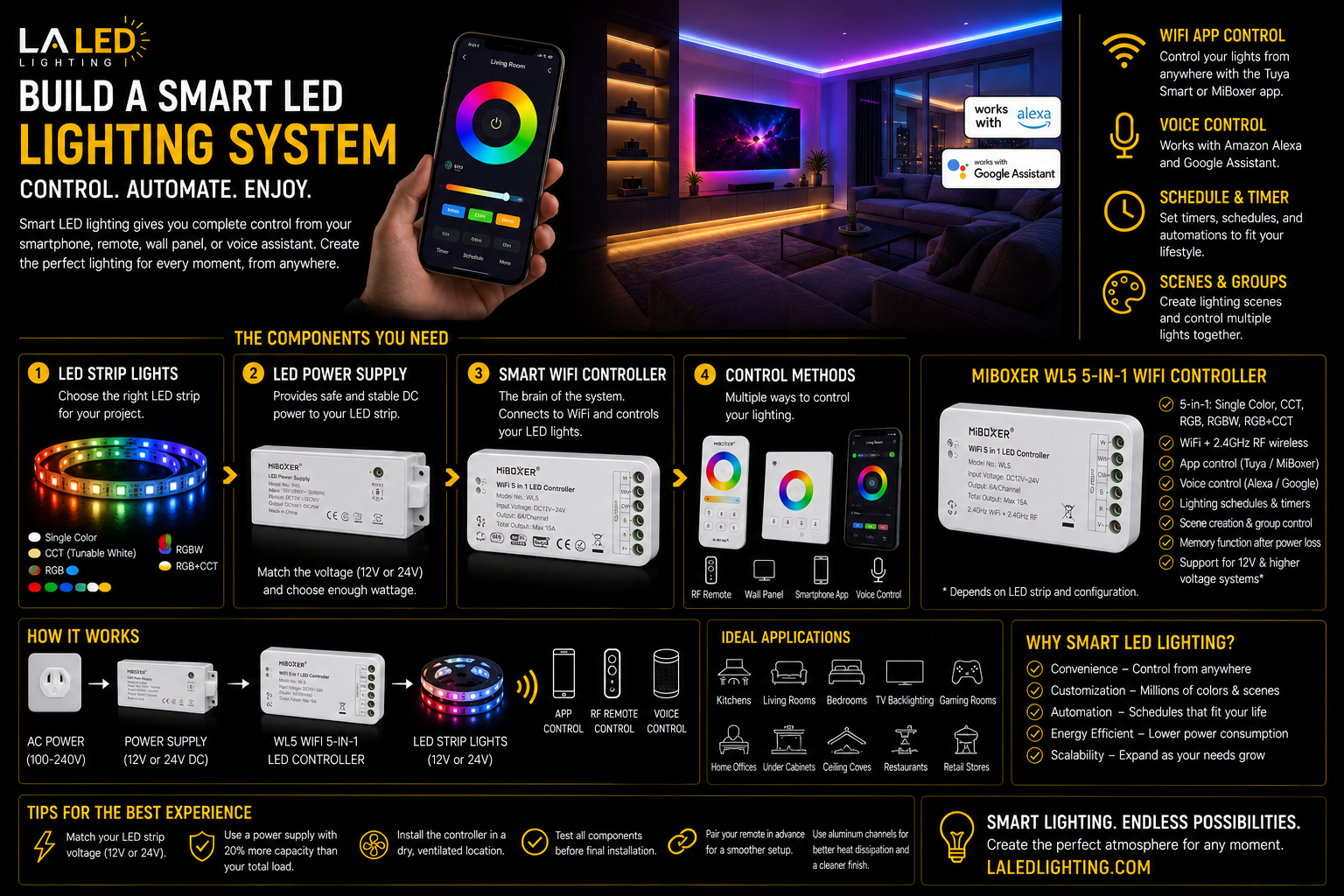
Smart home technology has transformed the way we interact with everyday devices, and lighting is no exception. Instead of relying on traditional wall switches or handheld remotes, today's LED lighting systems can be controlled from a smartphone, scheduled automatically, or even operated using simple voice commands.
Whether you're adding under-cabinet lighting, creating a colorful media room, or upgrading an entire home, a WiFi LED controller gives you the flexibility to manage your lighting from virtually anywhere.
The key is choosing the right controller and compatible components from the start.
What Is a Smart LED Lighting System?
A smart LED lighting system combines LED strip lights with a wireless controller that connects to your home network.
Instead of only using a physical switch, you can control your lights through:
- A smartphone app
- Voice assistants
- Wireless RF remotes
- Wall-mounted control panels
- Automated schedules
- Custom lighting scenes
This creates a lighting system that is more convenient, customizable, and energy efficient than traditional lighting.
The Components You'll Need
Building a smart LED lighting system is easier than many people expect.
The basic components include:
LED Strip Lights
Choose the LED strip that best matches your project.
Common options include:
- Single Color
- CCT (Tunable White)
- RGB
- RGBW
- RGB+CCT
Each provides different levels of lighting flexibility.
LED Power Supply
Every low-voltage LED strip requires a compatible DC power supply.
Make sure the power supply:
- Matches the strip voltage
- Provides sufficient wattage
- Is rated for continuous operation
A properly sized power supply helps ensure stable performance and long service life.
Smart WiFi Controller
The controller is the heart of the system.
It connects your LED strip to your home network and receives commands from your phone, compatible remotes, or voice assistants.
A quality controller allows you to:
- Turn lights on and off remotely
- Adjust brightness
- Change colors
- Modify white color temperature
- Create lighting scenes
- Set schedules and timers
- Group multiple lights together
Control Methods
Modern smart lighting systems often support several control options at the same time.
These may include:
- Smartphone apps
- RF handheld remotes
- Wall-mounted touch panels
- Voice assistants
- Automation routines
Using multiple control methods gives every member of the household a convenient way to operate the lighting.
Why a 5-in-1 Controller Is a Smart Investment
Many LED controllers are designed for only one type of LED strip.
If you later decide to switch from RGB to RGB+CCT or install tunable white lighting in another room, you may need a completely different controller.
A 5-in-1 controller offers much greater flexibility because it supports multiple lighting technologies in a single device.
This makes future upgrades easier while reducing the need to replace hardware.
A Flexible Solution: MiBoxer WL5
If you're looking for one controller that can handle almost any residential LED lighting project, the MiBoxer WL5 WiFi 5-in-1 LED Controller is an excellent choice.
It supports:
- Single Color LED strips
- CCT (Tunable White)
- RGB
- RGBW
- RGB+CCT LED strips
The WL5 connects directly to your WiFi network and can be controlled using the Tuya Smart or MiBoxer app. It also supports compatible 2.4GHz RF remotes and voice control with Amazon Alexa and Google Assistant, giving you several ways to manage your lighting.
Key benefits include:
- 5-in-1 compatibility
- WiFi app control
- RF remote compatibility
- Voice control
- Lighting schedules
- Scene creation
- Group control
- Memory function after power loss
- Support for both 12V and higher-voltage compatible installations depending on the controller version and LED strip system
Where Smart LED Lighting Works Best
Smart LED lighting can improve almost every room.
Popular applications include:
- Kitchen cabinet lighting
- Living rooms
- Bedrooms
- Home theaters
- Gaming rooms
- Home offices
- Hallways
- Restaurants
- Hotels
- Retail stores
- Display shelving
The ability to automate lighting schedules and adjust brightness remotely makes these spaces both more comfortable and more energy efficient.
Tips Before Buying
Before choosing a smart LED controller, make sure:
- It supports your LED strip type.
- The controller matches your system voltage.
- Your WiFi network operates on the required frequency if applicable.
- The controller is compatible with your preferred app and voice assistant.
- Your power supply has enough capacity for the total LED load.
Selecting compatible components from the beginning helps ensure a smooth installation and reliable long-term performance.
Final Thoughts
Smart LED lighting offers far more than simple on-and-off control. With app management, voice commands, automation, and customizable scenes, it transforms everyday lighting into an interactive part of your home.
A versatile controller such as the MiBoxer WL5 WiFi 5-in-1 LED Controller makes this possible by supporting multiple LED strip types while combining WiFi connectivity, RF remote compatibility, and smart home integration in one compact device. Whether you're starting with a single room or planning a whole-home lighting system, choosing a flexible controller today makes future expansion much easier.
FAQ
What is a WiFi LED controller?
A WiFi LED controller connects your LED strip lighting to your home network, allowing you to control the lights through a smartphone app, compatible remotes, or supported voice assistants.
Can one controller work with different types of LED strips?
Some models can. The MiBoxer WL5 is a 5-in-1 controller that supports Single Color, CCT, RGB, RGBW, and RGB+CCT LED strips.
Can I control my LED lights with Alexa or Google Assistant?
Yes. Compatible smart controllers, including the WL5, support voice control through Amazon Alexa and Google Assistant.
Do I still need a remote if I use a smartphone app?
Not necessarily, but many users prefer having both. The WL5 supports app control and compatible 2.4GHz RF remotes, so you can choose the method that works best for you.
Is smart LED lighting suitable for existing homes?
Yes. In most cases, adding a compatible WiFi controller to a low-voltage LED strip system is much easier than replacing your home's electrical wiring, making it a practical upgrade for both new and existing homes.