
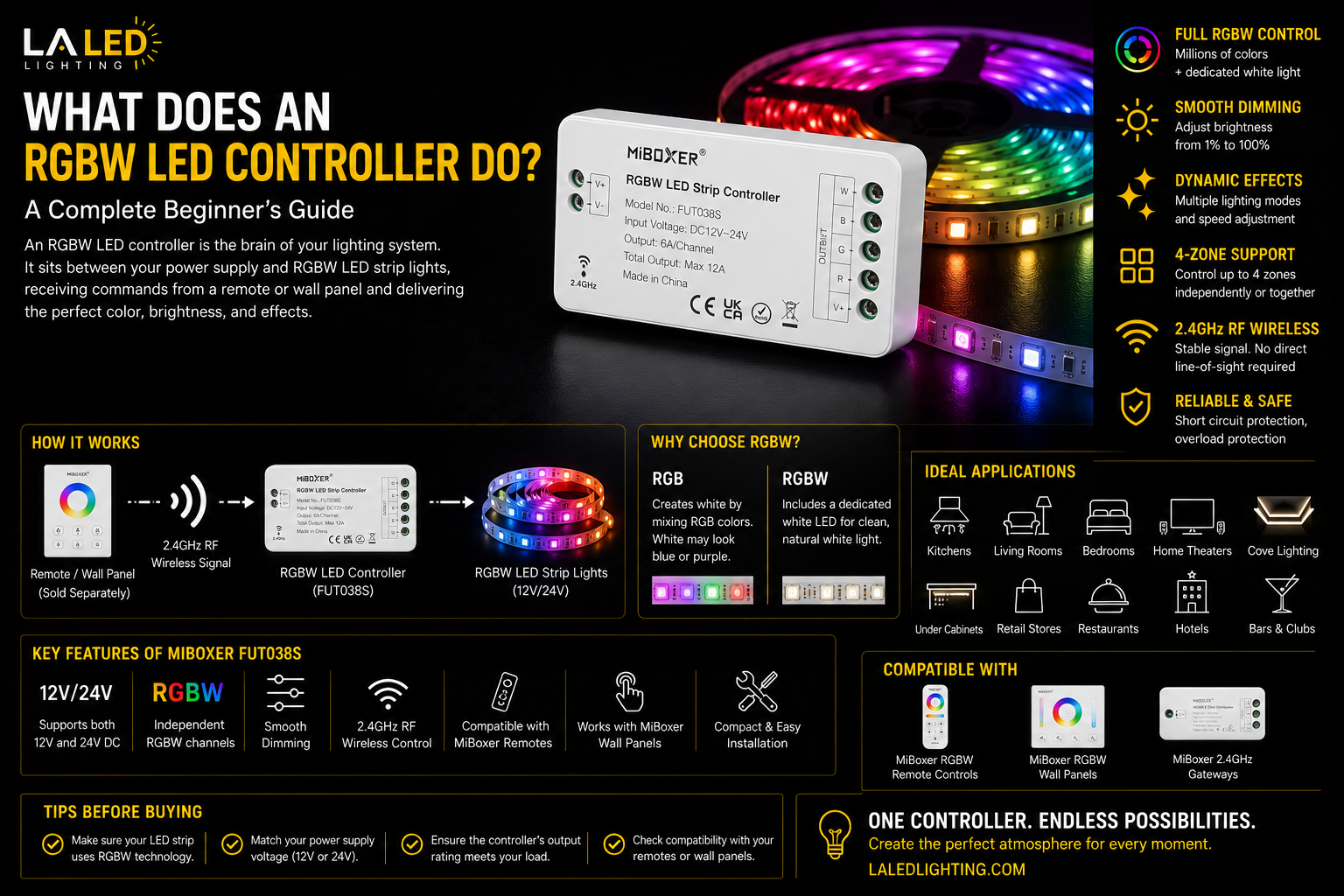
What Does an RGBW LED Controller Do? A Complete Beginner's Guide
If you're planning to install RGBW LED strip lights, one of the most important components you'll need isn't the LED strip itself—it's the controller. Without the proper controller, your LED strip can't change colors, dim smoothly, or respond to a remote or wall panel.
Whether you're upgrading your living room, adding under-cabinet lighting, or designing a complete smart lighting setup, understanding what an RGBW LED controller does will help you build a lighting system that performs exactly the way you want.
What Is an RGBW LED Controller?
An RGBW LED controller is an electronic device that sits between your power supply and your RGBW LED strip. It receives commands from a compatible remote control or wall panel and converts them into signals that tell the LED strip exactly how to behave.
Instead of simply turning the lights on and off, the controller allows you to:
- Select millions of RGB colors
- Switch to a dedicated white light
- Adjust brightness smoothly
- Change lighting effects
- Control multiple lighting zones
- Save favorite lighting scenes
Think of the controller as the "brain" of your lighting system.
Why RGBW Is Better Than Standard RGB
Many people assume RGB and RGBW LED strips are the same, but there is one important difference.
RGB strips create colors by mixing red, green, and blue LEDs. While they can produce white-looking light, it often appears slightly blue or purple.
RGBW LED strips include an additional dedicated white LED, allowing them to produce clean, natural white illumination alongside vibrant colors.
This means one lighting system can provide both decorative accent lighting and practical everyday lighting.
How Does an RGBW Controller Work?
The controller receives power from a compatible 12V or 24V DC power supply.
When you press a button on your remote or touch a wall panel, the wireless signal is sent to the controller. The controller then adjusts the power delivered to each color channel:
- Red
- Green
- Blue
- White
By varying the output to each channel independently, the controller creates millions of color combinations while also providing separate white illumination whenever needed.
Why Wireless Controllers Are So Popular
Modern RGBW controllers use 2.4GHz RF wireless technology instead of older infrared systems.
This provides several advantages:
- No direct line-of-sight required
- Reliable communication through most interior walls
- Faster response time
- Longer operating distance
- Easy pairing with multiple remotes
- Support for multi-room lighting control
Wireless control also keeps installations clean since additional control wiring is unnecessary.
Choosing the Right RGBW Controller
Not every controller offers the same features.
When comparing controllers, consider:
- Compatibility with 12V or 24V LED strips
- Maximum output capacity
- Wireless communication technology
- Multi-zone support
- Smooth dimming performance
- Compatibility with remotes and wall panels
- Ease of installation
A quality controller not only improves daily operation but also helps create a more reliable lighting system.
A Reliable Option: MiBoxer FUT038S
For homeowners and installers looking for dependable wireless control, the MiBoxer FUT038S RGBW LED Strip Controller is an excellent choice.
Designed for both 12V and 24V constant-voltage RGBW LED strip lights, it supports reliable 2.4GHz RF wireless communication and pairs with compatible MiBoxer remotes and wall panels.
Key features include:
- Supports both 12V and 24V DC systems
- Independent RGBW output channels
- Smooth dimming performance
- Wireless 2.4GHz RF communication
- Compatible with MiBoxer handheld remotes
- Works with MiBoxer wall-mounted touch panels
- Compact design for easy installation
Whether you're lighting a kitchen, bedroom, media room, retail display, or entertainment area, the FUT038S provides dependable control while remaining easy to install.
Where Are RGBW Controllers Commonly Used?
RGBW controllers are ideal for many residential and commercial lighting applications, including:
- Under-cabinet lighting
- Cove lighting
- Living rooms
- Bedrooms
- Home theaters
- Kitchen islands
- Shelving displays
- Restaurants
- Hotels
- Retail stores
- Bars
- Accent walls
Because RGBW systems combine decorative colors with functional white lighting, they're one of the most versatile LED lighting solutions available today.
Tips Before Buying
Before purchasing an RGBW controller, make sure:
- Your LED strip uses RGBW technology.
- Your power supply matches the strip voltage.
- The controller's output rating meets your lighting load.
- Your remote or wall panel is compatible with the controller.
Choosing compatible components from the beginning makes installation much easier and ensures reliable long-term performance.
Final Thoughts
An RGBW LED controller is the heart of any color-changing lighting system. It transforms a basic LED strip into a fully customizable lighting solution that can deliver vibrant colors, smooth dimming, dedicated white lighting, and convenient wireless control.
If you're building a new RGBW lighting system or upgrading an existing installation, a dependable controller like the MiBoxer FUT038S provides the flexibility, reliability, and ease of use needed for modern residential and commercial lighting projects.
FAQ
Can RGBW LED strips work without a controller?
No. Without a controller, RGBW LED strips cannot change colors, dim properly, or respond to wireless controls.
What's the difference between RGB and RGBW?
RGBW LED strips include a dedicated white LED, producing cleaner and brighter white light than standard RGB strips.
Can one controller operate multiple lights?
Yes. Many wireless controllers can manage multiple compatible receivers and support independent lighting zones.
Do I need a special power supply?
Yes. Your power supply must match the voltage of your LED strip (12V or 24V) and provide sufficient wattage.
Is the MiBoxer FUT038S suitable for home lighting?
Yes. It is ideal for kitchens, living rooms, bedrooms, home theaters, under-cabinet lighting, cove lighting, and many other indoor RGBW LED strip applications.