
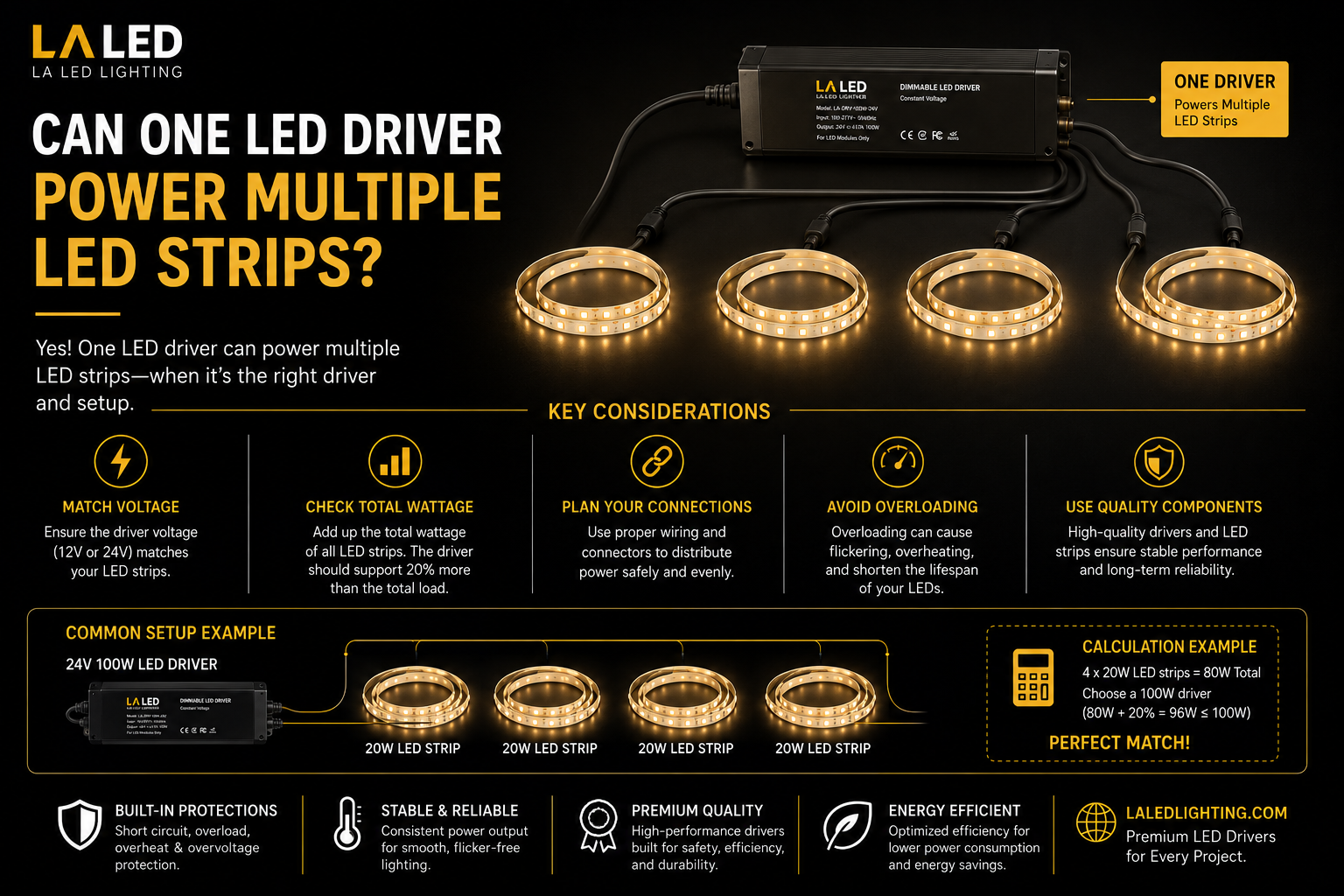
Can One LED Driver Power Multiple LED Strips?
Yes, one LED driver can power multiple LED strips, but only when the system is designed correctly. The strips must use the same voltage, the total wattage must stay within the driver’s capacity, and the wiring must be planned to prevent voltage drop and uneven brightness.
This matters for under-cabinet lighting, cove lighting, shelving, toe-kick lighting, and commercial LED strip installations. A system may turn on with the wrong setup, but that does not mean it will perform reliably.
The Basic Rule
One driver can power multiple LED strips when these four things match:
- Same strip voltage
- Correct total wattage
- Proper parallel wiring
- Compatible dimming method
For example, if all your LED strips are 24V, you need a 24V constant-voltage LED driver. You should not mix 12V and 24V strips on the same driver.
Start With Voltage
Voltage is the first thing to check.
Common LED strip voltages include:
- 12V DC
- 24V DC
Most COB LED strips, SMD tape lights, RGB strips, RGBW strips, and tunable white strips use constant-voltage drivers.
If the voltage is wrong, the strip may not work correctly or may be damaged.
How to Size the LED Driver
To size the driver, add the wattage of all connected strip sections.
Example:
- Strip power: 4 watts per foot
- Run length: 8 feet
- Number of runs: 3
Calculation:
8 feet × 4 watts = 32 watts per run
32 watts × 3 runs = 96 watts total
You should not use a 96W driver for a 96W load. Add about 20% extra capacity for safer operation.
In this example, a 120W driver would be a better choice.
Wire LED Strips in Parallel
When powering multiple LED strips from one driver, wire them in parallel.
That means each strip connects directly to the driver output:
- Positive to positive
- Negative to negative
Parallel wiring helps each strip receive the correct voltage and keeps brightness more consistent.
Avoid wiring constant-voltage LED strips in series. Series wiring can divide voltage incorrectly and cause poor performance.
Watch for Voltage Drop
Voltage drop is one of the most common problems in LED strip installations.
It can cause:
- Dim light at the end of the strip
- Uneven brightness
- Color shift
- Flickering
- Poor dimming performance
To reduce voltage drop, you can:
- Use 24V strips for longer runs
- Keep wire runs shorter
- Use thicker wire when needed
- Feed power from both ends when allowed
- Split long runs into shorter sections
- Use more than one driver for larger layouts
A centrally located driver often performs better than one large driver placed far away from the strips.
Dimming Compatibility Matters
If your LED strips need to dim, the driver must support the correct dimming method.
Common dimming options include:
- TRIAC
- ELV
- MLV
- 0-10V
For commercial, office, retail, and architectural lighting projects, 0-10V dimming is often a strong choice because it provides smooth and reliable control.
For professional-grade dimming, explore LA LED Lighting’s 0-10V Dimmable LED Drivers:
https://laledlighting.com/collections/0-10v-dimmable-led-drivers
These drivers are useful for:
- Architectural LED strip lighting
- Commercial lighting
- Office lighting
- Hospitality projects
- Recessed lighting systems
When One Driver Makes Sense
Using one driver for multiple LED strips works well when:
- The strip runs are close together
- The total load is safely below driver capacity
- The strips use the same voltage
- The lighting is controlled as one zone
- Wiring can be kept clean and short
Good examples include:
- Under-cabinet lighting
- Display shelves
- Toe-kick lighting
- Small cove lighting layouts
- Built-in cabinet lighting
When to Use More Than One Driver
More than one driver may be better when:
- Runs are far apart
- Separate dimming zones are needed
- The total wattage is high
- Voltage drop becomes difficult to control
- The project includes different strip types
- The installation is outdoors or in a wet location
Using multiple drivers can improve reliability, simplify troubleshooting, and create better zone control.
Common Mistakes to Avoid
Avoid these problems:
- Mixing 12V and 24V strips
- Undersizing the driver
- Loading the driver to 100%
- Ignoring voltage drop
- Wiring strips incorrectly
- Mixing incompatible dimmers and drivers
- Using indoor drivers in damp or wet locations
For wet-location installations, choose properly rated drivers and components. Wet-location products are not for submersion unless specifically rated for that use.
Final Thoughts
One LED driver can power multiple LED strips when the system is planned correctly. The key is to match voltage, calculate total wattage, wire the strips in parallel, and choose a driver that supports the required dimming method.
For the best result, plan the system from the LED strip backward. Confirm the strip voltage, wattage per foot, total run length, dimming method, and installation environment before choosing the driver.
A properly sized and compatible LED driver helps prevent flicker, uneven brightness, voltage drop, and early failure. That is what separates a basic LED strip installation from a clean, professional lighting system.