
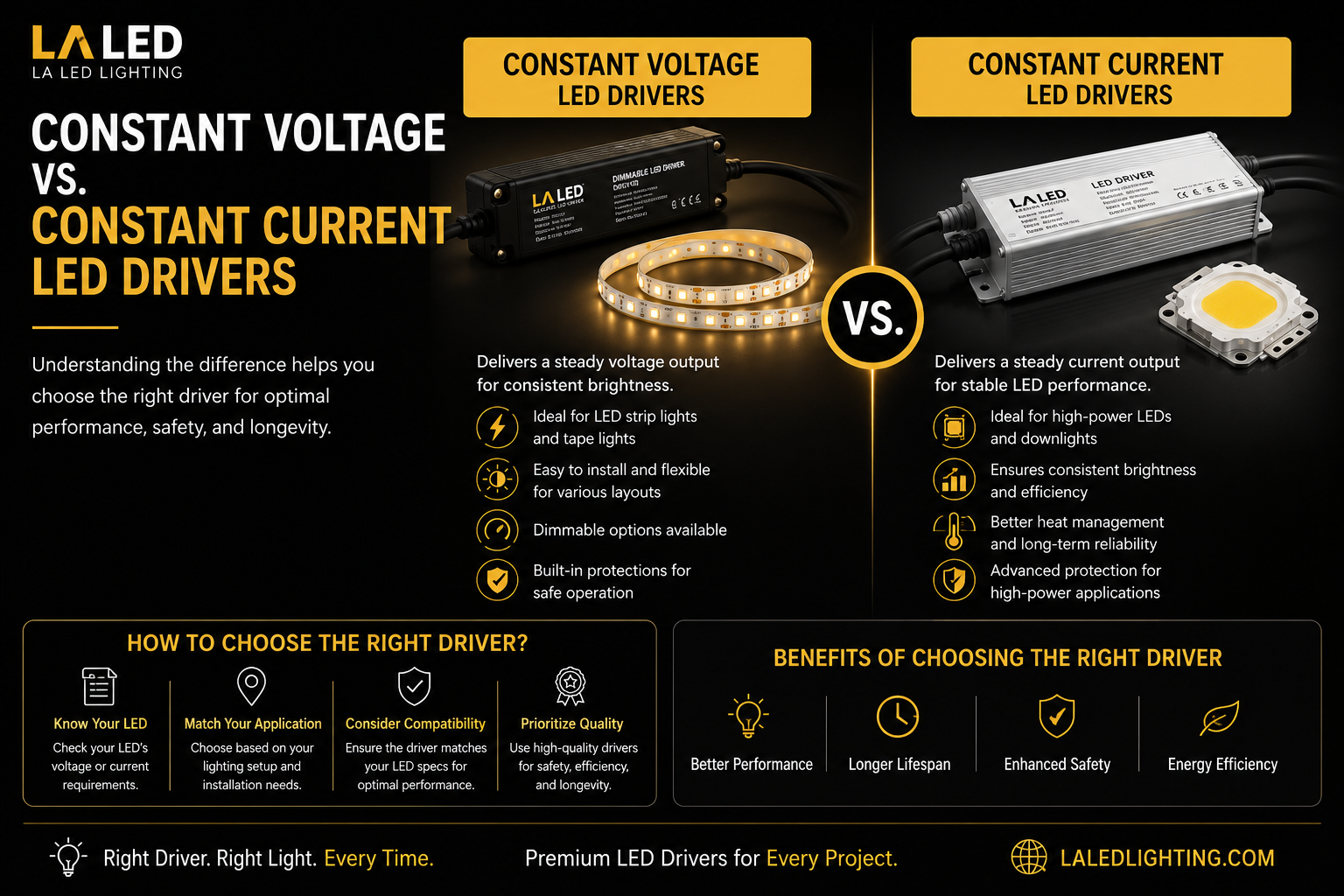
Constant Voltage vs Constant Current LED Drivers
Choosing the right LED driver is one of the most important decisions in any lighting project. Whether you're installing LED strip lights, recessed downlights, architectural lighting, or commercial fixtures, the driver determines how power is delivered to the LEDs and how the system performs over time.
Understanding the difference between constant voltage and constant current LED drivers can help prevent flickering, compatibility issues, premature failures, and costly installation mistakes.
What Is a Constant Voltage LED Driver?
A constant voltage LED driver delivers a fixed output voltage, typically:
-
12V DC
-
24V DC
The connected LED product controls how much current it draws from the driver.
Constant voltage drivers are commonly used for:
-
COB LED strips
-
LED tape lights
-
RGB LED strips
-
RGBW LED strips
-
Tunable white (CCT) LED strips
-
Under-cabinet lighting
-
Cove lighting
-
Accent lighting
Because they provide a stable voltage output, these drivers work well in systems where flexibility and expandability are important.
What Is a Constant Current LED Driver?
A constant current LED driver delivers a fixed current while automatically adjusting voltage to meet the requirements of the fixture.
Common output currents include:
-
350mA
-
500mA
-
700mA
-
1050mA
Constant current drivers are commonly used for:
-
Recessed downlights
-
LED modules
-
Commercial luminaires
-
Architectural fixtures
-
High-performance COB fixtures
These systems are designed around a specific current requirement and must be matched carefully to the fixture specifications.
Constant Voltage vs Constant Current: Key Differences
| Feature | Constant Voltage | Constant Current |
|---|---|---|
| Output Type | Fixed Voltage | Fixed Current |
| Typical Output | 12V or 24V DC | 350mA, 700mA, 1050mA |
| Common Applications | LED strips and tape lights | Downlights and fixtures |
| Installation Flexibility | High | Moderate |
| Driver Matching | Match voltage | Match current |
| Most Common Use | Residential and architectural strip lighting | Dedicated LED fixtures |
The correct choice depends entirely on the lighting product being powered.
When to Use a Constant Voltage Driver
Constant voltage drivers are ideal when powering LED strip lighting systems.
They are commonly used in:
-
Kitchen under-cabinet lighting
-
Cove lighting
-
Toe-kick lighting
-
Display shelving
-
Architectural accent lighting
-
Outdoor strip lighting
Because many LED strips operate on 12V or 24V DC, installation is often simpler and more flexible.
Recommended for:
-
COB LED strips
-
RGB lighting systems
-
RGBW lighting systems
-
Tunable white strips
-
Multi-zone strip lighting projects
When to Use a Constant Current Driver
Constant current drivers are used when the LED fixture requires a specific operating current.
They are often found in:
-
Recessed LED downlights
-
Commercial lighting fixtures
-
High-output architectural lighting
-
Specialty LED luminaires
These drivers provide precise current regulation that helps maintain consistent brightness, color stability, and long-term reliability.
Why Wattage Alone Is Not Enough
One of the most common mistakes is choosing a driver based only on wattage.
For example, a 60W driver is not automatically compatible with a 48W LED load.
Before considering wattage, you must verify:
For Constant Voltage Drivers
-
Output voltage (12V or 24V)
-
Total system wattage
-
Dimming compatibility
For Constant Current Drivers
-
Output current
-
Voltage range
-
Fixture requirements
Wattage is important, but voltage or current matching always comes first.
Dimming Compatibility Matters
The driver must also support the desired dimming method.
Common dimming protocols include:
-
TRIAC
-
ELV
-
MLV
-
0-10V
-
PWM
-
Smart lighting controls
For commercial and architectural projects, 0-10V dimming is often preferred because it provides reliable, smooth control across multiple fixtures.
Recommended Product
For projects requiring advanced dimming performance, explore our collection of:
0-10V Dimmable LED Drivers
https://laledlighting.com/collections/0-10v-dimmable-led-drivers
These drivers are commonly used for:
-
Commercial lighting
-
Office lighting
-
Architectural LED strip installations
-
Recessed lighting systems
-
Hospitality and retail projects
Common Mistakes to Avoid
Using the Wrong Driver Type
Never assume drivers are interchangeable. Always verify whether the LED product requires constant voltage or constant current.
Ignoring Dimming Compatibility
A dimmable fixture may still perform poorly if paired with an incompatible dimmer or driver.
Matching Wattage Only
Voltage and current requirements must be confirmed before wattage calculations are made.
Overloading the Driver
Always leave additional capacity above the actual lighting load to improve reliability and reduce heat.
How to Choose the Right Driver
The easiest approach is to start with the LED product.
Ask these questions:
-
Does the fixture require constant voltage or constant current?
-
What voltage or current does it require?
-
What is the total wattage?
-
Will the system be dimmed?
-
Is the installation indoors, damp, or wet location?
-
Does the driver fit the available installation space?
Answering these questions first eliminates guesswork and helps ensure compatibility.
Final Thoughts
The difference between constant voltage and constant current LED drivers comes down to how power is delivered to the LEDs.
Constant voltage drivers are the standard choice for LED strip lights, tape lights, and flexible lighting systems. Constant current drivers are typically used for dedicated fixtures that require precise current regulation.
Choosing the correct driver type improves performance, supports proper dimming, extends system life, and helps avoid installation problems. Always start with the requirements of the LED product and select a driver that matches those specifications exactly.