
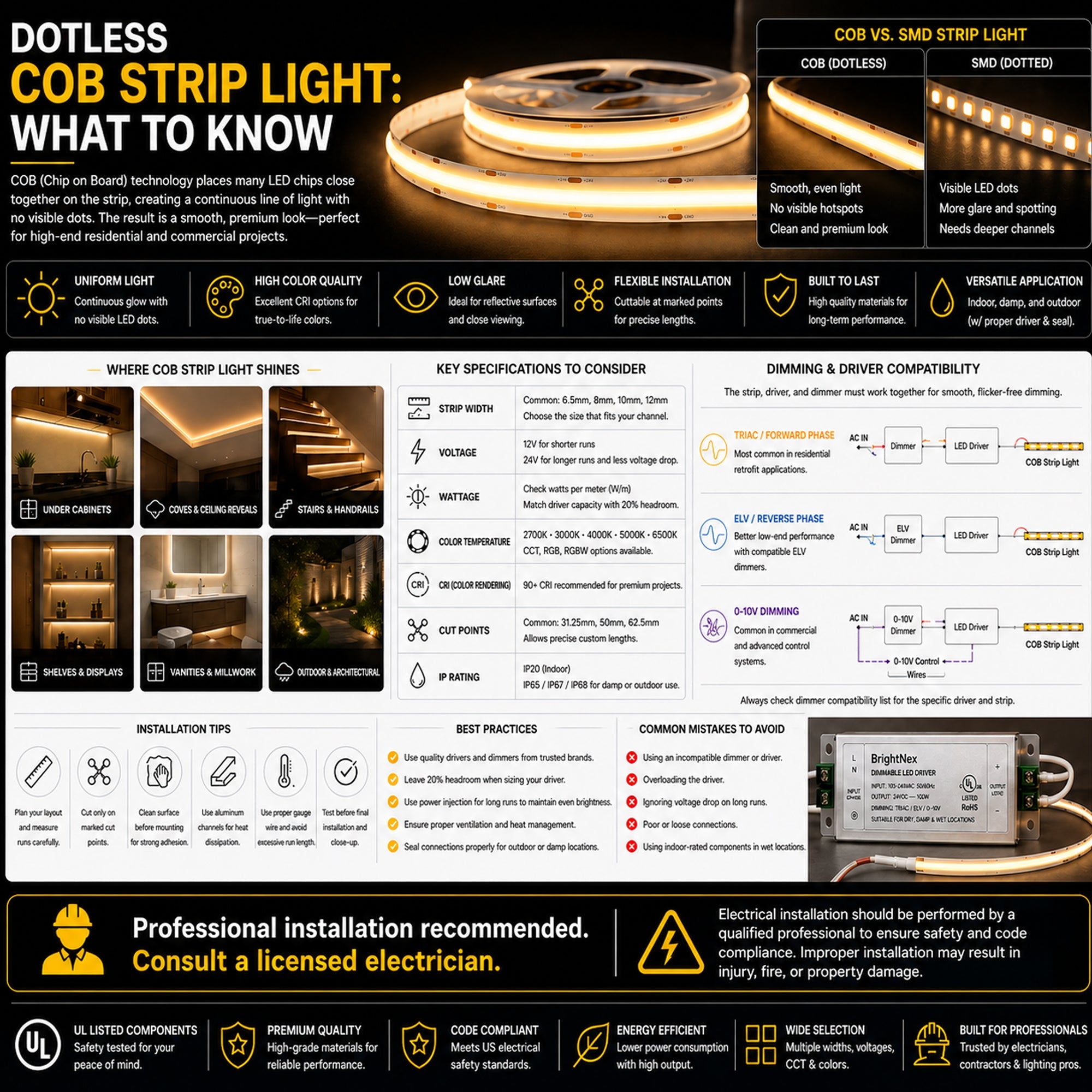
Dotless COB Strip Light: What You Need to Know
If you've ever installed LED strip lighting and noticed individual LED dots reflecting on countertops, walls, or glossy surfaces, you're not alone. Traditional LED strip lights can create visible hotspots that distract from an otherwise beautiful installation.
A dotless COB strip light solves this problem by producing a smooth, continuous line of light. The result is a cleaner, more professional appearance that is ideal for modern residential, commercial, and architectural lighting projects.
What Is a Dotless COB Strip Light?
COB stands for Chip on Board. Unlike traditional SMD LED strips that use spaced-apart LED packages, COB technology places hundreds of LED chips closely together along the strip.
This higher LED density creates:
-
Continuous light output
-
Reduced hotspot visibility
-
Improved visual comfort
-
Better performance in shallow channels
-
More uniform illumination
Because the LEDs are packed so closely together, the strip appears almost seamless when illuminated.
Why Choose a Dotless COB Strip Light?
The biggest advantage is appearance.
Traditional LED strips often require deep aluminum channels and heavy diffusers to hide visible LED dots. COB strips naturally produce a more uniform beam, allowing designers and installers greater flexibility.
Benefits include:
-
Smooth, dot-free illumination
-
Modern architectural appearance
-
Reduced glare and reflections
-
Better performance in shallow profiles
-
Cleaner under-cabinet lighting
This makes COB strips especially popular in high-end residential and commercial applications.
Best Applications for COB LED Strip Lighting
Under-Cabinet Lighting
COB LED strips are one of the best choices for kitchen lighting.
The continuous light output reduces reflections on:
-
Granite countertops
-
Quartz surfaces
-
Tile backsplashes
-
Gloss cabinetry
The result is a more luxurious and professional appearance.
Cove Lighting
Cove lighting often places LED strips close to ceilings and walls. A dotless COB strip creates a smooth wash of light without visible hotspots or scalloping.
Shelving and Display Lighting
Retail displays, built-ins, closets, and floating shelves benefit from the clean, even illumination COB strips provide.
Stair and Accent Lighting
Because viewers are often close to the light source, COB strips help eliminate the distracting dotted effect common with standard LED tape.
Choosing the Right COB Strip Light
Not all COB strips are the same. Several factors affect performance.
Voltage
Most COB strips are available in:
-
12V DC
-
24V DC
For longer runs, 24V systems are often preferred because they help reduce voltage drop and maintain consistent brightness.
Color Temperature
Choose the color temperature based on the space:
-
2700K – Warm residential lighting
-
3000K – Popular for kitchens and living spaces
-
4000K – Neutral white for offices and task lighting
-
5000K – Daylight applications
Color Options
Depending on the project, you may choose:
-
Single Color COB Strips
-
Tunable White (CCT) COB Strips
-
RGB COB Strips
-
RGBW COB Strips
Each offers different levels of control and customization.
Color Rendering
For premium installations, look for high CRI lighting.
A higher Color Rendering Index (CRI) helps materials, finishes, food, and skin tones appear more natural and vibrant.
Driver and Dimming Compatibility
One of the most common mistakes is focusing only on the strip while ignoring the power supply and dimming system.
For reliable performance, the following components must work together:
-
COB LED Strip
-
LED Driver
-
Dimmer
-
Controller (if applicable)
For commercial and architectural installations requiring advanced dimming control, 0-10V systems are often preferred.
Recommended Product
For smooth, reliable dimming performance, explore our collection of:
0-10V Dimmable LED Drivers
https://laledlighting.com/collections/0-10v-dimmable-led-drivers
These drivers are commonly used with:
-
COB LED strips
-
Architectural lighting
-
Retail displays
-
Office lighting
-
Hospitality projects
Installation Tips for Better Results
Even with a dotless COB strip, installation quality matters.
Use Aluminum Channels
Aluminum channels help:
-
Improve heat dissipation
-
Protect the strip
-
Create a cleaner finished appearance
-
Extend product lifespan
Plan Run Lengths Carefully
Long runs may require:
-
Power injection
-
Larger wire sizes
-
Additional drivers
Proper planning helps maintain consistent brightness throughout the installation.
Prepare Mounting Surfaces
For best adhesion:
-
Clean surfaces thoroughly
-
Remove dust and debris
-
Avoid mounting on unstable surfaces
In demanding environments, additional mounting clips may provide extra security.
Is COB Always Better Than SMD?
Not necessarily.
If the strip will be hidden behind a diffuser or installed where the LEDs are never visible, a traditional SMD strip may still be a practical option.
However, for visible installations where appearance matters, COB strip lighting typically delivers a more refined and professional result.
COB is especially beneficial for:
-
Under-cabinet lighting
-
Cove lighting
-
Display lighting
-
Stair lighting
-
Architectural lighting
-
Modern interior designs
Final Thoughts
A dotless COB strip light is one of the best ways to achieve smooth, continuous illumination without visible LED hotspots. Whether you're upgrading a kitchen, designing custom millwork, or creating architectural lighting details, COB technology provides a cleaner and more sophisticated appearance.
For the best results, choose a complete system that includes a quality COB strip, properly sized driver, compatible dimming controls, and appropriate installation accessories. When all components are matched correctly, the result is beautiful lighting that performs reliably for years to come.