
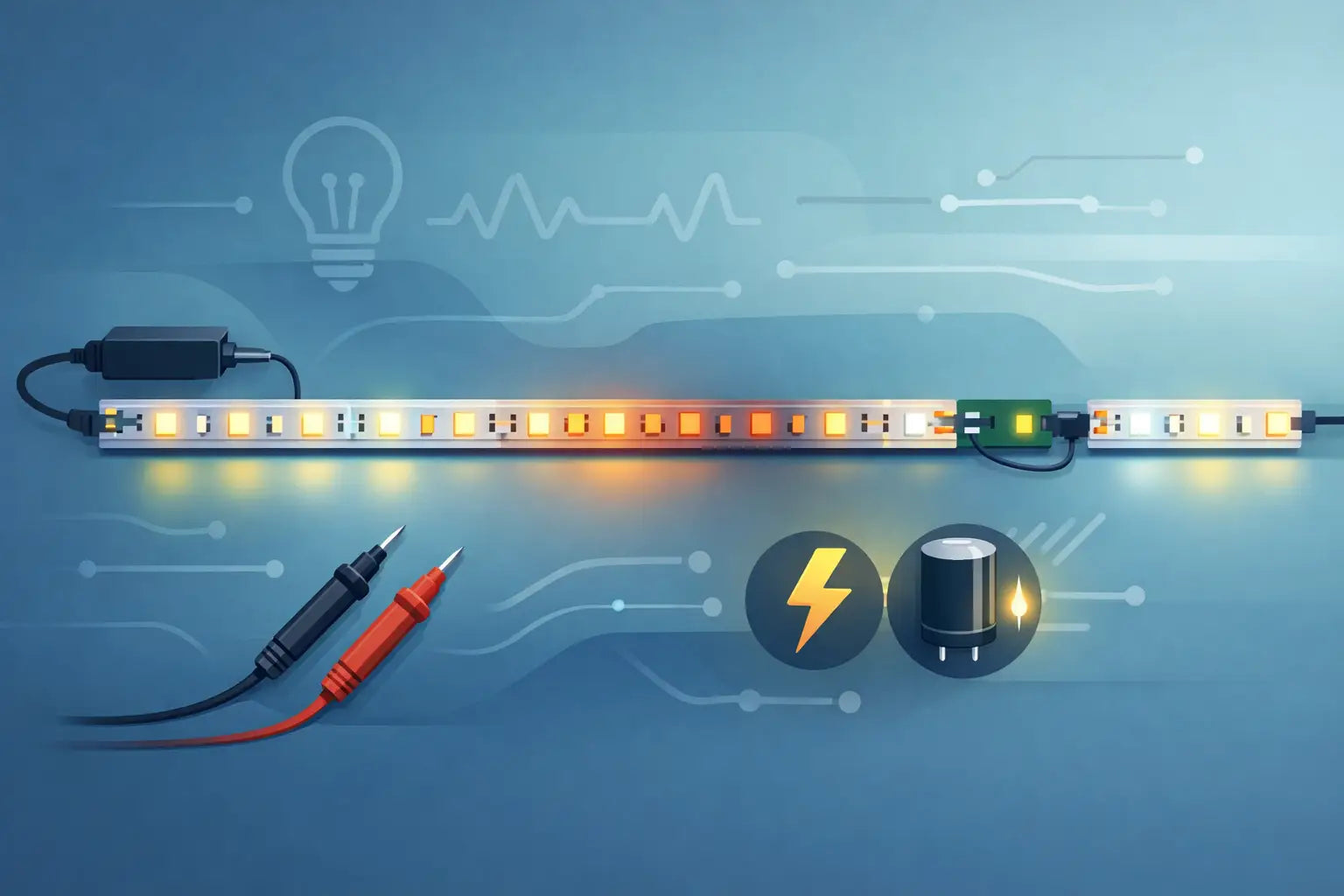
A strip that looks perfect on the first few feet and noticeably dimmer at the far end is not a product defect most of the time. It is a layout problem. If you are figuring out how to prevent voltage drop in LED strip installations, the fix usually comes down to power distribution, wire sizing, run length, and choosing the right voltage from the start.
For contractors and homeowners alike, voltage drop shows up fast in under-cabinet lighting, ceiling coves, toe-kick runs, retail shelving, and long outdoor tape light layouts. The result is familiar - brightness fades, white shifts warmer, RGB colors become inconsistent, and the finished job looks cheaper than it should. On premium installs, that is not acceptable.
What voltage drop actually does to LED strip performance
LED strip lights are low-voltage products, typically 12V or 24V. As electricity travels through the copper on the strip and through the supply wire feeding it, resistance causes voltage to fall along the run. The longer the run and the higher the load, the more noticeable that drop becomes.
The visual symptoms are easy to spot. Single-color strips dim toward the end. Tunable white strips may lose consistency. RGB and RGBW strips can shift color because each channel no longer receives the same effective voltage. On COB strip lights, the dotless look may still appear smooth, but output can still taper off in a way that undermines the whole installation.
That is why preventing voltage drop is less about one magic component and more about building the system correctly.
How to prevent voltage drop in LED strip installations from the start
The cleanest fix is early planning. Once drywall is closed, cabinetry is finished, or exterior hardscape is complete, correcting a poor feed strategy gets expensive.
Start with the strip voltage. In most longer runs, 24V performs better than 12V because it draws less current for the same wattage. Less current means less drop across the wire and the strip itself. If you are lighting a long cove, large kitchen, commercial display, or perimeter detail, 24V is often the better choice.
Next, match the power supply to the actual load, with headroom. If a strip run needs 80 watts, do not pair it with an 80-watt driver and call it done. A properly sized driver runs cooler and more reliably when it is not maxed out. In dimmable systems, proper sizing also helps maintain stable performance across compatible controls such as TRIAC, ELV, MLV, or 0-10V, depending on the driver and application.
Then consider where power enters the strip. Feeding a long run from one end is often what creates the visible problem. In many cases, center-feeding the strip or powering both ends produces much more even light. For very long sections, splitting the run into shorter segments with parallel feeds is usually the professional approach.
Choose wire size for distance, not just convenience
A common installation mistake is using whatever low-voltage wire is on hand. That may work on a short cabinet run, but it is risky on longer distances between driver and tape light.
Wire gauge matters because smaller wire has higher resistance. Higher resistance means more voltage loss before power even reaches the strip. If the driver is remote-mounted in a closet, attic, equipment room, or basement, the wire run can become a significant part of the problem.
Thicker wire reduces resistance. The exact gauge depends on voltage, amperage, and distance, but the principle stays the same: as length and load go up, wire size should usually increase. For short runs, a smaller gauge may be acceptable. For longer homeruns or higher-wattage strips, stepping up to heavier cable is the safer move.
This is one of those areas where low bid shortcuts show up later. The strip may turn on, but that does not mean the system is performing correctly.
Don’t ignore the distance from driver to strip
Installers sometimes focus only on the strip length and forget the wire between the driver and the first LED. A 16-foot strip with a 25-foot feed wire is not really a 16-foot electrical problem. The whole path matters.
If possible, place the driver closer to the load while still meeting code, ventilation needs, and service access requirements. Compact drivers and transformers can help in tight millwork, soffits, and damp-location applications, but they still need to be installed correctly. Shorter feed distances usually improve results.
Power injection solves many long-run problems
If one long continuous strip run is already planned, power injection is often the right answer. That means feeding additional power to the strip at another point, instead of relying on a single entry point to carry the full load through the entire circuit path.
In practice, that can mean feeding both ends of a run, injecting power at the midpoint, or dividing a long layout into multiple sections wired in parallel back to the driver or distribution point. The right method depends on the strip type, wattage per foot, voltage, and total distance.
Power injection is especially useful for:
- long architectural coves
- extended under-cabinet systems with multiple connected sections
- RGB, RGBW, and CCT tape light where color consistency matters
- outdoor and landscape layouts with long physical distances
Do not exceed the strip manufacturer’s maximum run length
Every LED strip has a practical maximum continuous run length. That number is not arbitrary. It is based on the strip’s copper weight, design, and power draw. Ignore it, and even a premium strip can show dimming or color shift.
This is where many problems begin. Someone sees a 16.4-foot reel and assumes they can keep extending from one end indefinitely. Electrically, that is not how strip lighting works.
If the layout is longer than the recommended maximum single run, cut the strip at the marked cut points and create separate powered sections. For large projects, this is standard practice, not overbuilding.
High-output strips need more caution
Not all LED tape lights behave the same way. Higher-wattage products, dense COB strips, and dynamic color-changing systems can draw enough current to expose weak design choices quickly. A low-output accent strip may tolerate a simpler layout. A high-output task or architectural strip usually will not.
That is why product selection and power planning should happen together. The more premium the lighting effect, the less room there is for guesswork.
Connections matter more than many buyers expect
Voltage drop is not only about wire length. Poor connections add resistance too. Loose terminals, undersized connectors, weak solder joints, and cheap accessory parts can all create localized losses that affect brightness and consistency.
This is especially relevant in jobs with multiple jumpers, corners, cabinet transitions, or RGB/RGBW controller connections. Each connection point should be secure, compatible with the strip width and type, and rated for the application. Wet and damp locations need even more attention because environmental exposure raises the stakes.
A clean electrical path is part of good lighting design. If one section of a run is underperforming, inspect the connection quality before assuming the strip itself is the issue.
12V vs 24V: which is better for preventing voltage drop?
If the goal is to reduce voltage drop, 24V usually has the advantage. For the same wattage, current is lower on 24V systems than on 12V systems, and lower current means less loss through wires and strip conductors.
That does not make 12V wrong. It still makes sense in shorter runs, certain retrofit situations, and applications where tighter cut intervals are important. But when long runs and uniform output matter most, 24V is often the more stable platform.
For professional results, choose based on the layout rather than habit. The right answer depends on run length, brightness target, control method, and installation constraints.
A better result starts with system design
The best-looking LED strip installations are rarely the simplest electrically. They look effortless because the planning happened before the lights were ever mounted. Proper driver sizing, the right voltage, realistic run lengths, heavier wire where needed, and smart feed placement all work together to prevent visible drop.
For trade professionals, that means fewer callbacks. For homeowners and designers, it means the finished lighting looks even, premium, and intentional. If you are sourcing strip lights, drivers, transformers, and accessories for a project that needs dependable performance, LA LED Lighting is built for exactly that kind of work.
Before you place the strip, trace the power path. That is usually where the real answer is.