
How Many Lumens Do You Need for Under Cabinet Lighting?
Under-cabinet lighting can completely transform a kitchen, but choosing the wrong brightness can ruin the effect. Too little light leaves countertops covered in shadows. Too much creates glare on backsplashes, countertops, and appliances. If you're wondering how many lumens you need for under cabinet lighting, the answer depends on how the space is used and the type of lighting experience you want to create.
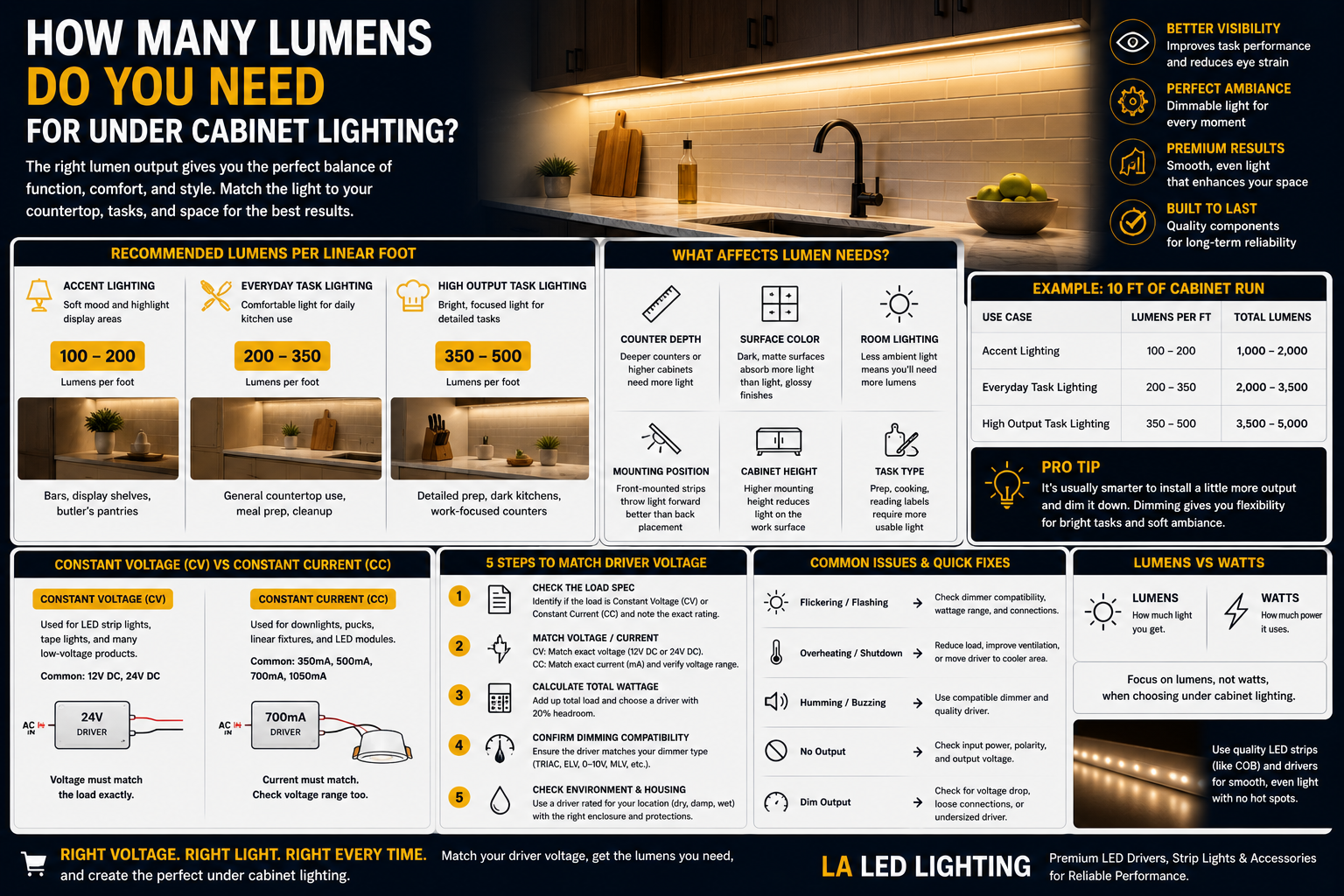
For most kitchens, a target of 200 to 500 lumens per linear foot provides excellent results. Lower levels create soft ambient lighting, while higher outputs deliver bright task lighting for cooking, food preparation, and cleanup.
How Many Lumens Do You Need for Under Cabinet Lighting?
The ideal lumen output depends on the purpose of the lighting.
Accent Lighting
If the goal is primarily decorative lighting, plan for approximately:
- 100 to 200 lumens per foot
This creates a subtle glow that highlights backsplashes, cabinetry, and architectural details without overwhelming the room.
Everyday Kitchen Task Lighting
For most residential kitchens, the ideal range is:
- 200 to 350 lumens per foot
This provides comfortable countertop illumination for everyday cooking, meal prep, and cleaning while maintaining a warm, inviting atmosphere.
The Indoor Dotless COB LED Strip (10mm, 24V) sits in this range and just above it, depending on color temperature: 340 lm/ft at 2700K, 370 lm/ft at 3000K, 410 lm/ft at 4000K, and 415 lm/ft at 5000K.
High-Performance Task Lighting
For serious cooking spaces, darker kitchens, or work-heavy countertops:
- 350 to 500 lumens per foot
This range offers excellent visibility for chopping, reading recipes, and detailed food preparation.
Where a dark stone counter or a deep work surface demands more, the 24V SMD LED Strip at 7.7W per foot produces roughly 1,000 lm/ft at 4000K. That is well above the range above, so it should always be paired with a dimmer and installed behind a diffuser to control glare.
Why Under-Cabinet Lighting Needs More Than General Lighting
Many homeowners assume recessed ceiling lights provide enough illumination. Unfortunately, overhead lighting often creates shadows because your body blocks the light while working at the counter.
Under-cabinet lighting solves this problem by placing light directly where tasks happen. Because the light source sits closer to the work surface, lumen requirements differ from general room lighting calculations.
This is why properly designed under-cabinet lighting often feels brighter and more useful than higher-lumen ceiling fixtures.
COB LED Strip Lights vs Standard LED Strips
The best under-cabinet lighting isn't just about brightness. Light quality matters just as much.
COB LED Strip Lights
COB (Chip-on-Board) LED strips create a smooth, continuous line of light with virtually no visible hotspots.
Benefits include:
- Dotless illumination
- Better appearance on reflective backsplashes
- More uniform countertop lighting
- Premium architectural finish
- Reduced glare
For luxury kitchens and high-end residential projects, COB LED strip lights are often the preferred choice. Our COB LED strip light range lists lumens per foot for every color temperature, so the calculations in this article can be checked against the actual product before ordering.
What Factors Affect Lumen Requirements?
Countertop Color
Lighter surfaces reflect more light and often require fewer lumens.
Examples:
- White quartz
- Light granite
- Marble
- Glossy backsplashes
Darker materials absorb light and generally benefit from higher output.
Examples:
- Black granite
- Dark quartz
- Matte stone
- Dark tile
Cabinet Height and Depth
Standard cabinet installations work well within the recommended lumen ranges.
Deeper counters or higher mounting positions may require additional output to effectively illuminate the entire work surface.
Kitchen Size
Large kitchens with open floor plans often need stronger task lighting than compact kitchens with plenty of ambient light.
Mounting Position
Placement can significantly affect performance.
For most kitchens, mounting the strip toward the front underside of the cabinet provides the best countertop coverage. A properly positioned strip often outperforms a brighter strip installed in the wrong location.
How to Calculate Total Lumens Needed
Calculating total lumens is straightforward.
Example:
10 feet of cabinet lighting × 300 lumens per foot = 3,000 lumens
For a typical kitchen:
- Accent lighting: 1,000–2,000 lumens
- General task lighting: 2,500–3,500 lumens
- Heavy task lighting: 3,500–5,000 lumens
These numbers provide a useful starting point before selecting your LED strip system.
Why Dimming Is Important
Rather than trying to choose one perfect brightness level, many professionals recommend installing a dimmable system.
Benefits include:
- Full brightness during cooking
- Reduced light for entertaining
- Soft nighttime illumination
- Better flexibility throughout the day
- Improved energy efficiency
A dimmable system allows one installation to serve multiple purposes without compromise. A driver such as the 100W 5-in-1 Dimmable LED Driver supports TRIAC, ELV, MLV, 0-10V, and PWM control, so the dimming method can be chosen to match the wall controls already in the kitchen. For premium residential and commercial projects, the 0-10V dimmable LED driver range provides smooth low-end control.
Color Temperature Also Affects Perceived Brightness
Lumens tell you how much light is produced. Color temperature affects how bright the space feels.
2700K
Warm and inviting. Excellent for traditional kitchens and evening ambiance.
3000K
The most popular residential choice. Warm enough to feel comfortable while providing strong task visibility.
3500K
Clean and modern. Great for contemporary kitchens and brighter work surfaces.
4000K
Crisp and highly functional. Often used in commercial kitchens and utility spaces.
For most kitchens, 3000K to 3500K provides the best balance of comfort and visibility.
Common Under-Cabinet Lighting Mistakes
Not Enough Light
Using decorative accent strips as task lighting often leaves countertops underlit.
Too Much Light Without Dimming
High-output strips without dimming can create glare and visual discomfort.
Visible LED Dots
Lower-quality strips may show individual LED points, especially on reflective surfaces.
Poor Driver Selection
An improperly sized driver can cause flickering, reduced performance, or premature failure. Cabinet cavities also limit the physical space available, which is where a short-body unit like the 60W Compact Dimmable LED Transformer (24V) at 3.3 inches long solves a problem a full-size driver cannot.
Final Thoughts
For most kitchens, the ideal under-cabinet lighting falls between 200 and 500 lumens per foot, depending on how the space is used. Decorative lighting can use less, while serious task lighting often benefits from higher output.
A quality COB LED strip paired with a properly sized dimmable driver delivers the best overall result. It provides smooth, even illumination, excellent countertop visibility, and the flexibility to adjust brightness throughout the day.
When brightness, color temperature, driver compatibility, and installation quality all work together, under-cabinet lighting becomes one of the most valuable upgrades in the entire kitchen.