
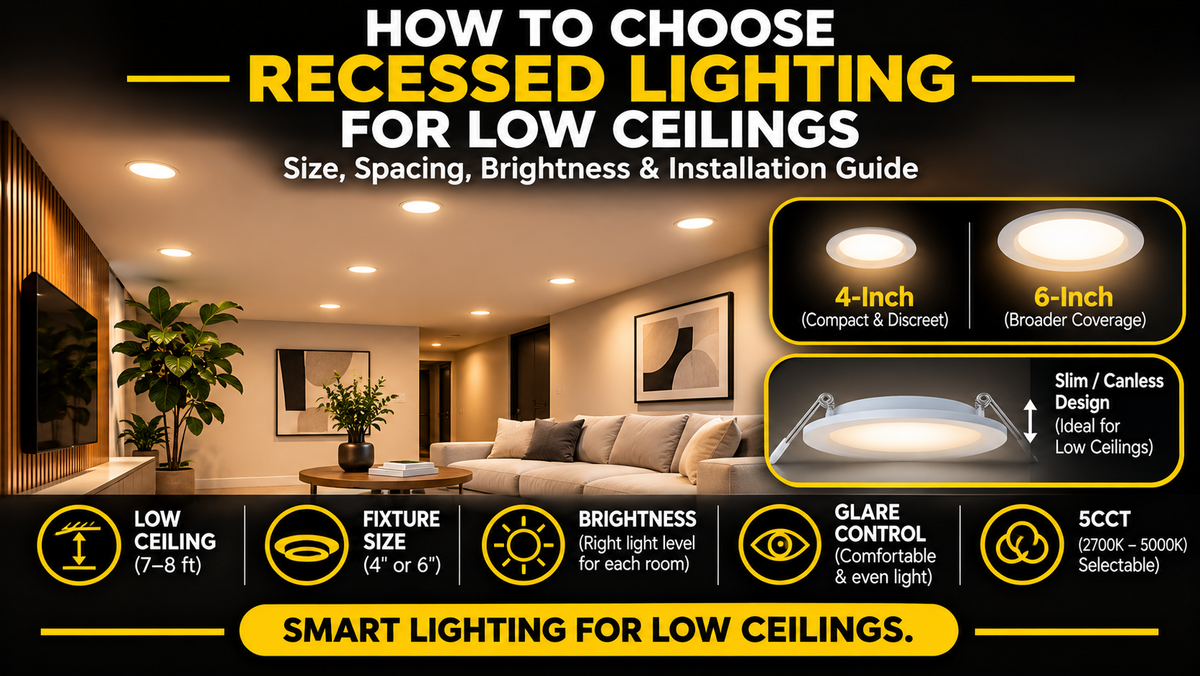
How to Choose Recessed Lighting for Low Ceilings
Low ceilings can make a room feel smaller, darker, and more crowded, especially when the lighting fixtures hang below the ceiling.
Fortunately, recessed LED lighting offers an effective solution.
Unlike pendant lights or bulky ceiling fixtures, recessed downlights sit flush or nearly flush with the ceiling, helping maintain a clean, uncluttered appearance.
They can also provide comfortable, evenly distributed illumination when properly selected and positioned.
However, choosing recessed lighting for a low ceiling requires more than selecting an attractive fixture.
The size, beam angle, brightness, spacing, installation depth, and color temperature all influence the final result.
A poorly planned layout can create excessive glare, uneven illumination, or an uncomfortable room.
In this guide, we'll explain how to select recessed LED lighting for low ceilings, including practical recommendations for bedrooms, kitchens, living rooms, hallways, and basements.
Our recessed downlight range covers 3, 4 and 6 inch fixtures from 6W to 12W, all dimmable, flicker-free and CRI ~90.
1. What Is Considered a Low Ceiling?
In residential lighting design, ceilings around 7 to 8 feet high are commonly treated as relatively low compared with taller modern interiors.
Typical examples include:
Basement ceilings
Older residential homes
Apartments and condominiums
Renovated attics
Small bedrooms
Compact kitchens
Low-ceiling hallways
Why Does Ceiling Height Matter?
Ceiling height affects how light spreads throughout a room.
With a lower ceiling, the light source is closer to the floor, furniture, and occupants.
This can create several challenges:
More noticeable glare
Smaller light distribution areas
Uneven illumination
Visible bright spots
Limited installation space
A crowded appearance when fixtures protrude
The Goal
For low ceilings, the objective is to provide sufficient illumination while keeping the ceiling visually simple and minimizing uncomfortable glare.
2. Why Recessed LED Lights Are Ideal for Low Ceilings
Recessed lighting offers several advantages over hanging fixtures.
A. Space-Saving Design
Recessed fixtures do not occupy the same visible space as pendant lights or chandeliers.
This helps maintain a clean ceiling appearance.
B. Modern, Minimalist Style
Flush-mounted LED downlights can blend into the ceiling and complement contemporary interiors.
C. Even Illumination
When properly spaced, multiple recessed lights can provide balanced illumination throughout the room.
D. Flexible Lighting Layouts
Recessed lighting can be used for:
General illumination
Task lighting
Accent lighting
Wall illumination
Highlighting architectural details
E. Energy Efficiency
Modern LED downlights can provide useful illumination with relatively low electrical consumption compared with many older lighting technologies.
For scale, our 4″ gimbal downlight produces around 700 lumens from 9W, and our 6″ slim panel around 950 lumens from 12W.
Important
Not every recessed fixture is suitable for every ceiling.
The available cavity depth, insulation conditions, structural framing, and electrical requirements must be checked before installation.
3. Slim LED Downlights vs Traditional Recessed Fixtures
One of the first decisions is choosing between slim LED downlights and traditional recessed lighting systems.
Slim or Canless LED Downlights
Slim LED downlights are designed with a relatively shallow profile.
Many use a separate driver or junction box connected to the light panel.
Advantages
Shallow fixture design
Clean, nearly flush appearance
Useful for many renovation projects
May fit locations where traditional recessed housings are impractical
Available in different sizes and color temperatures
Limitations
Still require sufficient installation clearance
Driver or junction box placement must meet installation requirements
Some models may create more noticeable glare because the light-emitting surface is close to the ceiling plane
Not all products are suitable for insulated or damp locations
Our slim panels ship with an aluminum junction box as part of the fixture, which addresses the second point — see the 6″ slim panel, rated for dry and damp locations.
Traditional Recessed Downlights
Traditional systems use a recessed housing or compatible mounting arrangement.
They may include deeper optical designs that help control glare.
Advantages
A variety of trims and optical configurations
Potentially better glare control with suitable recessed optics
Adjustable and directional options
Useful for accent and general lighting
Limitations
Some models require greater ceiling depth
Installation may be more complicated
Existing framing and utilities can restrict placement
Which Is Better for Low Ceilings?
Slim LED downlights are often a practical choice when installation depth is limited.
However, a deeper recessed fixture with good glare control may be preferable when adequate ceiling space is available.
The best option depends on both the ceiling structure and the desired lighting quality.
4. Should You Choose 4-Inch or 6-Inch Recessed Lights?
Both 4-inch and 6-inch LED downlights can work well in rooms with low ceilings.
The difference is not simply that larger fixtures produce more light.
Actual brightness depends on the LED module and fixture specifications.
4-Inch Recessed Lights
Four-inch downlights are popular for compact residential spaces.
Advantages
Smaller visible ceiling opening
Minimalist appearance
Useful for smaller rooms
Suitable for focused lighting layouts
Can create a refined ceiling design
Common Applications
Bedrooms
Hallways
Small kitchens
Bathrooms
Home offices
Compact living rooms
Our 4″ options are the 9W slim panel with night light and the 9W gimbal with 90° tilt (~700 lumens).
6-Inch Recessed Lights
Six-inch downlights offer a larger visible aperture.
Depending on the fixture design, they may provide broader light distribution or higher output.
Advantages
Available in a wide range of lumen outputs
Suitable for larger rooms
Can support general illumination
Useful for open-plan spaces
Common Applications
Living rooms
Basements
Kitchens
Family rooms
Larger residential areas
Our 6″ option is the 12W slim panel with night light at ~950 lumens and a 110° beam angle.
4-Inch vs 6-Inch Comparison
| Feature | 4-Inch Downlights | 6-Inch Downlights |
|---|---|---|
| Ceiling appearance | Smaller, discreet | Larger aperture |
| Small rooms | Often a good fit | Can also work |
| Large rooms | May require more fixtures | May offer higher-output options |
| Glare control | Depends on optical design | Depends on optical design |
| Installation depth | Model-specific | Model-specific |
| Brightness | Depends on lumens | Depends on lumens |
| Best choice | Compact, minimalist layouts | Broader general-lighting layouts |
Recommendation
For many low-ceiling residential rooms, 4-inch recessed lights are an attractive starting point because of their compact appearance.
However, 6-inch downlights can also be an excellent choice when their output and beam distribution suit the space.
Do not select fixture size based on appearance alone.
There is also a smaller option worth considering for low ceilings specifically: our 3″ downlight at 6W, available in black trim as well as white. A smaller aperture at lower output lets you use more fixtures at lower individual brightness, which is often more comfortable when the ceiling is close.
5. How Bright Should Recessed Lights Be for Low Ceilings?
Brightness is one of the most important considerations.
A common mistake is assuming that low ceilings require extremely bright fixtures.
In reality, excessive brightness can create discomfort because the lights are relatively close to occupants.
Understanding Lumens
Lumens measure the total visible light produced by a fixture.
Typical residential LED downlights are available in many output ranges, including approximately:
500–700 lumens
700–900 lumens
900–1,200 lumens
Higher-output models for specialized applications
These are general product categories, not specifications for a particular LA LED Lighting downlight.
Our own fixtures sit in the first three bands: the 3″ at 6W, the 4″ at 9W and ~700 lumens, and the 6″ at 12W and ~950 lumens — deliberately in the comfortable residential range rather than the high-output end.
How Much Light Does a Room Need?
The answer depends on the room's purpose.
A bedroom generally requires a different lighting approach from a kitchen.
| Room | Approximate General Lighting Target |
|---|---|
| Bedroom | 100–200 lux |
| Living room | 100–300 lux |
| Hallway | 100–200 lux |
| Kitchen general lighting | 200–300 lux |
| Kitchen task surfaces | 300–500 lux |
| Home office work surface | 300–500 lux |
These are illustrative design ranges rather than universal code requirements.
The appropriate target depends on activities, occupant needs, and applicable lighting standards.
Important
Lumens and lux are not interchangeable.
Lumens describe the light emitted by a fixture.
Lux describes the illumination reaching a surface.
Fixture position, beam angle, room reflectance, and other factors affect how many lumens are needed to achieve the desired lux.
Note that the kitchen task row at 300–500 lux is usually better served by under-cabinet lighting than by brighter ceiling fixtures, since a person standing at the counter casts a shadow on their own work surface — see our 10mm COB strip at 340–415 lm/ft.
6. How Many Recessed Lights Do You Need?
The number of fixtures depends on:
Room dimensions
Ceiling height
Fixture lumen output
Beam distribution
Wall and ceiling colors
Furniture layout
Lighting purpose
Example: A 12 × 12 Foot Bedroom
Room area:
12 × 12 = 144 square feet
Converted to square meters:
144 ÷ 10.764 ≈ 13.4 m²
Suppose the target average illumination is 150 lux.
The theoretical light reaching the target area would be:
13.4 × 150 = 2,010 lumens
However, the total fixture output must generally be higher because not all emitted light reaches the target area.
For illustration, assume a combined utilization and maintenance factor of 0.6.
Required fixture lumens:
2,010 ÷ 0.6 ≈ 3,350 lumens
If each downlight produces 800 lumens:
3,350 ÷ 800 ≈ 4.2 fixtures
This suggests approximately four to five fixtures as an initial planning estimate.
Run against our own fixtures, that same room works out at about five 4″ downlights (3,350 ÷ 700) or about four 6″ downlights (3,350 ÷ 950) — which is a useful illustration of the size trade-off in section 4.
Important
This is a simplified calculation, not a final lighting design.
Actual fixture count should be confirmed using the manufacturer's photometric data and the room layout.
7. How Far Apart Should Recessed Lights Be in Low Ceilings?
Spacing is essential for avoiding uneven illumination.
If recessed lights are too far apart, the room may have dark areas.
If they are too close together, the ceiling may appear cluttered and certain areas may receive excessive light.
General Starting Points
For residential ceilings around 7–8 feet high, fixture spacing might begin around 3–5 feet for many common downlight configurations.
However, this is not a universal rule.
The correct spacing depends heavily on the beam angle and fixture photometric distribution.
Example: A 12 × 12 Foot Room
A simple layout could use four downlights arranged in a square pattern.
The lights should be positioned symmetrically while accounting for furniture, doors, and task areas.
Wall Distance
A starting point is sometimes to position the first row of fixtures approximately half the distance used between fixtures.
However, wall-washing and task-lighting applications may require different positioning.
Best Practice
Use the fixture manufacturer's recommended spacing criteria or photometric information whenever available.
8. Choose the Right Beam Angle
Beam angle describes the angular spread of light from a fixture.
It has a major influence on how recessed lighting performs in low-ceiling rooms.
Narrow Beam Angles
Approximately 15°–30°.
Often used for:
Accent lighting
Artwork
Decorative objects
Focused architectural features
Medium Beam Angles
Approximately 35°–60°.
Often used for:
General residential lighting
Kitchens
Bedrooms
Hallways
Wide Beam Angles
Approximately 60° or greater.
Often used for:
Broad illumination
General lighting
Spaces where wider distribution is desirable
Which Is Best for Low Ceilings?
A medium or wide distribution is often a practical starting point for general illumination.
However, a wide beam does not automatically guarantee comfortable lighting.
Glare control and fixture design are also important.
Our 6″ slim panel has a 110° beam angle, which falls well into the wide category and is the main reason it covers a low-ceiling room with fewer fixtures than a narrower distribution would.
9. How to Reduce Glare from Recessed Lights
Glare is particularly important in rooms with low ceilings.
Because the light source is closer to eye level, poorly selected fixtures can create discomfort.
Choose Recessed Optics
Fixtures with deeper light sources or suitable optical shielding can reduce direct visibility of bright components.
Every fixture in our downlight range uses a glare-free lens for this reason, and all are specified flicker-free — both matter more at 7 feet than at 10.
Avoid Excessive Brightness
Use the amount of light required for the room rather than automatically choosing the highest lumen output.
This is the practical argument for the 3″ 6W fixture in a low-ceiling room: several lower-output fixtures usually read as more comfortable than fewer bright ones.
Use Dimming
Compatible dimming allows the brightness to be adjusted for different activities. All our downlights are dimmable.
Consider Fixture Position
Avoid placing bright downlights directly in common sightlines when possible.
Use Appropriate Beam Distribution
A suitable beam can improve light distribution and reduce unnecessary bright spots.
Consider Ceiling Finish
Light-colored matte ceilings can help distribute reflected light and create a brighter visual environment.
Important
A slim panel light may offer a clean appearance, but its broad luminous surface can still produce glare depending on its brightness and diffuser design.
10. What Color Temperature Is Best for Low Ceilings?
Color temperature affects how a room feels.
It is measured in Kelvin (K).
2700K — Warm White
Creates a soft, comfortable atmosphere.
Suitable for:
Bedrooms
Living rooms
Relaxing spaces
3000K — Warm White
Provides a warm appearance with a slightly more neutral character.
Suitable for:
Kitchens
Living rooms
Hallways
General residential lighting
3500K — Neutral-Warm White
A balanced option between warm and neutral lighting.
Suitable for:
Kitchens
Home offices
Multipurpose rooms
4000K — Neutral White
Creates a cleaner, more neutral appearance.
Suitable for:
Workspaces
Kitchens
Utility rooms
Offices
5000K — Cool White
Produces a cooler daylight-like appearance.
May be appropriate for certain task-focused environments.
Our Recommendation
For many low-ceiling homes, 2700K or 3000K provides a comfortable residential atmosphere.
For kitchens and workspaces, 3000K–4000K may be preferable depending on the desired appearance.
You do not have to commit to one at the point of purchase: our 4″ and 6″ fixtures are 5CCT selectable across all five of the temperatures above, and the 3″ fixtures offer three.
11. Why 5CCT Recessed Lights Are Useful
5CCT downlights allow users to select from five preset color temperatures.
A common configuration includes:
2700K
3000K
3500K
4000K
5000K
The exact settings depend on the product.
That is exactly the set offered on our 4″ gimbal, 4″ night light and 6″ night light fixtures.
Advantages of 5CCT Lighting
Flexibility
You can select a suitable color temperature for the room.
Simpler Product Selection
One fixture model may support several lighting preferences.
Useful for Renovations
Color temperature can be selected during installation.
Better Coordination
Different rooms can use different settings while maintaining a consistent fixture appearance.
This last point is particularly useful alongside strip lighting: a 5CCT downlight can be set on site to match whichever colour temperature you chose for the COB strips in the same room.
Important
Many 5CCT downlights use a physical switch to select the color temperature.
They do not necessarily allow continuous color adjustment from a wall dimmer or remote control.
Always check the specific product's control features.
Ours are switch-selected at installation. If you want white that changes on demand rather than being set once, that is a strip-lighting feature — see the CCT COB Strip with a FUT035 controller.
12. Recessed Lighting for Low-Ceiling Living Rooms
Living rooms often need several types of lighting.
These include:
General illumination
Reading light
Accent lighting
Television-area lighting
Decorative illumination
Recommended Approach
Use recessed downlights for balanced general lighting.
Combine them with suitable accent lighting to create depth.
Avoid These Mistakes
Installing too many bright downlights
Placing lights directly above television screens without considering reflections
Using only one central fixture
Ignoring seating positions
Choosing overly cool color temperatures for a relaxing space
Design Tip
Consider using dimmable recessed lights together with concealed warm white COB LED strips.
This allows you to create different lighting moods without adding hanging fixtures.
In practice that is a 4″ downlight layout plus the 8mm COB strip in a ceiling cove or behind the television, both set to the same colour temperature. The strip side needs a driver, and a 5-in-1 dimmable driver lets both layers run from wall dimmers.
13. Recessed Lighting for Low-Ceiling Kitchens
Kitchens need functional illumination for food preparation and everyday activities.
General Lighting
Recessed downlights can provide overall room illumination — the 6″ at 950 lumens with its 110° beam covers a compact kitchen with few fixtures.
Countertop Lighting
Under-cabinet COB LED strips can provide more direct illumination for food preparation — the 10mm COB strip at 340–415 lm/ft is sized for this.
Kitchen Islands
Recessed downlights can illuminate the island without requiring pendant lights that may visually crowd a low ceiling.
This is a real advantage in a 7-foot room, where pendants over an island are often the single biggest contributor to a crowded feeling.
Recommended Layout
Position downlights based on the actual work surfaces rather than relying only on a symmetrical ceiling grid.
For example, placing fixtures appropriately near the front edge of cabinets may help reduce shadows cast by people standing at countertops.
The correct placement depends on the beam distribution and kitchen geometry.
Design Tip
A combination of recessed downlights and hidden COB LED strips can create both functional and decorative illumination.
14. Recessed Lighting for Low-Ceiling Bedrooms
Bedrooms generally benefit from comfortable, adjustable illumination.
Recommended Features
Warm color temperature
Compatible dimming
Good glare control
Balanced fixture placement
Minimal ceiling clutter
Common Mistake
Installing bright downlights directly above the bed can create discomfort when lying down.
Better Approach
Consider fixture placement relative to the bed and common sightlines.
Use indirect lighting or bedside fixtures where appropriate.
Color Temperature
2700K or 3000K is often a comfortable choice.
Our 4″ night light downlight is worth considering for a bedroom specifically — its integrated soft night light mode gives low-level illumination for moving around at night without switching on the main fixture, which addresses the "bright light directly above the bed" problem from a different direction. The 6″ version has the same feature.
For a genuinely warm bedside glow, a concealed 1800K Golden Yellow strip behind a headboard is warmer than any downlight setting.
15. Best Recessed Lighting for Low-Ceiling Basements
Basements frequently have limited ceiling height and restricted installation depth.
Common Challenges
Low structural clearance
Joists and beams
Ductwork
Plumbing
Limited natural light
Dark wall finishes
Why Slim LED Downlights Are Popular
Their shallow design can make them practical for many basement renovations.
However, sufficient clearance is still required for the fixture, wiring, and associated electrical components.
Recommended Features
Low-profile design
Suitable lumen output
Appropriate beam distribution
Dimmable operation
Selectable color temperature
Proper electrical and environmental ratings
The 6″ slim panel meets all six: slim aluminum panel with its own junction box, ~950 lumens, 110° beam, dimmable, 5CCT selectable, and rated for dry and damp locations — the last point mattering in basements more than most rooms.
Important
Do not cut or modify structural members to accommodate recessed lighting without appropriate professional evaluation.
16. Can Adjustable Recessed Lights Work in Low Ceilings?
Yes.
Adjustable recessed downlights can be useful when light needs to be directed toward specific features.
Common Applications
Artwork
Accent walls
Decorative shelving
Architectural details
Display areas
Advantages
Directional illumination
Greater design flexibility
Ability to highlight specific objects
Limitations
May create concentrated bright spots
May produce glare if aimed toward occupants
May not be the best choice for uniform general illumination
Recommendation
Use adjustable recessed lights selectively for accent lighting rather than automatically choosing them for every fixture in the room.
Our adjustable option is the 4″ Multi-Direction gimbal with 90° tilt, CRI 90 and a glare-free lens. In a low-ceiling room the tilt has a second use beyond accent work: aiming fixtures slightly away from seating positions is one of the more effective ways to reduce glare without reducing light levels.
17. Should You Use Recessed Lights or Surface-Mounted Fixtures?
Both can work in low-ceiling rooms.
Recessed Lights
Best when:
A clean ceiling appearance is important
Suitable installation space is available
Minimal visual obstruction is desired
Surface-Mounted Lights
Best when:
Recessing is not practical
Ceiling construction limits cutouts
A particular decorative appearance is desired
Installation conditions favor surface mounting
Comparison
| Feature | Recessed Lighting | Surface-Mounted Lighting |
|---|---|---|
| Ceiling appearance | Flush or nearly flush | Visible fixture body |
| Installation cavity | Usually required | Often less cavity depth |
| Minimalist appearance | Excellent | Depends on design |
| Fixture variety | Wide | Wide |
| Glare control | Depends on optics | Depends on optics |
| Low-ceiling suitability | Often excellent | Also suitable |
The correct choice depends on ceiling construction, fixture design, and lighting goals.
Where a cutout is not possible at all, concealed COB strip lighting in a cove or along a wall detail is a third option that adds no ceiling depth whatsoever.
18. Common Recessed Lighting Mistakes in Low Ceilings
Mistake 1: Installing Too Many Lights
More fixtures do not always improve lighting quality.
Solution: Calculate the required illumination and plan the layout.
Mistake 2: Choosing Excessively Bright Fixtures
High lumen output can create uncomfortable glare.
Solution: Select brightness based on room requirements. Our range tops out at 950 lumens per fixture for this reason.
Mistake 3: Ignoring Beam Angle
Poor beam selection can create dark areas or excessive overlap.
Solution: Review fixture photometric information.
Mistake 4: Choosing the Wrong Fixture Size
A larger aperture is not automatically better.
Solution: Compare 4-inch and 6-inch models based on output and appearance.
Mistake 5: Ignoring Ceiling Depth
Some fixtures require more installation space than expected.
Solution: Verify clearance before cutting openings.
Mistake 6: Poor Fixture Placement
Lights positioned incorrectly may create shadows or glare.
Solution: Consider furniture, work surfaces, and sightlines.
Mistake 7: Using the Wrong Color Temperature
Very cool lighting may feel uncomfortable in certain residential spaces.
Solution: Select color temperature based on room function. A 5CCT fixture lets you decide at installation.
Mistake 8: Ignoring Dimming Compatibility
Not all LED downlights work with every dimmer.
Solution: Verify the fixture and dimmer compatibility.
Mistake 9: Forgetting About Insulation
Some fixtures require specific clearances from insulation.
Solution: Follow the manufacturer's insulation-contact and installation ratings.
Mistake 10: Relying Only on Recessed Lighting
A room may feel flat without additional lighting layers.
Solution: Combine recessed lighting with suitable task and accent lighting — concealed COB strips are the usual second layer.
19. Quick Decision Summary
| Your Situation | Recommended Starting Point |
|---|---|
| Very limited ceiling depth | Slim or canless LED downlight |
| Small bedroom | Compact 4-inch recessed light |
| Large living room | 4-inch or 6-inch, based on photometrics |
| Low-ceiling kitchen | Recessed downlights plus under-cabinet task lighting |
| Basement renovation | Low-profile downlights with suitable clearances |
| Need adjustable color temperature | 5CCT downlight |
| Need comfortable evening lighting | Warm white with compatible dimming |
| Need accent lighting | Adjustable recessed downlight |
| Concerned about glare | Fixture with suitable optical shielding |
| Want a minimalist ceiling | Flush or nearly flush recessed fixture |
Final Recommendation: For many rooms with 7- to 8-foot ceilings, slim LED downlights with appropriate brightness, good glare control, and compatible dimming provide a practical starting point. Choose fixture size and spacing based on the actual room and photometric requirements.
Translated into our range: the small-bedroom and minimalist rows point to the 3″ or 4″ fixtures; the living room, kitchen and basement rows to the 6″ slim panel; the accent row to the 4″ gimbal; and the under-cabinet half of the kitchen row to the 10mm COB strip.
20. Professional Recessed Lighting Checklist
Before purchasing or installing recessed lighting, confirm:
Ceiling height has been measured.
Available installation depth has been checked.
Ceiling framing and obstructions have been identified.
Fixture size is appropriate.
Required illumination has been estimated.
Lumen output is suitable.
Beam distribution meets the room's needs.
Fixture spacing has been planned.
Glare control has been considered.
Color temperature is appropriate.
Dimming compatibility is verified.
Insulation-contact requirements are satisfied.
Damp-location or wet-location ratings are suitable where required.
Electrical installation requirements have been reviewed.
The final layout has been checked before cutting ceiling openings.
Wattage, lumen output, beam angle, CCT options, CRI, dimming and location rating are published on every page in our downlight range.
Frequently Asked Questions
1. What is the best recessed lighting for low ceilings?
Slim LED downlights are often a practical choice, especially when ceiling depth is limited. The best fixture also needs appropriate brightness, beam distribution, and glare control.
2. Are recessed lights good for 7-foot ceilings?
Yes, when properly selected and installed. Pay particular attention to glare, spacing, and installation clearance.
3. Are 4-inch or 6-inch recessed lights better for low ceilings?
Both can work. Four-inch fixtures offer a smaller appearance, while six-inch models may provide different output and distribution options. Our 4″ is ~700 lumens and our 6″ ~950.
4. How many recessed lights do I need for a 12 × 12 room?
The number depends on fixture output, beam angle, room reflectance, and desired illumination. Four to six fixtures may be a starting point for some layouts, but a lighting calculation is preferable.
5. How far apart should recessed lights be in an 8-foot ceiling?
Spacing often begins around 3–5 feet for many residential layouts, but the correct distance depends on the fixture's photometric characteristics.
6. Are slim LED downlights better than traditional recessed lights?
Slim fixtures are useful when installation depth is limited. Traditional recessed designs may offer advantages in optical control when sufficient space is available.
7. What color temperature is best for low ceilings?
2700K or 3000K is often comfortable for residential spaces. Kitchens and workspaces may benefit from 3000K–4000K. A 5CCT fixture covers both.
8. Do recessed lights make ceilings look higher?
They can help create a less cluttered appearance because they do not hang below the ceiling. The perceived effect also depends on the overall lighting design.
9. Can recessed lighting make a small room look bigger?
Balanced lighting and reduced visual clutter can help a room feel more open.
10. Are recessed LED lights dimmable?
Many are, but dimming compatibility depends on the specific fixture and dimmer. All fixtures in our downlight range are dimmable.
11. What is a 5CCT recessed light?
A 5CCT fixture provides five selectable color temperature settings — typically 2700K, 3000K, 3500K, 4000K and 5000K — chosen at installation.
12. Are canless recessed lights suitable for basements?
They can be an excellent option when installation clearance and electrical requirements are satisfied. Check the damp-location rating, which our 6″ panel carries.
13. Do recessed lights need a junction box?
The required electrical connection method depends on the fixture design and applicable electrical codes. Many canless fixtures include a separate junction box, as ours do.
14. Can recessed lights be installed near insulation?
Only when the fixture is appropriately rated and installed according to the manufacturer's instructions.
15. Do recessed lights create glare?
They can, especially in low ceilings. Suitable optics, placement, brightness, and dimming help manage glare. Our fixtures use a glare-free lens and are flicker-free.
16. What beam angle is best for low ceilings?
Medium or wide beam distributions are often suitable for general lighting. Our 6″ panel is 110°.
17. Can I use adjustable recessed lights in a low ceiling?
Yes. They are useful for accent lighting when properly positioned to avoid glare — see the 4″ gimbal with 90° tilt.
18. Should recessed lights be placed directly above kitchen countertops?
They should be positioned to provide effective task illumination while minimizing shadows. Under-cabinet COB strip lighting avoids the shadow problem entirely.
19. Are LED downlights energy-efficient?
Modern LED downlights can be highly energy-efficient. Compare actual lumens per watt — our 6″ fixture produces ~950 lumens from 12W.
20. What is the biggest mistake when installing recessed lighting in a low ceiling?
Choosing fixtures or spacing without considering glare, room function, and available installation depth.