
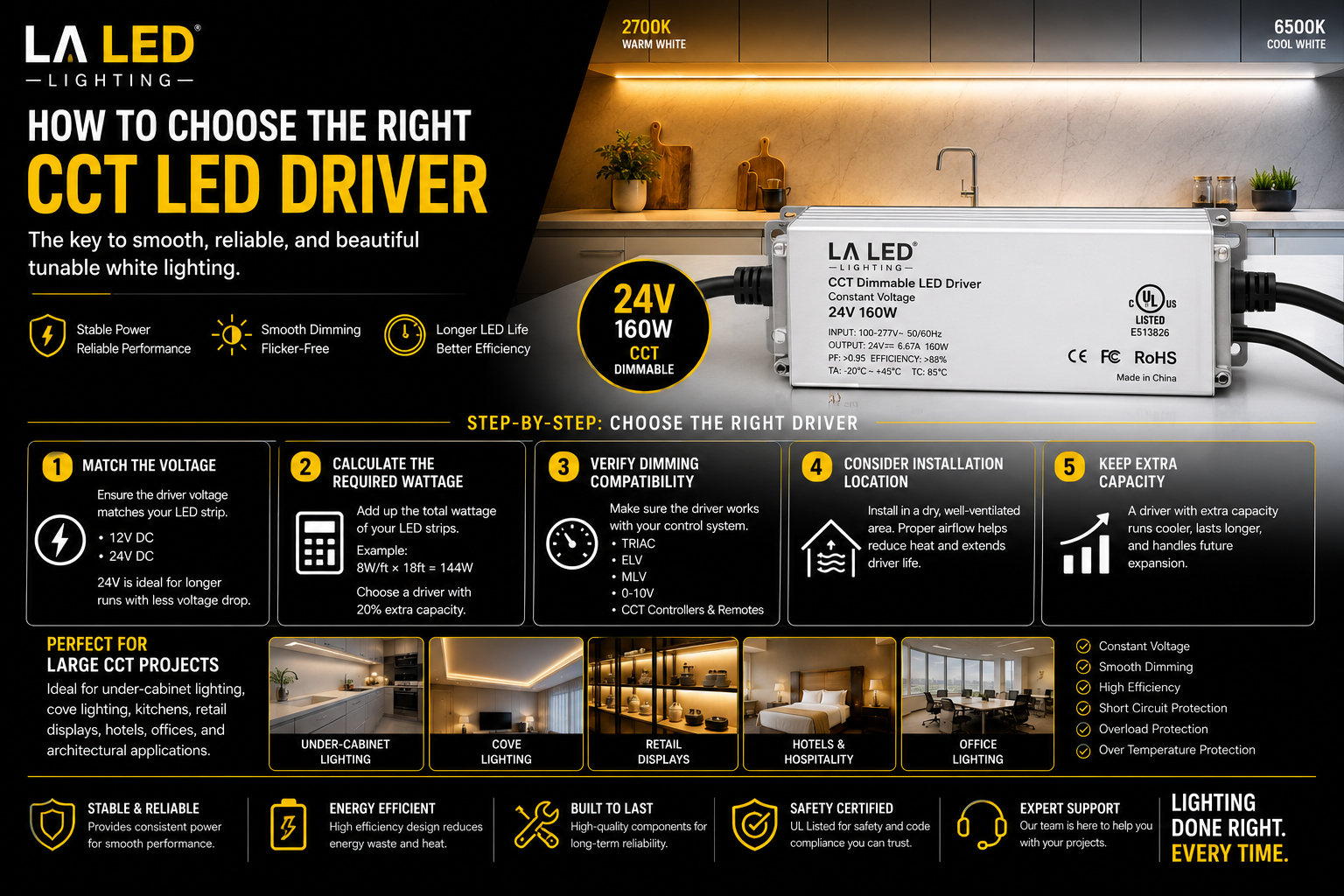
A beautiful tunable white LED lighting system starts with more than just high-quality LED strips. While the LED strip creates the light, the LED driver provides the stable power that allows the entire system to perform reliably. Choosing the wrong driver can lead to flickering, unstable brightness, poor dimming performance, or even premature failure.
Whether you're installing under-cabinet lighting, ceiling coves, display shelves, or architectural lighting, selecting the correct LED driver is one of the most important decisions you'll make.
What Is a CCT LED Driver?
A CCT (Correlated Color Temperature) LED driver converts your home's AC power into the low-voltage DC power required by tunable white LED strips.
Unlike a standard power supply, a dimmable LED driver is designed to provide stable output while allowing smooth adjustment of both brightness and white color temperature when paired with a compatible CCT controller and remote.
The driver serves as the power source that keeps your lighting system operating safely and consistently.
Why the Right Driver Matters
Many lighting issues are caused by using an undersized or incompatible driver.
A properly selected driver helps provide:
- Stable voltage output
- Smooth dimming performance
- Longer LED strip life
- Reduced flickering
- Improved energy efficiency
- Reliable operation during continuous use
Using the correct driver from the beginning helps avoid unnecessary maintenance and replacement costs.
Step 1: Match the Voltage
The first step is ensuring that the driver matches your LED strip voltage.
Most tunable white LED strips operate on either:
- 12V DC
- 24V DC
Never connect a 12V LED strip to a 24V driver or vice versa.
For many modern residential and commercial projects, 24V systems are preferred because they experience less voltage drop over longer runs and maintain more consistent brightness.
Step 2: Calculate the Required Wattage
Before selecting a driver, calculate the total power required by your LED strip.
For example:
- LED strip power: 8 watts per foot
- Total strip length: 18 feet
- Total load: 144 watts
Rather than choosing a 144W driver, it's recommended to leave additional capacity—typically around 20% headroom—to improve reliability and reduce heat buildup.
Choosing a driver with extra capacity can also make future system expansion easier.
Step 3: Verify Dimming Compatibility
Not all dimmable drivers work with every control method.
Depending on your lighting system, you may need compatibility with:
- TRIAC dimmers
- ELV dimmers
- MLV dimmers
- 0–10V dimmers
- Compatible CCT controllers and remotes
Matching the driver with the intended control method helps ensure smooth, flicker-free dimming.
Step 4: Consider Installation Location
Indoor drivers should be installed in dry, well-ventilated locations.
For kitchens, display cabinets, ceilings, and utility spaces, make sure there is adequate airflow around the driver to help manage operating temperatures and maximize service life.
A Great Solution for Larger CCT Installations
For larger tunable white lighting projects, a 24V 160W CCT Dimmable LED Driver provides dependable power for compatible LED strip systems.
This type of driver is well suited for applications such as:
- Under-cabinet lighting
- Cove lighting
- Kitchen renovations
- Retail displays
- Architectural lighting
- Hotel projects
- Office lighting
- Residential accent lighting
With 24V output, 160W capacity, and support for dimmable CCT lighting systems, it offers the power needed for longer LED strip runs while helping maintain smooth and consistent performance.
Common Installation Mistakes
Avoid these common errors when selecting an LED driver:
- Choosing the wrong voltage
- Selecting a driver with insufficient wattage
- Ignoring dimming compatibility
- Installing the driver in an enclosed space without ventilation
- Overloading the driver beyond its rated capacity
Planning these details before installation helps prevent performance issues later.
Where These Drivers Are Commonly Used
High-capacity dimmable drivers are popular in:
- Kitchen cabinet lighting
- Ceiling cove lighting
- Living rooms
- Bedrooms
- Home offices
- Retail stores
- Hotels
- Restaurants
- Reception areas
- Display cabinets
- Luxury residential projects
Their ability to provide stable power makes them suitable for both residential and commercial lighting systems.
Final Thoughts
The LED driver is one of the most important components in any tunable white lighting system. It provides the stable power needed for smooth dimming, reliable operation, and long-term performance.
By choosing the correct voltage, calculating the proper wattage, and ensuring compatibility with your dimming system, you can build a lighting installation that performs consistently for years.
For larger 24V tunable white LED strip projects, a 160W CCT Dimmable LED Driver offers the power, stability, and flexibility needed to support modern residential and commercial lighting applications.
FAQ
What does a CCT LED driver do?
A CCT LED driver converts household AC power into low-voltage DC power for tunable white LED strips, providing stable power for reliable operation.
Why is a 24V driver often preferred?
A 24V system typically experiences less voltage drop on longer LED strip runs, helping maintain more consistent brightness.
How much wattage should my LED driver have?
Calculate the total wattage of your LED strips and choose a driver with additional capacity—commonly around 20%—to improve reliability.
Can I use any dimmer with a dimmable LED driver?
No. The driver and dimming method must be compatible. Always verify compatibility before installation.
Where are 160W CCT LED drivers commonly used?
They are ideal for larger under-cabinet installations, cove lighting, architectural lighting, retail displays, offices, hotels, restaurants, and residential lighting projects.