
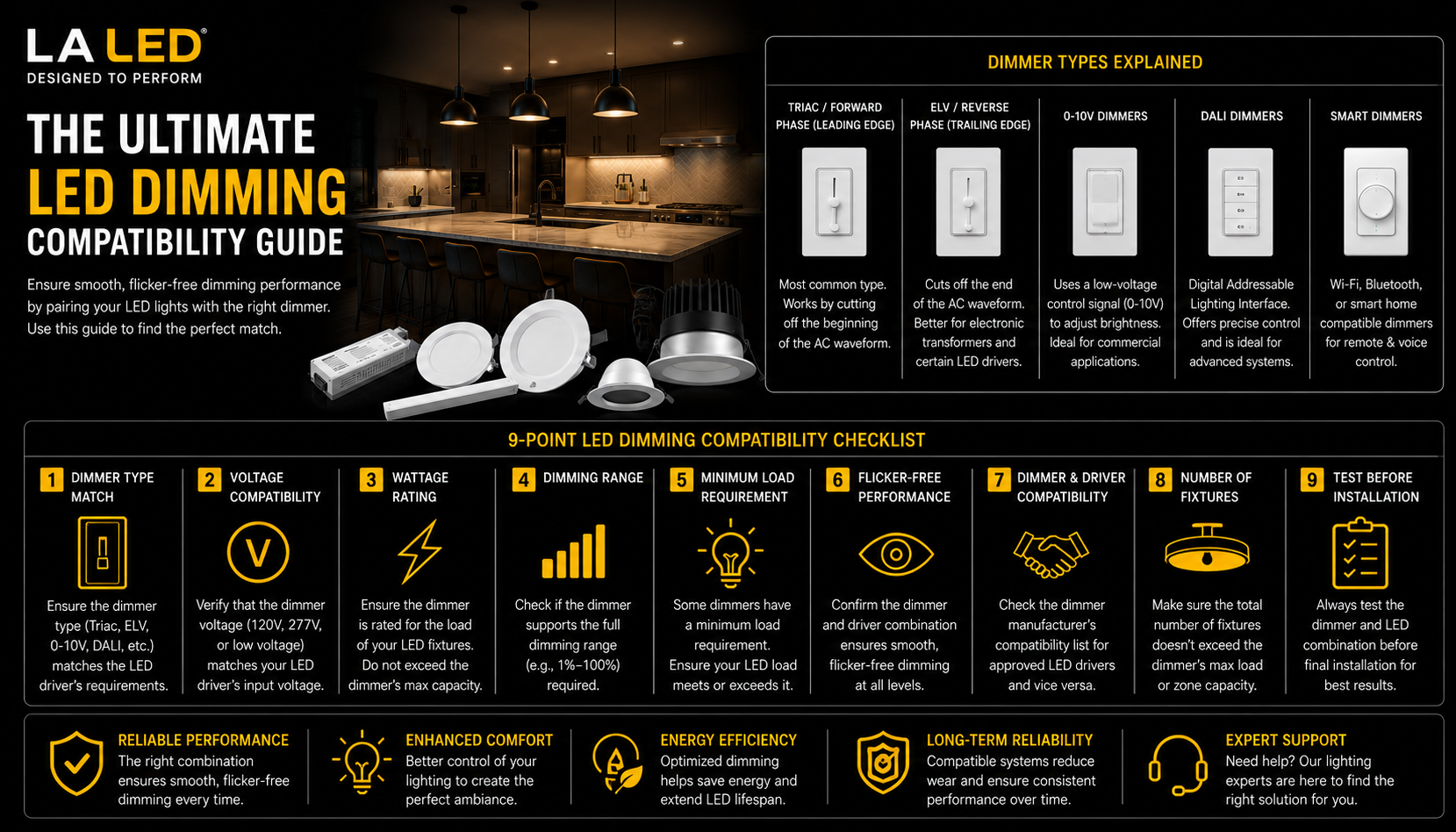
LED Dimming Compatibility Guide
A dimmer that worked perfectly with incandescent bulbs can create flickering, buzzing, or poor performance when paired with LEDs. That's why understanding LED dimming compatibility is essential. The goal is simple: make sure the dimmer, driver, and fixture work together before installation.
Whether you're upgrading a home, designing a commercial space, or installing LED strip lighting, compatibility determines whether the system delivers smooth dimming or becomes a troubleshooting headache.
Why LED Dimming Compatibility Matters
Most LED dimming problems are not caused by defective fixtures. They happen when the dimmer, driver, and lighting load are not designed to work together.
Unlike incandescent lamps, LEDs rely on electronic drivers to regulate power. The dimmer and driver must communicate correctly for the system to dim smoothly and consistently.
When they don't, common problems include:
- Flickering
- Buzzing or humming
- Sudden dropouts
- Limited dimming range
- Dead travel on the dimmer
- Lights that won't reach full brightness
In residential, commercial, and architectural projects, these issues can quickly turn into expensive callbacks.
Common LED Dimming Methods
Understanding the most common dimming protocols helps prevent compatibility problems.
TRIAC (Forward Phase)
TRIAC dimming remains one of the most common options for residential lighting.
Many LED drivers are designed to work with TRIAC dimmers, making them a practical choice for retrofits where existing wall controls are already installed.
However, performance depends heavily on the driver and load. Some TRIAC systems may struggle with low-wattage LED loads, resulting in uneven low-end dimming or flicker.
ELV (Reverse Phase)
ELV dimming is often preferred for modern electronic LED drivers.
Compared to TRIAC, ELV typically offers:
- Smoother low-end dimming
- Reduced flicker
- Less audible noise
- Better performance with electronic loads
For premium residential and architectural lighting, ELV is often the preferred solution when supported by the driver.
MLV (Magnetic Low Voltage)
MLV dimming is designed for magnetic transformers and older low-voltage systems.
While less common in modern LED installations, it still appears in some retrofit applications. MLV dimmers should only be used when the lighting system specifically requires them.
0-10V Dimming
0-10V dimming is widely used in commercial buildings, offices, retail spaces, and larger residential projects.
Instead of modifying line voltage, a separate low-voltage control signal tells the driver how bright the LEDs should operate.
Benefits include:
- Stable dimming performance
- Consistent control across multiple fixtures
- Easy integration with lighting control systems
- Ideal for larger installations
The main requirement is dedicated low-voltage control wiring.
Start With the Driver, Not the Dimmer
One of the most common mistakes is choosing a dimmer first.
A better approach is to start with the driver specifications.
If the driver is:
- TRIAC dimmable → Use a compatible TRIAC dimmer
- ELV dimmable → Use an ELV dimmer
- 0-10V → Design the system around 0-10V controls
The driver determines how the lighting system accepts dimming commands. Choosing the dimmer afterward helps avoid compatibility issues.
Load Size Matters
LEDs consume far less power than traditional incandescent lighting, which can create problems for older dimmers.
A dimmer originally designed for hundreds of watts of incandescent load may not perform well with a 20W or 30W LED circuit.
Before installation, verify:
- Minimum load requirements
- Maximum load capacity
- LED compatibility ratings
- Approved fixture or driver compatibility lists
This simple step can eliminate many common dimming problems.
LED Strip Light Dimming Considerations
LED strip lighting introduces additional components that affect compatibility.
In most systems, you must match:
- LED strip voltage
- Driver output
- Dimming method
- Controller requirements
Single-color strips typically rely on the driver to determine dimming compatibility.
RGB, RGBW, tunable white, and pixel-controlled systems often use dedicated controllers instead of traditional wall dimmers. In these applications, the controller becomes a critical part of the dimming system.
A premium COB strip light paired with the wrong driver or controller will never deliver premium performance.
Application-Specific Considerations
Recessed Downlights
Most residential downlights include integrated dimmable drivers.
Always verify compatibility between the fixture manufacturer and the selected dimmer. Two fixtures labeled "dimmable" may perform very differently on the same control.
LED Tape and Strip Lighting
For tape lighting, dimming performance depends heavily on the driver.
If wall dimming is required, choose a compatible dimmable driver from the beginning rather than trying to add dimming later.
Commercial and Office Lighting
In commercial environments, 0-10V is often the preferred choice because it supports larger fixture groups, scene controls, occupancy sensors, and daylight harvesting systems.
Proper planning during the design phase is essential.
Common Dimming Problems and Their Causes
| Problem | Common Cause |
|---|---|
| Flickering | Driver and dimmer incompatibility |
| Buzzing or humming | Incorrect dimming protocol |
| Lights shut off at low levels | Poor low-end dimming performance |
| Limited dimming range | Driver or dimmer mismatch |
| Lights won't reach full brightness | Load or compatibility issue |
| Uneven performance between fixtures | Mixed fixture or driver types |
What to Check Before You Buy
Before purchasing dimmable LED components, confirm:
- Driver dimming method
- Dimmer compatibility
- Input voltage requirements
- Load capacity
- Fixture compatibility
- Indoor, damp, or wet location rating
- Controller requirements for RGB, RGBW, or tunable white systems
Verifying these details upfront prevents most dimming-related problems.
Final Thoughts
Good LED dimming is about more than making the lights respond. It is about achieving smooth, quiet, and predictable control across the entire dimming range.
The best results come from treating the dimmer, driver, and fixture as one integrated system. When all three are matched correctly, the lighting performs consistently, avoids flicker and buzzing, and delivers the polished finish that modern residential and commercial projects demand.
Whether you're installing recessed lighting, LED tape lights, architectural accents, or commercial fixtures, proper dimming compatibility is one of the most important decisions you'll make.