
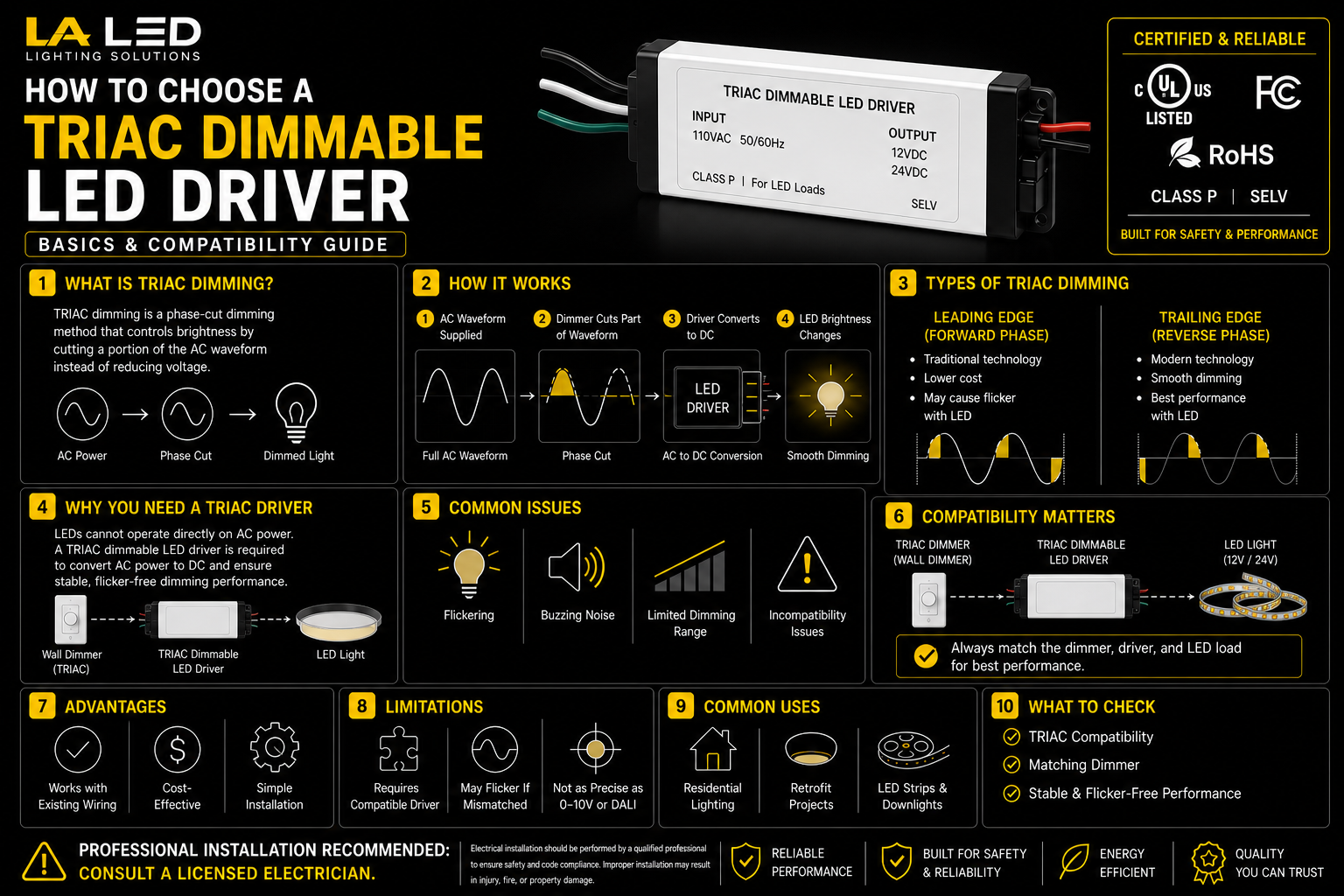
TRIAC Dimmable LED Driver: What You Need to Know
A dimmer that worked perfectly with incandescent bulbs can become a problem when LED strip lights or downlights are added to the project. Flickering, buzzing, poor low-end dimming, and lights that drop out are often caused by a mismatch between the dimmer, driver, and LED load.
That is where a TRIAC dimmable LED driver matters. It acts as the bridge between a traditional wall dimmer and low-voltage LED lighting that needs stable, regulated power.
What Is a TRIAC Dimmable LED Driver?
A TRIAC dimmable LED driver is designed to work with phase-cut wall dimmers. It receives the dimmed AC signal from the wall control, converts it into low-voltage DC power, and adjusts the LED output accordingly.
In simple terms, it allows compatible LED lighting to dim from a standard wall dimmer while still receiving the regulated power LEDs require.
TRIAC dimmable drivers are commonly used for:
- LED strip lights
- COB tape lights
- Under-cabinet lighting
- Cove lighting
- Toe-kick lighting
- Architectural accents
- Some LED downlight systems
Why LEDs Need a Compatible Driver
Incandescent bulbs dim naturally when voltage is reduced. LEDs do not work the same way.
LEDs require a driver to regulate power. If the driver is not designed to interpret the TRIAC dimming signal correctly, the system may experience:
- Flickering
- Buzzing
- Dead travel on the dimmer
- Poor low-end dimming
- Lights that will not turn fully off
- Early driver or LED failure
A dimmable LED system only works properly when the dimmer, driver, and load are compatible.
When TRIAC Dimming Makes Sense
TRIAC dimming is often a strong choice for residential remodels and retrofit projects because many homes already have standard wall dimmers installed.
It is useful when you want:
- Familiar wall-dimming control
- Simple retrofit installation
- No extra low-voltage control wiring
- Compatibility with common residential dimmers
- Clean control for low-voltage LED lighting
This makes TRIAC dimmable drivers popular for kitchens, bedrooms, living rooms, millwork lighting, and under-cabinet installations.
How to Choose the Right TRIAC Dimmable LED Driver
Start with the LED load.
Match the Voltage
Most LED strip lighting systems use:
- 12V DC
- 24V DC
A 24V strip requires a 24V driver. A 12V strip requires a 12V driver.
Voltage must match exactly.
Calculate Total Wattage
Add the wattage of every LED strip or fixture connected to the driver.
For strip lights:
Watts per foot × Total feet = Total load
Then add approximately 20% headroom so the driver does not operate at maximum capacity all the time.
Confirm Dimmer Compatibility
Not every wall dimmer works well with every TRIAC dimmable driver.
Before installation, verify that the dimmer is LED-rated and compatible with the driver. This is especially important for low-wattage LED loads, where older dimmers may perform poorly.
Check Location Rating
Choose a driver rated for the environment.
Consider:
- Dry locations
- Damp locations
- Wet locations
- Cabinet installations
- Outdoor or landscape applications
For wet-location products, remember: wet location does not mean suitable for submersion unless specifically rated for that use.
Why Flicker and Buzzing Happen
Most TRIAC dimming problems are caused by compatibility issues.
Common causes include:
- Wrong dimmer type
- Low-quality driver
- Load below dimmer minimum
- Overloaded driver
- Poor wiring connections
- Voltage drop on long runs
If the lights flicker only at low levels, the dimmer-driver-load combination may not be stable across the full dimming range.
TRIAC vs ELV vs 0-10V
TRIAC is not the only dimming option.
TRIAC
Best for residential retrofits and standard wall-dimming applications.
ELV
Often smoother and quieter for many electronic LED drivers, especially in premium residential projects.
0-10V
Common in commercial, office, and larger architectural lighting systems where consistent control across multiple fixtures is needed.
TRIAC is often the simplest choice when existing wall dimmers are already part of the project. However, ELV or 0-10V may be better for advanced control or ultra-smooth dimming requirements.
Best Applications for TRIAC Dimmable Drivers
TRIAC dimmable LED drivers work well in many residential and light commercial applications, including:
- Kitchen under-cabinet lighting
- Cove lighting
- Toe-kick lighting
- Floating shelves
- Display lighting
- Bedroom accent lighting
- Living room architectural details
- Low-voltage LED tape installations
The key is selecting a driver that matches the LED load and dimmer.
Installation Tips
For best performance:
- Match voltage exactly
- Size the driver with headroom
- Use an LED-compatible dimmer
- Avoid loading the driver to 100%
- Use proper wire gauge
- Keep the driver accessible
- Provide ventilation
- Test the full dimming range before closing walls or cabinetry
These details help prevent flicker, noise, and early failure.
When TRIAC Is Not the Best Choice
TRIAC may not be ideal when the project requires:
- Ultra-deep theatrical dimming
- Advanced scene control
- Large commercial zoning
- Tunable white control
- RGB or RGBW control systems
- 0-10V building automation integration
In those cases, ELV, 0-10V, or a dedicated controller may be a better fit.
Final Thoughts
A TRIAC dimmable LED driver is a practical solution when you want low-voltage LED lighting to work with familiar wall dimmers. It is especially useful for residential remodels, under-cabinet lighting, cove lighting, and architectural accent projects.
The best results come from matching the driver to the strip or fixture, confirming dimmer compatibility, sizing the load correctly, and choosing the proper rating for the installation environment.
When the dimmer, driver, and LED load are properly matched, TRIAC dimming can deliver smooth, quiet, and reliable performance without unnecessary complexity.