
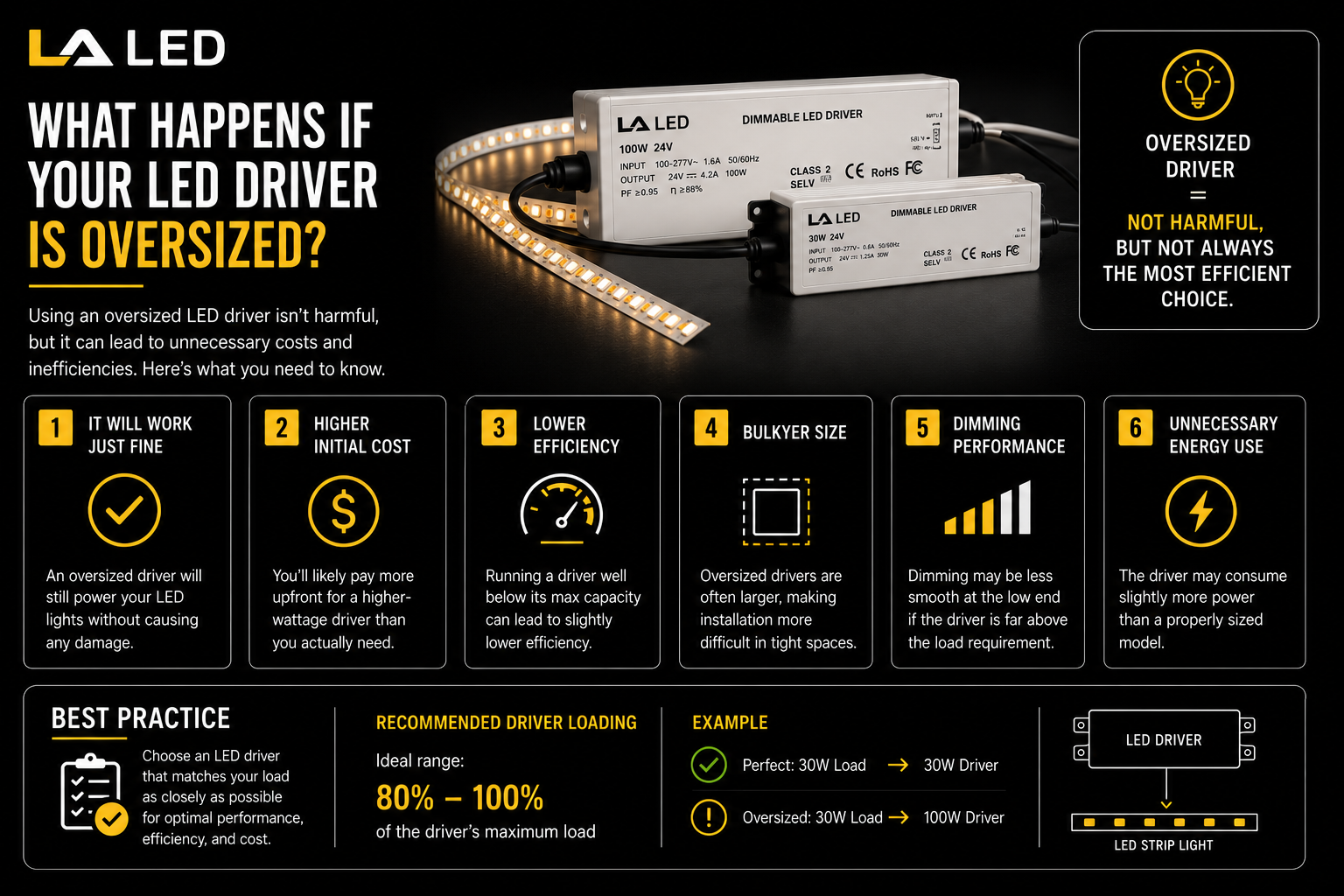
What Happens If Your LED Driver Is Oversized?
One of the most common questions when planning an LED lighting project is whether an oversized LED driver will cause problems. After calculating the wattage of your LED strip lights or fixtures, you may discover that the driver you have available provides significantly more power than the load requires.
Fortunately, an oversized LED driver is usually not harmful when selected correctly. In fact, many professional lighting installations intentionally include extra driver capacity to improve reliability and long-term performance.
The key is understanding the difference between driver capacity and actual power consumption.
Does an Oversized LED Driver Damage LEDs?
In most cases, no.
LEDs only draw the power they need from the driver. The driver does not force its maximum wattage into the lighting system.
For example:
-
LED load: 60 watts
-
Driver capacity: 100 watts
-
Driver voltage: 24V
The LED strip will still consume approximately 60 watts. The additional 40 watts simply remain available as unused capacity.
This is why driver wattage is considered capacity rather than output demand.
Why Oversized Drivers Are Often Recommended
Professional installers rarely size a driver at exactly 100% of the connected load.
Adding extra capacity provides several benefits:
-
Lower operating temperatures
-
Improved reliability
-
Longer driver lifespan
-
Better performance in enclosed spaces
-
Room for future expansion
For example, if a COB LED strip installation requires 80 watts, many installers would choose a 96W or 120W driver rather than an 80W driver operating at maximum capacity. A 100W 5-in-1 Dimmable LED Driver covers that load with about 20 watts of reserve.
This additional headroom helps reduce stress on internal components and can improve long-term performance.
Voltage Matters More Than Wattage
The most important specification is not wattage—it's voltage.
A driver must match the LED system voltage exactly.
Common LED strip voltages include:
-
12V DC
-
24V DC
Examples:
✓ 24V LED strip + 24V driver = Correct
✗ 24V LED strip + 12V driver = Poor performance
✗ 12V LED strip + 24V driver = Potential damage
Even the perfect wattage rating cannot compensate for incorrect voltage.
Constant Voltage vs Constant Current
Another critical factor is driver type.
Constant Voltage Drivers
Commonly used for:
-
COB LED strips
-
LED tape lights
-
RGB strips
-
RGBW strips
-
Under-cabinet lighting
-
Cove lighting
Most operate at:
-
12V DC
-
24V DC
A constant-voltage product such as the Indoor Dotless Dimmable COB LED Strip (10mm, 24V) is a typical example of this category, drawing a fixed wattage per foot from a 24V driver.
Constant Current Drivers
Commonly used for:
-
Recessed downlights
-
LED modules
-
Commercial fixtures
-
Architectural luminaires
Typical outputs include:
-
350mA
-
700mA
-
1050mA
Oversizing the wrong driver type can create flickering, poor performance, overheating, or premature failure.
When an Oversized LED Driver Can Cause Problems
Although extra wattage is usually beneficial, there are situations where an oversized driver can create issues.
Minimum Load Requirements
Some dimmable drivers require a minimum connected load to operate correctly.
If the load is too small, you may experience:
-
Flickering
-
Dimming instability
-
Buzzing
-
Dropout at low light levels
-
Inconsistent startup
This is most common with certain:
-
TRIAC dimmers
-
ELV dimmers
-
MLV dimmers
Always review the manufacturer's minimum load specifications.
Physical Size Limitations
Higher-wattage drivers are often physically larger.
This can create installation challenges in:
-
Cabinets
-
Millwork
-
Ceiling cavities
-
Junction box installations
-
Compact architectural applications
Where space is tight, a smaller unit such as the 60W Compact Dimmable LED Transformer (24V) is often the better choice than a larger driver that will not fit the cavity.
Always verify both electrical and physical compatibility before purchasing.
Oversized Driver vs Undersized Driver
If given the choice, slightly oversized is generally safer than undersized.
Undersized Drivers May Cause:
-
Overheating
-
Flickering
-
Reduced brightness
-
Driver shutdown
-
Premature failure
Properly Oversized Drivers May Provide:
-
Better reliability
-
Cooler operation
-
Longer lifespan
-
Expansion flexibility
However, there is little benefit in dramatically oversizing a system.
For example:
-
20W load on a 30W driver = Reasonable
-
20W load on a 300W driver = Usually unnecessary
How Much Extra Capacity Should You Allow?
A common guideline is approximately 20% to 30% spare capacity.
Examples:
| LED Load | Recommended Driver |
|---|---|
| 60W | 75W–100W |
| 80W | 96W–120W |
| 100W | 120W–150W |
For a 100W load at the top of that table, a 150W 5-in-1 Dimmable LED Driver sits in the recommended range while leaving room for a future section of strip.
This helps improve efficiency and reduce stress on the driver.
Always follow manufacturer recommendations when available.
Dimming Systems Require Extra Attention
Dimming introduces additional considerations.
An oversized driver that works perfectly in a non-dimming installation may behave differently when connected to a dimming system.
Common dimming methods include:
-
TRIAC
-
ELV
-
MLV
-
0-10V
For commercial and architectural applications, 0-10V dimming often delivers smooth and reliable performance across a wide load range. A driver that accepts all of these methods, such as the 200W 5-in-1 Dimmable LED Driver, avoids the minimum-load and protocol mismatches described above. You can also browse the full range of 0-10V dimmable LED drivers.
These drivers are ideal for:
-
LED strip lighting
-
Commercial lighting
-
Recessed lighting systems
-
Office lighting
-
Hospitality projects
How to Size an LED Driver Correctly
To select the right driver:
Step 1: Calculate Total Load
Add the wattage of all connected LED strips or fixtures.
Step 2: Verify Voltage
Match the driver voltage exactly to the LED product.
Step 3: Confirm Driver Type
Determine whether the application requires:
-
Constant voltage
-
Constant current
Step 4: Check Dimming Requirements
Verify compatibility with:
-
TRIAC
-
ELV
-
MLV
-
0-10V
-
Smart controls
Step 5: Add Capacity Buffer
Choose a driver with sufficient reserve capacity above the calculated load.
Final Thoughts
An oversized LED driver is usually not a problem when voltage, driver type, and dimming compatibility are matched correctly. The LEDs will only draw the power they require, while the extra capacity can improve reliability and help reduce thermal stress.
The biggest mistakes occur when installers focus only on wattage while ignoring voltage, driver type, dimming compatibility, or environmental requirements.
For the best results, size the driver according to the actual load, allow reasonable headroom, and ensure every component in the system is designed to work together. A properly matched LED driver will provide smoother dimming, longer service life, and more dependable performance for years to come.