
What Happens If Your LED Driver Is Too Small?
An LED lighting system is only as reliable as the driver powering it. While many installers focus on selecting the right LED strips or fixtures, choosing the correct driver is just as important. If the driver is undersized, the entire system can suffer from poor performance, instability, and shortened lifespan.
So, what happens if your LED driver is too small?
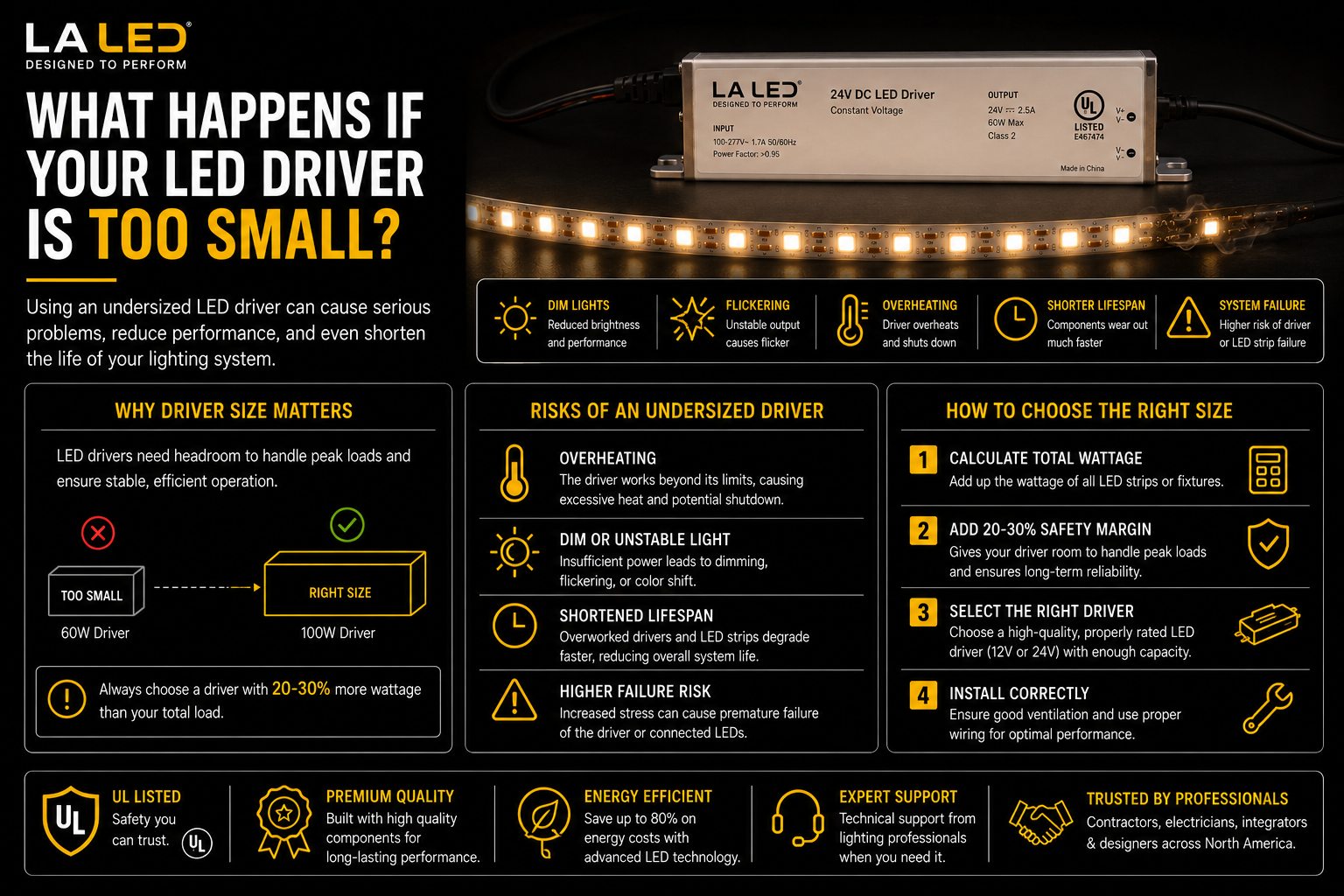
In most cases, the driver cannot supply enough power to meet the demands of the connected lighting load. The result can be flickering, dim output, overheating, unexpected shutdowns, and premature driver failure.
Whether you're installing COB LED strips, under-cabinet lighting, recessed downlights, landscape lighting, or commercial lighting systems, proper driver sizing is essential for dependable performance.
What Happens When an LED Driver Is Undersized?
An undersized driver is forced to operate at or beyond its maximum capacity.
When this happens, the driver may:
-
Overheat
-
Reduce output
-
Enter overload protection mode
-
Cycle on and off
-
Fail prematurely
Quality drivers often include protection circuits that prevent catastrophic failure. However, even when protection systems work correctly, the lighting system will not perform as intended.
Common Signs Your LED Driver Is Too Small
Flickering Lights
One of the first warning signs is flickering.
The lights may:
-
Flicker continuously
-
Flicker only at full brightness
-
Flicker after warming up
-
Flicker when dimmed
As the driver struggles to supply enough power, output stability decreases.
Dim Output
An undersized driver may not provide enough power for the LEDs to reach full brightness.
This is especially noticeable with:
-
High-output COB strips
-
Long LED strip runs
-
Multi-channel RGBW systems
-
Commercial lighting installations
Driver Overheating
All drivers generate some heat during operation.
However, excessive heat often indicates the driver is working too hard.
Overheating can lead to:
-
Reduced efficiency
-
Shorter lifespan
-
Thermal shutdown
-
Component failure
Lights Turning On and Off
Some drivers include overload protection.
When overloaded, the driver may:
-
Turn on
-
Detect excessive load
-
Shut down
-
Cool off
-
Restart
This cycle can repeat continuously until the load is reduced or the driver is replaced. Where reducing the load is not an option, stepping up to a unit such as the 100W 5-in-1 Dimmable LED Driver gives the system roughly 80W of comfortable working capacity instead of running at the edge.
Why the Lights Sometimes Appear to Work
One reason driver sizing mistakes are often overlooked is that the lights may initially appear to function normally.
For example:
-
A quick test may look successful
-
Lower dimming levels may operate correctly
-
Cooler ambient temperatures may mask the problem
Once the system reaches full output or operates for an extended period, problems begin to appear.
This is why bench testing alone should never be used to determine whether a driver is properly sized.
How an Undersized Driver Shortens System Life
Heat is one of the biggest enemies of electronic components.
When a driver constantly operates at maximum capacity:
-
Internal temperatures increase
-
Electronic components age faster
-
Efficiency decreases
-
Reliability suffers
Even if the driver never completely fails, its lifespan can be dramatically reduced.
In professional installations, this often results in costly service calls and unnecessary maintenance.
Dimming Systems Are Even More Sensitive
Undersized drivers often create additional issues in dimming applications.
Common symptoms include:
-
Flicker at low dim levels
-
Dead travel on dimmers
-
Buzzing
-
Inconsistent dimming curves
-
Poor color mixing
This can affect systems using:
-
TRIAC dimming
-
ELV dimming
-
MLV dimming
-
0-10V dimming
For commercial and architectural lighting projects requiring dependable dimming performance, properly matched drivers are critical. A driver that supports all four protocols with capacity to spare, such as the 200W 5-in-1 Dimmable LED Driver, addresses both the sizing and the compatibility side of these symptoms at once. You can also browse the full range of 0-10V dimmable LED drivers, which are commonly used for:
-
LED strip lighting
-
Recessed lighting systems
-
Commercial lighting
-
Office lighting
-
Hospitality projects
-
Architectural installations
How to Determine If Your Driver Is Too Small
Start by calculating the actual load.
For LED Strip Lights
Multiply:
Watts per foot × Total installed length
Example:
-
LED strip: 5W per foot
-
Length: 20 feet
Total load:
5W × 20 = 100W
A 100W driver may technically operate the load, but most professionals would select a larger driver to provide additional capacity.
Add Safety Margin
A common recommendation is to allow approximately 20% additional capacity.
For a 100W load:
-
Minimum recommended driver: 120W
The 150W 5-in-1 Dimmable LED Driver is the next size above that minimum, leaving about 120W of usable capacity for a 100W load.
This reserve helps improve:
-
Reliability
-
Thermal performance
-
Startup behavior
-
Long-term lifespan
Environmental Conditions Matter
Driver performance is affected by installation conditions.
Examples include:
-
Cabinet installations
-
Ceiling cavities
-
Outdoor enclosures
-
Damp locations
-
Wet locations (not for submersion)
Limited airflow can increase operating temperatures and place additional stress on the driver. For damp and outdoor enclosures specifically, a sealed unit such as the 96W Dimmable LED Transformer (24V, IP65) is designed for those conditions rather than relying on a protected box around an indoor driver.
This is another reason professional installers avoid sizing drivers at their absolute limit.
Slightly Undersized vs Severely Undersized
Not all sizing mistakes produce the same symptoms.
Slightly Undersized
May cause:
-
Occasional flicker
-
Excessive heat
-
Reduced lifespan
-
Dimming issues
Severely Undersized
May cause:
-
Continuous shutdowns
-
Failure to start
-
Significant brightness loss
-
Complete driver failure
The larger the mismatch, the more severe the symptoms become.
How to Choose the Right Driver
Before purchasing a driver, verify:
Voltage
Match the LED system voltage exactly.
Common options:
-
12V DC
-
24V DC
A selectable unit such as the 60W 5-in-1 Dimmable LED Driver (12V / 24V) covers either voltage on smaller runs, which removes one common ordering mistake.
Driver Type
Confirm whether the product requires:
-
Constant voltage
-
Constant current
Total Wattage
Calculate the complete connected load.
Dimming Compatibility
Verify support for:
-
TRIAC
-
ELV
-
MLV
-
0-10V
Installation Environment
Choose a driver rated for:
-
Dry locations
-
Damp locations
-
Wet locations when required
Final Thoughts
An LED driver that is too small can create a wide range of problems, including flickering, dim output, overheating, poor dimming performance, and shortened equipment life.
The good news is that these issues are often preventable. By calculating the actual load, selecting the correct voltage and driver type, and allowing additional capacity for reliability, you can build an LED lighting system that performs consistently for years to come.
For homeowners, contractors, and lighting professionals, proper driver sizing is one of the simplest ways to reduce callbacks, improve dimming performance, and protect the overall investment in the lighting system.