
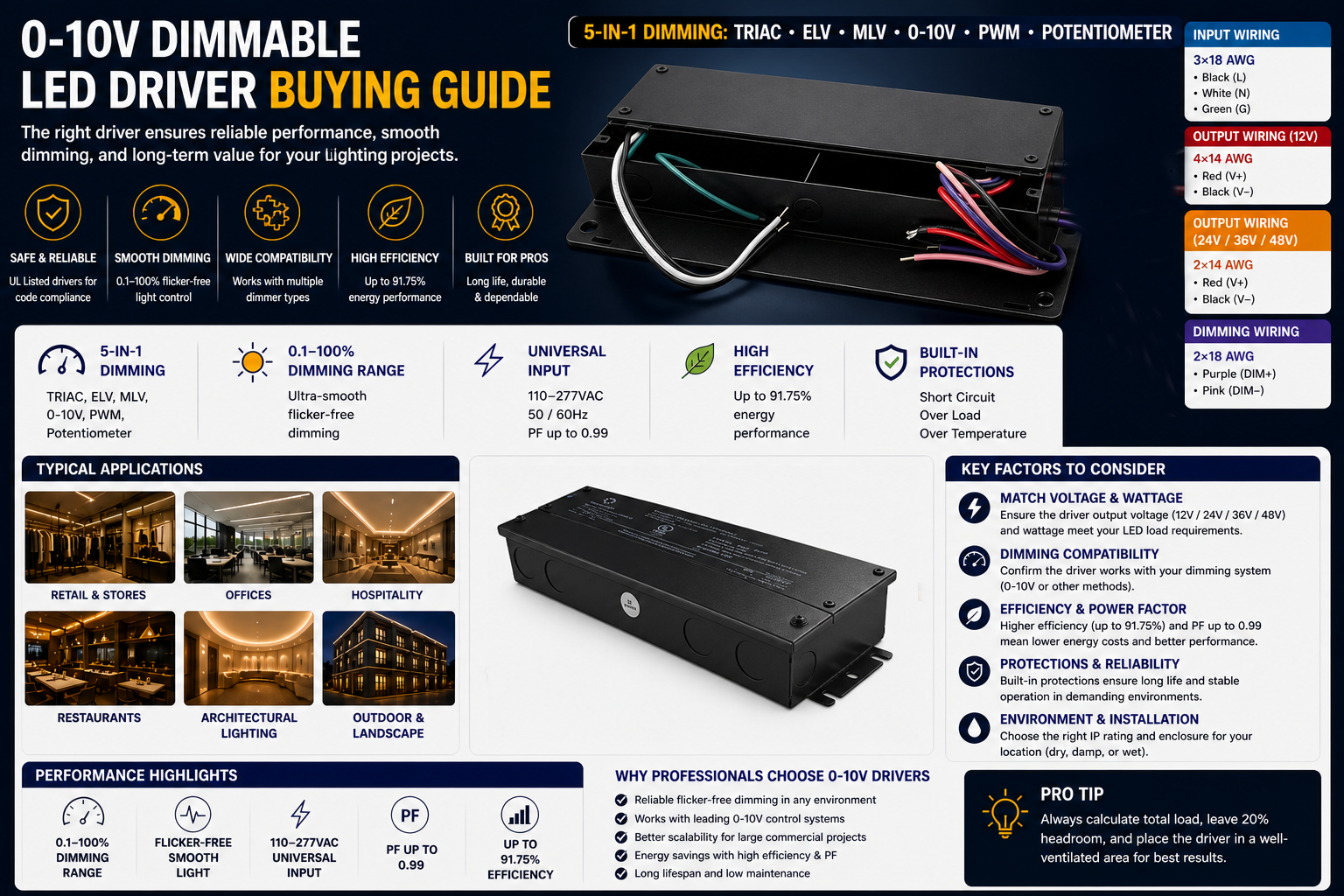
0-10V Dimmable LED Driver: What You Need to Know
A lighting system can look premium and still perform poorly if the dimming components aren't matched correctly. Flickering, uneven dimming, buzzing, or lights that refuse to respond often trace back to one overlooked component: the driver.
If your project calls for a 0-10V dimmable LED driver, choosing the right one is critical. The driver not only powers the LEDs but also determines how smoothly the system responds to dimming controls.
For contractors, electricians, designers, and homeowners, 0-10V dimming remains one of the most dependable solutions for commercial spaces, architectural lighting, custom homes, and large-scale LED installations.
What Is a 0-10V Dimmable LED Driver?
A 0-10V dimmable LED driver powers an LED fixture while responding to a low-voltage control signal from a dimmer, control panel, or automation system.
The driver interprets a signal ranging from 0 to 10 volts:
- 10V = Full brightness
- Lower voltage = Reduced light output
- 0V = Minimum output or off, depending on the driver design
Unlike phase-cut dimming methods such as TRIAC or ELV, 0-10V uses a dedicated control signal rather than modifying the incoming AC power waveform. This often results in smoother, more predictable dimming performance.
Why 0-10V Dimming Is Popular
The biggest advantage of 0-10V dimming is consistency.
When properly designed, a 0-10V system offers:
- Smooth dimming across a wide range
- Stable low-end performance
- Reduced flicker
- Better scalability for multiple fixtures
- Easy integration with lighting control systems
These benefits make 0-10V a popular choice for:
- Office buildings
- Conference rooms
- Retail spaces
- Restaurants
- Hospitality environments
- Custom homes
- Architectural lighting projects
For larger installations, a single control signal can manage multiple compatible drivers, simplifying lighting control across an entire space.
How to Choose the Right 0-10V Dimmable LED Driver
Start With the LED Load
Before selecting a driver, determine whether the lighting system requires constant voltage or constant current power.
Most LED strip lights and tape lights use:
- 12V DC constant voltage
- 24V DC constant voltage
Many LED fixtures and modules use:
- Constant current drivers
- Specific current outputs such as 350mA, 700mA, or 1050mA
The driver must match the requirements of the LED load exactly.
Size the Driver Correctly
Once voltage and output type are confirmed, calculate total wattage.
Add up the wattage of all connected fixtures or strip lighting and allow approximately 20% headroom.
For example:
- Total LED load: 80W
- Recommended driver size: 100W–120W
This extra capacity helps reduce operating temperatures and supports long-term reliability.
Verify Input Voltage
Many commercial-grade drivers offer universal input voltage, but it's still important to confirm compatibility with the electrical service available on site.
Common input voltages include:
- 120V
- 277V
- Universal voltage models
Always verify the driver matches the building's power supply requirements.
Compatibility Matters
One of the most common installation mistakes is assuming all dimmers and drivers labeled "0-10V" will work together seamlessly.
Successful dimming depends on:
- Compatible control devices
- Proper driver selection
- Correct wiring
- Suitable LED load characteristics
Low-end dimming performance can vary significantly between products. Some drivers dim smoothly to 10%, while others achieve much deeper dimming ranges.
For premium residential and architectural projects, this difference is often noticeable.
Best Applications for 0-10V Dimmable LED Drivers
Commercial Lighting
0-10V dimming has become a standard in commercial environments because it provides reliable control across multiple fixtures and zones.
Common applications include:
- Offices
- Retail stores
- Schools
- Healthcare facilities
- Hospitality spaces
Architectural LED Strip Lighting
Large cove lighting systems, indirect ceiling details, and custom millwork installations benefit from the smooth dimming and scalability of 0-10V control.
For long runs of tape lighting, 0-10V often delivers more consistent results than traditional phase-cut dimming.
Custom Residential Projects
Luxury homes increasingly use 0-10V dimming for:
- Layered lighting designs
- Recessed lighting zones
- Architectural accents
- Cove lighting
- Feature walls
- Large open-concept spaces
When multiple lighting layers need coordinated control, 0-10V offers excellent flexibility.
Indoor, Damp, and Outdoor Applications
Environmental conditions should influence driver selection.
Choose drivers rated appropriately for:
- Dry locations
- Damp locations
- Wet locations
Outdoor installations, soffits, landscape lighting, and exterior architectural details require suitable enclosures and environmental protection.
The driver rating should always match the installation environment.
Common Installation Issues
Even a quality driver can perform poorly if the installation is not planned correctly.
Common problems include:
Undersized Drivers
Operating too close to maximum capacity can reduce performance and shorten lifespan.
Voltage Drop
Long low-voltage wire runs can cause uneven brightness that may be mistaken for dimming problems.
Wiring Errors
Incorrect 0-10V control wiring, poor terminations, or polarity issues can create erratic dimming behavior.
Mixed Loads
Combining fixtures with different dimming characteristics on the same control zone may produce inconsistent results.
What to Look for Beyond the Specs
Not all drivers are built to the same standard.
For professional installations, look for:
- UL certification
- Compliance with US electrical standards
- Thermal protection
- Quiet operation
- Reliable dimming performance
- Appropriate environmental ratings
Driver size also matters. Compact drivers can simplify installations in cabinetry, millwork, and tight remodel conditions, while larger enclosed units may be better suited for serviceability and environmental protection.
Is 0-10V the Right Choice?
0-10V dimming is not always the simplest retrofit solution. In some residential applications, TRIAC or ELV dimming may be easier because the control wiring already exists.
However, when the goal is:
- Smooth dimming
- Stable low-end performance
- Multi-fixture control
- Commercial-grade reliability
- Future scalability
0-10V is often one of the best options available.
Final Thoughts
A 0-10V dimmable LED driver does far more than power a lighting system. It plays a major role in dimming quality, control consistency, and long-term reliability.
Choosing the right driver means matching the LED load, sizing the wattage correctly, confirming control compatibility, and selecting a unit rated for the installation environment.
When those pieces are aligned, 0-10V dimming delivers the smooth, professional performance that architects, contractors, and homeowners expect from a modern lighting system.