
COB vs SMD LED Strip Lights: Which One Should You Choose?
When comparing COB vs SMD LED strip lights, the best choice is not simply the newest or most popular option. The right strip depends on how the lighting will be used, how visible the strip will be, and what level of finish the project requires.
For kitchens, coves, millwork, retail displays, offices, and architectural details, this choice affects both appearance and performance. A strip that looks fine hidden under a cabinet may not look refined enough inside a shallow ceiling reveal or custom display shelf.
What Is a COB LED Strip?
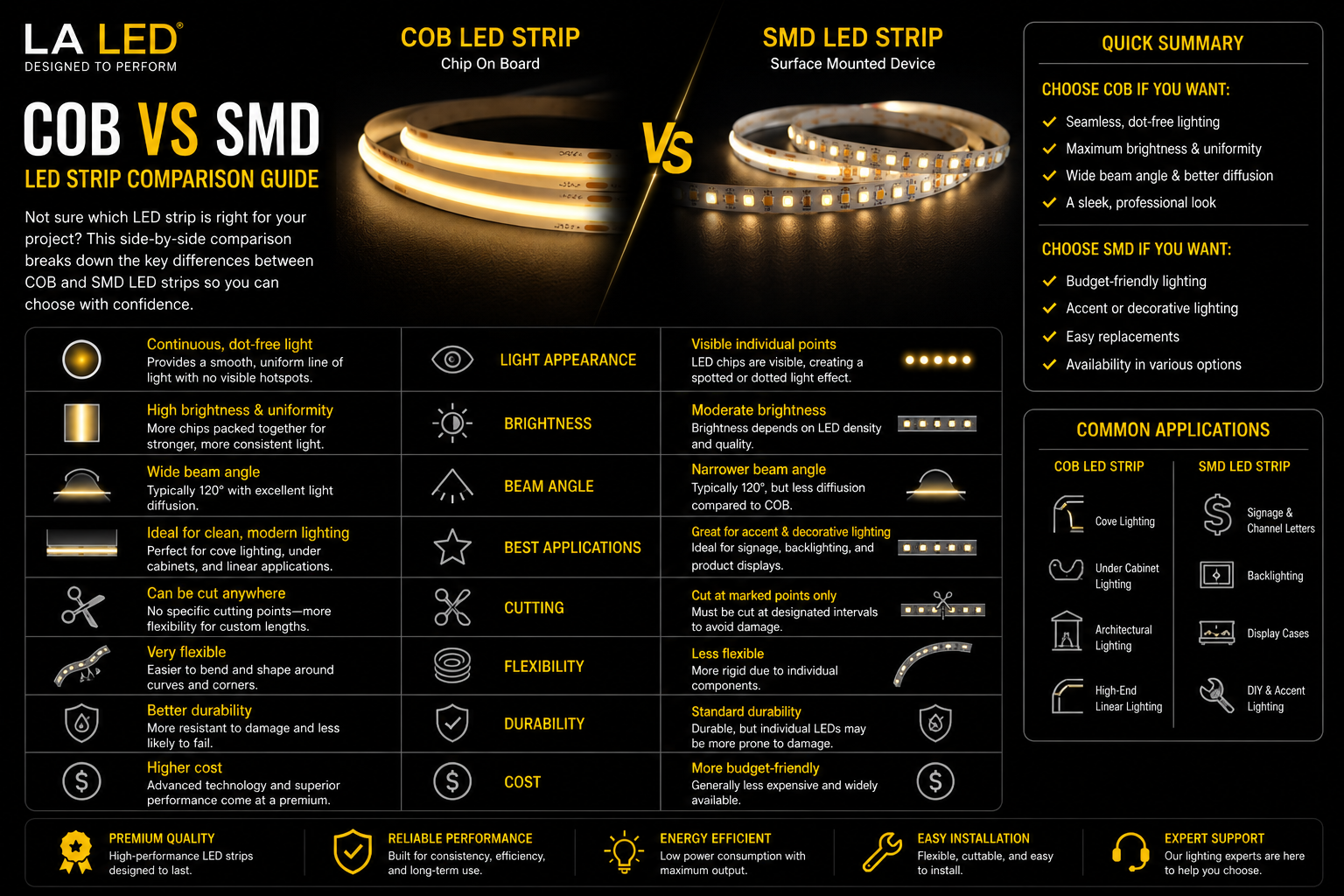
COB stands for Chip on Board. In a COB strip, many small LED chips are placed close together and covered with a phosphor layer. This creates a smooth, continuous line of light with fewer visible dots.
COB strips are popular for applications where the light source may be visible or reflected on surfaces such as:
- Stone countertops
- Glossy tile
- Glass shelves
- Lacquered cabinets
- Polished metal finishes
The result is a cleaner, more architectural appearance.
What Is an SMD LED Strip?
SMD stands for Surface-Mounted Device. In an SMD strip, individual LED packages are spaced along the tape.
SMD LED strips have been widely used for many years and remain a practical choice for many projects. They are available in many brightness levels, colors, voltages, and control options.
SMD strips can work very well when the strip is hidden from direct view or installed inside a deeper aluminum channel with a diffuser.
COB vs SMD: Main Difference
The biggest difference is the appearance of the light.
COB strips produce a smoother, more dotless line of light.
SMD strips may show visible LED points, especially in shallow channels or direct-view applications.
If the strip will be visible, COB usually looks better. If the strip will be fully hidden, SMD may be enough.
Where COB Strip Lights Work Best
COB is usually the better choice when the lighting is part of the design.
Choose COB for:
- High-end kitchens
- Under-cabinet lighting
- Floating vanities
- Stair lighting
- Display shelving
- Cove lighting
- Millwork
- Modern architectural details
COB strips are especially useful when the installation requires a clean, continuous glow without visible diode spacing. For these applications the Indoor Dotless Dimmable COB LED Strip (10mm, 24V) is the standard choice, available in 2700K through 5000K and in 16.5ft or 82ft lengths. The full range of COB LED strip lights covers single color, CCT, and RGB versions.
Where SMD Strip Lights Still Make Sense
SMD is still a strong option when the strip is not directly visible.
Choose SMD for:
- Hidden accent lighting
- Utility lighting
- Backlighting
- Budget-focused projects
- Deep aluminum channels
- Applications where dotless output is not critical
SMD strips can also be a practical choice for large projects where cost control matters and the light source is fully concealed. A low-draw option such as the 12V 8mm SMD LED Strip (1.7W per foot) suits concealed accent and utility runs where the diodes will never be seen.
Brightness and Efficiency
COB is not automatically brighter than SMD.
Brightness depends on:
- Wattage per foot
- LED density
- Chip quality
- Strip design
- Driver selection
A high-output SMD strip can be brighter than a lower-output COB strip. The 24V 10mm SMD LED Strip at 7.7W per foot is a good example, drawing more than twice the power of many dotless COB strips. Always compare product specifications instead of assuming one format is brighter.
Efficiency also depends on the specific product, not only the LED type.
Dimming and Driver Compatibility
Both COB and SMD strips can dim well when paired with the correct driver and controls.
Before purchasing, confirm:
- Strip voltage
- Total wattage
- Driver capacity
- Dimming protocol
- Controller compatibility
Common dimming options include:
- TRIAC
- ELV
- MLV
- 0-10V
A driver that accepts all of these, such as the 100W 5-in-1 Dimmable LED Driver (12V / 24V), works with either strip type and either voltage. For larger commercial and architectural jobs, the 0-10V dimmable LED driver range offers smooth dimming across a wide load range.
Installation Considerations
Before choosing COB or SMD, check the installation details.
Important factors include:
- Strip width
- Cut points
- Channel depth
- Diffuser type
- Run length
- Voltage drop
- Connector compatibility
- Damp or wet-location rating if needed
That last point rules out most indoor tape. For covered patios, soffits, and other damp locations, use a rated product such as the Outdoor Dotless Dimmable COB LED Strip (10mm, 24V) rather than an indoor strip in a sealed channel.
A strip that performs well electrically may still be the wrong choice if it does not fit the channel or match the installation conditions.
Which One Should You Choose?
Choose COB if:
- The strip will be visible
- The light reflects on glossy surfaces
- The project needs a premium finish
- You want a smooth dotless line
- The installation uses shallow channels
Choose SMD if:
- The strip will be fully hidden
- Budget is a major factor
- A deep diffuser will hide the dots
- The project is more functional than decorative
Final Thoughts
Both COB and SMD LED strips have a place in modern lighting projects. COB is usually the better choice when the appearance of the light line matters. SMD remains a practical and cost-effective option when the strip is hidden or the project does not require a dotless finish.
The best choice depends on the application, finish level, channel depth, dimming requirements, and budget. Start with the way the lighting will be seen, then choose the strip, driver, and accessories that support that result.