
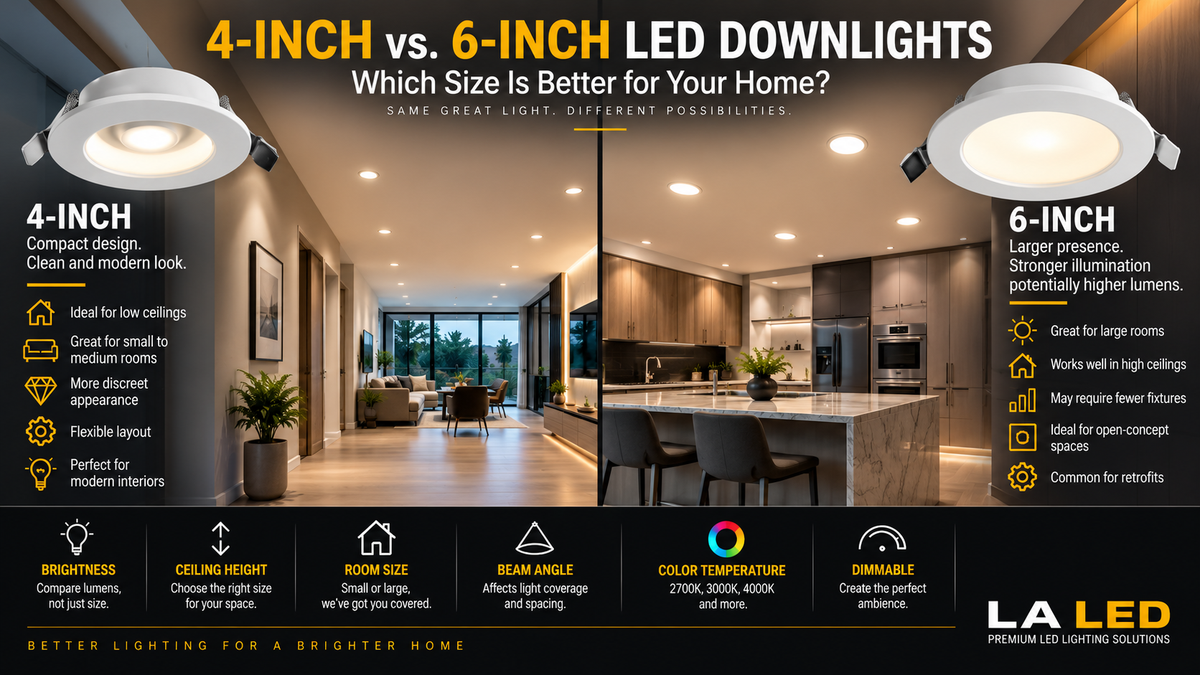
4-Inch vs. 6-Inch LED Downlights: Which Is Better?
Choosing LED downlights seems simple until you start comparing sizes.
Two of the most common options are:
4-inch LED downlights
and
6-inch LED downlights
Both can provide excellent general lighting, but they do not create exactly the same effect.
A 4-inch downlight often gives a cleaner, more compact ceiling appearance.
A 6-inch downlight typically provides a larger illuminated opening and may offer higher lumen output or a wider visual presence, depending on the fixture.
So which one is better?
There is no universal winner.
The right choice depends on:
- Ceiling height
- Room size
- Required brightness
- Fixture lumen output
- Beam angle
- Spacing
- Ceiling layout
- Interior style
- Glare control
- Whether the downlights are the main light source or part of layered lighting
Here is how to compare them.
What Does 4-Inch or 6-Inch Mean?
The measurement generally refers to the nominal size of the downlight or recessed-light opening.
A 4-inch downlight is more compact.
A 6-inch downlight has a noticeably larger face.
However, size alone does not determine brightness.
A well-designed 4-inch LED downlight can sometimes produce as much—or even more—light than a lower-output 6-inch fixture.
Always compare the actual specifications.
The most important number is usually:
Lumens
not simply fixture diameter.
Our full LED recessed downlight range lists wattage, lumens, beam angle, and CRI on every product page in 3-inch, 4-inch, and 6-inch sizes, so the sizes can be compared on the numbers rather than the diameter.
4-Inch LED Downlights
4-inch downlights are popular in modern residential interiors because they create a more refined and less visually dominant ceiling.
They work especially well in:
- Kitchens
- Bedrooms
- Hallways
- Bathrooms
- Home offices
- Smaller living rooms
- Low ceilings
- Modern minimalist interiors
Their smaller size can make the ceiling look cleaner when multiple fixtures are installed.
Our 4-Inch 5CCT Flat Panel Downlight (9W) is the canless version of this fixture, with selectable 2700K–5000K and CRI 90.
Advantages of 4-Inch Downlights
Cleaner Ceiling Appearance
Because the fixtures are smaller, they tend to blend into the ceiling more easily.
This can be especially attractive in:
- Modern interiors
- Minimalist homes
- Low ceilings
- Smaller rooms
Instead of seeing several large circles overhead, the lighting feels more integrated into the architecture.
More Flexible Layout
Smaller fixtures can make it easier to create a balanced layout around:
- Cabinets
- Beams
- Ceiling vents
- Fans
- Pendant lights
- Kitchen islands
They can also work well when you need more carefully positioned points of light.
Good Choice for Lower Ceilings
For rooms with lower ceilings, large fixtures can sometimes feel visually heavy.
A 4-inch downlight typically creates a more proportional appearance.
Better for Focused Placement
Depending on beam angle, a smaller downlight can be useful when you want to place light more precisely over:
- Countertops
- Hallways
- Artwork
- Work areas
- Bathroom vanities
When the light needs to be aimed rather than simply placed, the 4-Inch Multi-Direction Gimbal Downlight (9W) tilts up to 90°, which suits artwork, sloped ceilings, and wall-washing.
6-Inch LED Downlights
6-inch downlights have long been a popular residential lighting size.
Their larger opening gives them a stronger ceiling presence and, depending on the model, they may provide higher lumen output or broader coverage.
They are commonly used in:
- Large living rooms
- Kitchens
- Basements
- Family rooms
- Garages
- Large bedrooms
- Open-concept spaces
The 6-Inch Slim Flat Panel Downlight (12W) is the direct counterpart to the 4-inch model above—same canless construction and selectable 5CCT, in the larger aperture.
Advantages of 6-Inch Downlights
Potentially More Light per Fixture
Many 6-inch fixtures are available with higher lumen outputs than smaller fixtures.
That can mean fewer fixtures are needed to achieve the desired illumination.
But again, compare actual lumens, not diameter alone.
Wider Visual Coverage
A larger aperture can create a broader appearance of light across the ceiling and room.
This can work well in larger spaces.
Good for Large Rooms
In an expansive living room or open-plan area, a 6-inch fixture may look more proportional than a very small downlight.
Useful When Replacing Existing Fixtures
Many older homes already have 6-inch recessed housings.
In those situations, a 6-inch LED retrofit can often be a convenient upgrade without redesigning the entire ceiling.
Our 6-Inch 5CCT Retrofit Downlight (14W) is designed to fit standard 6″ can housings and is rated for wet locations.
4-Inch vs. 6-Inch: Quick Comparison
| Feature | 4-Inch Downlight | 6-Inch Downlight |
|---|---|---|
| Appearance | Smaller, more discreet | Larger, more noticeable |
| Best for | Small/medium rooms, modern layouts | Medium/large rooms |
| Low ceilings | Often excellent | Can work, but looks larger |
| Layout flexibility | High | Moderate |
| Potential light output | Moderate to high | Often moderate to high |
| Fixture count | May require more | May require fewer |
| Ceiling visual impact | Lower | Higher |
| Retrofit use | Depends on opening | Common for older 6" housings |
| Modern minimalist look | Excellent | Good |
| Large open spaces | Good | Often excellent |
Is a 6-Inch Downlight Brighter Than a 4-Inch?
Not necessarily.
This is one of the biggest misconceptions.
Fixture size and brightness are not the same thing.
For example:
4-inch fixture: 900 lumens
6-inch fixture: 850 lumens
In this example, the 4-inch fixture is actually brighter.
Another 6-inch model might produce 1,200 lumens.
Our own range shows this directly: the 4-Inch 5CCT Retrofit Downlight (10W) and the 6-Inch 5CCT Retrofit Downlight (14W) both deliver approximately 1,100 lumens. Same light output, two inches apart in aperture—the 4-inch simply does it at lower wattage.
So when comparing downlights, look at:
- Lumens
- Wattage
- Beam angle
- CRI
- Color temperature
- Dimming performance
Do not choose solely based on diameter.
Which Size Is Better for Low Ceilings?
In many cases, 4-inch downlights are a very good choice for low ceilings.
They can help the ceiling look less crowded and more refined.
Large 6-inch fixtures installed close together in a low ceiling can sometimes dominate the visual design.
That does not mean 6-inch fixtures are wrong.
If the room requires higher light output and the spacing is appropriate, 6-inch fixtures can still work well.
But for a modern low-ceiling room, 4-inch downlights often create a cleaner appearance.
Which Size Is Better for High Ceilings?
For higher ceilings, a 6-inch downlight can sometimes be advantageous because larger fixtures are often available with stronger lumen packages.
However, ceiling height alone should not determine fixture size.
For high ceilings, consider:
- Fixture lumen output
- Beam angle
- Ceiling height
- Desired illumination at floor level
- Spacing
- Whether adjustable fixtures are needed
A narrow-beam high-output 4-inch fixture may perform better than a wide low-output 6-inch fixture in some situations.
Photometric performance matters more than diameter.
Which Size Is Better for Kitchens?
Both can work.
4-Inch Downlights
Great for:
- Modern kitchens
- Lower ceilings
- More precise placement
- Cleaner ceiling designs
- Lighting between cabinets and islands
6-Inch Downlights
Useful for:
- Larger kitchens
- Open-concept areas
- Higher lumen requirements
- Existing recessed-light layouts
For kitchens, good lighting often comes from combining downlights with other sources.
For example:
Downlights → General Lighting
COB LED Strip → Under-Cabinet Task Lighting
Pendant Lights → Island Lighting
This layered approach usually produces a better result than relying on recessed lighting alone. For the task layer, our Indoor Dotless COB LED Strip (8mm) fits under standard upper cabinets and matches the 2700K–5000K range of the downlights above.
Which Size Is Better for Living Rooms?
For smaller or contemporary living rooms:
4-inch downlights often look more elegant.
For larger living rooms:
6-inch downlights may provide broader coverage and reduce the total number of fixtures needed.
But living rooms generally benefit from softer layered lighting.
Instead of covering the ceiling with downlights, consider combining:
- Downlights
- COB cove lighting
- Floor lamps
- Table lamps
- Wall lighting
- Accent lighting
This creates more depth and comfort. For the cove layer, the 10mm Indoor Dotless COB LED Strip gives a continuous line of light with no visible dots.
Which Size Is Better for Bedrooms?
4-inch fixtures are often a strong choice for bedrooms.
Why?
Because bedrooms usually do not require extremely high general light levels.
A smaller fixture can provide sufficient illumination while maintaining a calmer ceiling appearance.
Pair them with:
- 2700K or 3000K color temperature
- Dimming
- Bedside lighting
- Headboard COB lighting
- Cove lighting
This provides much more flexibility than using bright overhead lighting alone.
The 4-Inch 5CCT Downlight with Night Light (9W) is worth considering here—the integrated soft night mode covers low-level nighttime movement without switching on the main fixture. For a headboard accent, the 1800K Golden Yellow COB Strip sits far warmer than any downlight can go.
Which Size Is Better for Bathrooms?
Both sizes can work.
4-inch downlights are especially useful when the ceiling is small or when fixtures need to fit around:
- Exhaust fans
- Shower areas
- Vanity lighting
- Ceiling obstacles
A 6-inch fixture may be useful in larger bathrooms where broader general illumination is desired.
Always use fixtures appropriately rated for the installation location, especially in damp or wet areas. Where the ceiling is genuinely crowded, our 3-Inch White Trim Recessed Light (6W) fits gaps a 4-inch fixture cannot, and the wet-rated 6-Inch 14W Retrofit suits larger bathrooms.
How Many 4-Inch Downlights Do You Need?
There is no reliable rule that says every 4-inch fixture must be spaced a specific number of feet apart.
The correct quantity depends on:
- Lumens per fixture
- Beam angle
- Ceiling height
- Room dimensions
- Wall colors
- Furniture
- Task requirements
- Other light sources
A lower-output fixture will usually require more units than a higher-output fixture.
How Many 6-Inch Downlights Do You Need?
The same principle applies.
A 6-inch fixture is not automatically designed to cover a certain number of square feet.
Two different 6-inch downlights can have very different:
- Lumens
- Beam distributions
- Wattages
- Optics
Use actual fixture specifications when planning the layout.
For larger or important projects, a lighting plan or photometric calculation can provide a much better result than using a generic spacing formula.
Should 4-Inch Downlights Be Spaced Closer Together?
Often, but not always.
If 4-inch fixtures have lower lumen output or narrower beam angles, they may need closer spacing to create even general illumination.
But a high-output wide-beam 4-inch fixture may allow wider spacing.
The same applies to 6-inch fixtures.
Better Rule
Don't calculate spacing from fixture diameter alone.
Calculate it from:
Beam Angle + Ceiling Height + Lumens + Room Requirements
What About Beam Angle?
Beam angle is extremely important.
Two downlights of the same size can create completely different lighting patterns.
Narrow Beam
Produces more concentrated light.
Useful for:
- Accent lighting
- Higher ceilings
- Artwork
- Focused areas
Wide Beam
Spreads light across a larger area.
Useful for:
- General room illumination
- Lower ceilings
- Open spaces
For residential general lighting, a wider and softer distribution often creates better uniformity.
Does a Bigger Downlight Mean a Wider Beam?
Not necessarily.
The physical size of the fixture and the beam angle are separate specifications.
A 4-inch fixture might have a:
90° beam
while a 6-inch fixture might have a:
60° beam
In that case, the smaller fixture could actually distribute light across a wider area.
Our range shows the same pattern. The 3-Inch Black Trim Recessed Light—the smallest fixture we carry—has the widest beam at 120°, while the 4-Inch 5CCT Retrofit is tighter at roughly 95°.
Always check the product's beam specifications.
What About Glare?
Glare is especially important with recessed lighting.
Too many bright downlights can create:
- Harsh ceilings
- Eye discomfort
- Strong reflections
- Excessive contrast
A smaller fixture does not automatically mean less glare.
Look at:
- Recessed light source depth
- Trim design
- Diffuser
- Beam angle
- Fixture brightness
- Placement
Dimming can also significantly improve comfort.
4-Inch vs. 6-Inch for a Modern Look
If aesthetics are the priority, 4-inch downlights often have an advantage.
Modern lighting design generally favors:
- Smaller fixtures
- Cleaner ceilings
- Fewer visual distractions
- Layered illumination
For a sophisticated residential interior, you may choose:
4-inch downlights
plus
COB LED strip lighting
instead of filling the ceiling with large recessed fixtures.
This lets the downlights provide functional illumination while hidden COB lighting creates ambient light.
Should You Mix 4-Inch and 6-Inch Downlights?
You can, but do it intentionally.
For example:
4-inch fixtures → General ceiling lighting
6-inch adjustable fixture → Special architectural area
might work.
However, randomly mixing sizes throughout one ceiling can make the layout look inconsistent.
For most residential spaces, keeping one primary downlight size within the same visual area creates a cleaner appearance.
Can You Replace 6-Inch Downlights with 4-Inch Downlights?
Potentially, but it is not always a simple fixture swap.
If your ceiling already has a 6-inch opening, installing a smaller 4-inch fixture may require:
- Ceiling repair
- Adapter plates
- Different housings
- New placement
If the goal is simply upgrading older recessed lighting to LED, a compatible 6-inch retrofit may be easier.
If you are doing a full renovation, changing to smaller fixtures may make more sense. We carry retrofits in both apertures—the 4-inch 10W for standard 4″ cans and the 6-inch 14W for standard 6″ cans.
What About Slim LED Downlights?
Slim downlights have become popular because they require less ceiling depth than traditional recessed housings.
They can be useful when space above the ceiling is limited.
Both 4-inch and 6-inch slim options are available.
Slim fixtures can work especially well in:
- Basements
- Renovations
- Low ceilings
- Locations with limited plenum space
But installation must still follow the fixture manufacturer's requirements and applicable electrical codes.
Our canless slim panels—the 4-inch 9W and 6-inch 12W—have an integrated driver and low-profile aluminum housing, so no separate recessed can is required.
Color Temperature Matters Too
Fixture size is only one part of choosing downlights.
Color temperature significantly affects how the room feels.
2700K
Warm and relaxing.
Good for:
- Bedrooms
- Living rooms
- Dining areas
3000K
Warm but slightly cleaner.
Excellent for many residential spaces.
4000K
More neutral and crisp.
Often used in:
- Kitchens
- Bathrooms
- Utility spaces
Many modern downlights include selectable CCT options, giving you more flexibility during installation. Our 4-inch and 6-inch flat panels are 5CCT selectable across 2700K, 3000K, 3500K, 4000K and 5000K, so the color temperature is chosen on site rather than at the point of order.
Don't Forget CRI
CRI describes how accurately colors appear under the light.
For residential interiors, CRI 90+ is often a good target when color quality matters.
High-quality lighting can improve how you perceive:
- Skin tones
- Food
- Wood
- Furniture
- Flooring
- Artwork
- Paint colors
A high-quality 4-inch fixture can therefore produce a better visual result than a poor-quality 6-inch fixture, even if both provide similar brightness.
Every fixture in our recessed downlight range is CRI 90 with a glare-free lens, in every aperture from 3-inch to 6-inch.
Should You Choose Downlights by Wattage?
Not primarily.
LED technology makes wattage less useful as a direct measure of brightness.
Instead, prioritize:
Lumens
Wattage tells you how much electrical power the fixture consumes.
Lumens tell you approximately how much visible light it produces.
For example:
9W fixture → 750 lumens
and
12W fixture → 1,000 lumens
The higher-wattage fixture may produce more light, but efficiency varies between products.
Our own figures follow that pattern closely: the 4-inch 9W produces roughly 700 lumens and the 6-inch 12W roughly 950.
Example: Small Bedroom
Imagine a bedroom with:
8-foot ceiling
A compact room
Warm interior finishes
In this situation, several carefully spaced 4-inch dimmable downlights may create a cleaner appearance than larger fixtures.
Pair them with:
2700K–3000K lighting
and optional COB strip accent lighting.
The result can feel much softer and more modern.
Example: Large Open-Concept Living Room
Now imagine:
A large living/dining area
Higher ceiling
Wide open layout
Here, 6-inch downlights with sufficient lumen output may reduce the number of fixtures required.
Alternatively, higher-output 4-inch downlights may also work.
The correct choice depends on the specific fixture performance and layout.
Example: Kitchen Remodel
For a modern kitchen, you might choose:
4-inch downlights → General illumination
COB strips → Under cabinets
Pendant fixtures → Island
This layered combination provides:
- General light
- Task light
- Decorative light
without overloading the ceiling with recessed fixtures.
In practice that is the 4-Inch 5CCT Flat Panel set to 3000K or 4000K overhead, with the 8mm Indoor COB Strip handling the counters.
When 4-Inch Downlights Are Usually the Better Choice
Consider 4-inch fixtures when:
- You want a modern minimalist look
- The ceiling is relatively low
- The room is small or medium-sized
- You need precise fixture placement
- You want the fixtures to be less noticeable
- You're combining downlights with other lighting layers
When 6-Inch Downlights Are Usually the Better Choice
Consider 6-inch fixtures when:
- The room is large
- You want potentially higher output per fixture
- You prefer broader visual coverage
- You're replacing existing 6-inch recessed lights
- You want to reduce the number of fixtures
- The larger size fits the proportions of the room
Common Mistake: Choosing Size Before Brightness
One of the biggest mistakes is deciding:
“I'll use 6-inch because they're brighter.”
or:
“I'll use 4-inch because they're modern.”
before checking the actual specifications.
Instead, compare:
Lumens
Beam Angle
CRI
CCT
Dimming
Fixture Depth
Spacing
Room Size
Then choose the diameter that works best aesthetically and physically.
Common Mistake: Installing Too Many Downlights
More downlights do not automatically create better lighting.
Too many can make a ceiling look like a grid and create uncomfortable brightness.
A better approach is often:
Fewer well-positioned downlights
Task Lighting
Indirect COB Lighting
Decorative Fixtures
Layered lighting creates depth and makes a home feel much more intentional.
Final Verdict: 4-Inch or 6-Inch?
Neither size is universally better.
Choose 4-Inch When You Want:
- Smaller fixtures
- Modern aesthetics
- Greater layout flexibility
- A cleaner low-ceiling appearance
- More precise lighting placement
Choose 6-Inch When You Want:
- Larger fixture presence
- Potentially higher lumen output
- Broad general lighting
- Fewer fixtures in large spaces
- Easy replacement of existing 6-inch recessed lights
For many modern residential projects, 4-inch downlights offer an excellent balance between performance and appearance.
But for large rooms or existing 6-inch installations, a quality 6-inch downlight can be the more practical choice.
The best decision comes from evaluating the fixture's actual performance—not just its diameter. Compare the full LED recessed downlight range side by side on lumens, beam angle, and CRI.
FAQ
Are 6-inch LED downlights brighter than 4-inch downlights?
Not necessarily. Brightness depends on lumen output, not fixture diameter. Always compare the specifications of the actual fixtures.
Are 4-inch downlights better for low ceilings?
Often yes. Their smaller size tends to look cleaner and less dominant on lower ceilings.
Do I need more 4-inch downlights than 6-inch downlights?
Possibly, but not always. The number required depends on lumen output, beam angle, ceiling height, spacing, and room requirements.
Which size looks more modern?
4-inch downlights are often preferred in modern and minimalist interiors because their smaller profile creates a cleaner ceiling appearance.
Can I replace a 6-inch downlight with a 4-inch one?
Potentially, but the existing ceiling opening may need modification or an adapter. In some renovations, staying with a compatible 6-inch retrofit is easier.
Which is better for a kitchen: 4-inch or 6-inch?
Both can work. 4-inch fixtures provide flexible placement and a modern appearance, while 6-inch fixtures can be useful in larger kitchens requiring broader general illumination.
What color temperature is best for LED downlights?
2700K and 3000K are popular for residential interiors, while 4000K can work well in kitchens, bathrooms, or utility spaces depending on the desired appearance.
Should LED downlights be dimmable?
Dimmable downlights are highly useful in residential spaces because they allow you to adjust brightness for different activities and times of day. Make sure the fixture and dimmer are compatible.