
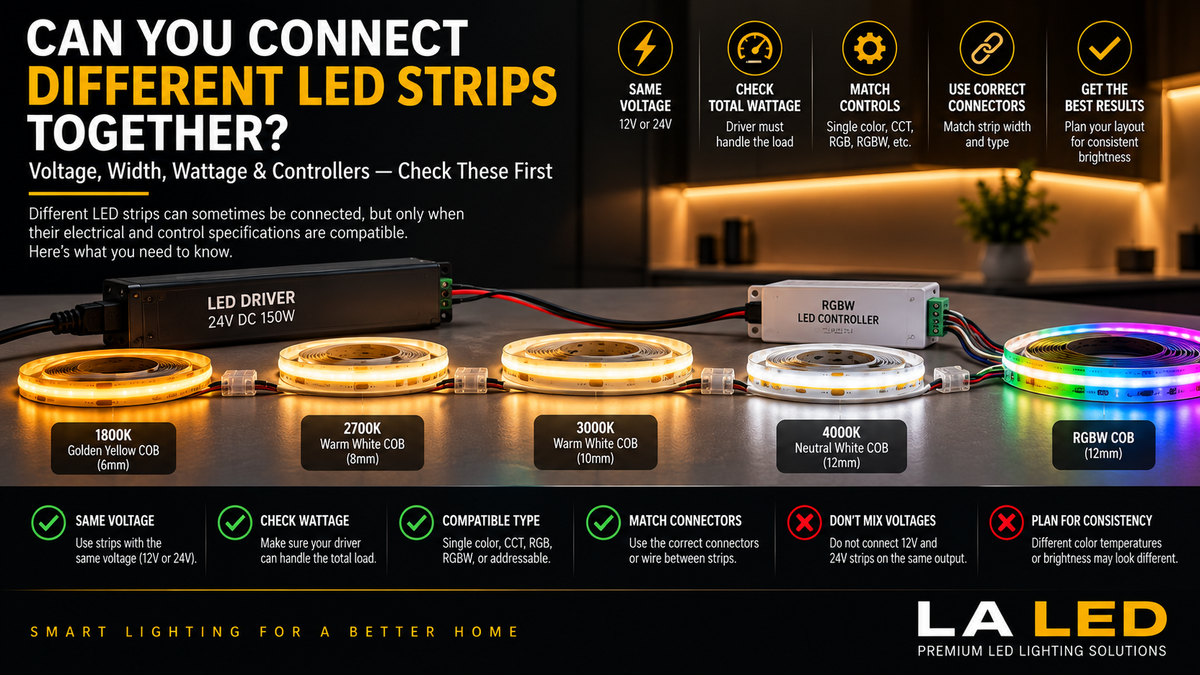
You already have an LED strip installed, but you need to extend it.
Or maybe you want to combine two different types of strips in the same project.
This raises a common question:
Can you connect different LED strips together?
Sometimes, yes.
But simply because two LED strips look similar—or even fit into the same connector—doesn't mean they're electrically compatible.
Before connecting different LED strips, you need to consider:
- Voltage
- Wattage
- Current
- Strip type
- Number of channels
- Color temperature
- Width
- Connector type
- Controller compatibility
- Driver capacity
- Maximum run length
Connecting incompatible strips can result in poor performance, incorrect colors, overheating, damaged components, or complete failure.
Here's what you need to know before mixing LED strips.
First: What Does “Different LED Strips” Mean?
Two strips can be different in many ways.
For example:
12V COB + 24V COB
3000K COB + 4000K COB
6mm COB + 10mm COB
Single-Color COB + CCT COB
RGB + RGBW
Different wattages
Different LED densities
Different manufacturers
Each combination presents different compatibility questions.
So instead of asking only:
“Can these strips connect?”
ask:
“Are these strips electrically and functionally compatible?”
That's the more important question.
1. Voltage Must Be Compatible
This is the first specification you should check.
Common low-voltage LED strips include:
12V DC
and
24V DC
A 12V LED strip should be operated from an appropriate 12V supply.
A 24V LED strip should be operated from an appropriate 24V supply.
You should not directly connect a 12V strip and a 24V strip as one continuous electrical load on the same fixed-voltage output.
For example:
24V Driver → 24V Strip → 12V Strip
is not an appropriate configuration.
Supplying 24V directly to a 12V strip can damage it.
Likewise, supplying only 12V to a 24V strip will not provide its intended operating conditions.
Basic Rule
12V → 12V
24V → 24V
Always verify the voltage printed on the strip or listed in the product specifications.
If a project involves both voltages, each needs its own supply. A selectable unit such as the 60W 5-in-1 Dimmable LED Driver (12V / 24V) can be set to either output, so one part number covers both systems—but each driver still feeds only one voltage at a time.
2. Can Different Wattage LED Strips Be Connected?
Potentially, if their other electrical requirements are compatible.
For example, imagine two 24V COB strips:
Strip A: 3W/ft
Strip B: 5W/ft
The fact that they have different wattages doesn't automatically mean they can't be part of the same system.
But the driver must be sized for the combined load.
For example:
10 ft × 3W = 30W
10 ft × 5W = 50W
Total:
80W
Your power supply needs sufficient capacity for the complete installation.
A commonly used design approach is to leave additional driver capacity rather than operating continuously at the absolute maximum rating, while always following the driver's manufacturer specifications. For the 80W combined load above, a 100W 5-in-1 Dimmable LED Driver is the minimum sensible size, and a 150W unit leaves room to extend later.
3. Can Different Color Temperatures Be Connected?
Electrically, two single-color strips with the same voltage and compatible electrical characteristics may potentially operate from the same power source even if their color temperatures differ.
For example:
24V 2700K COB
and
24V 3000K COB
could potentially be used within the same appropriately designed installation.
But visually, there's an important issue.
The transition from 2700K to 3000K may be noticeable.
An even bigger difference would occur between:
2700K → 5000K
So while the electrical system may work, the lighting may look inconsistent.
For one continuous visible line of light, using the same color temperature and matching product usually produces a cleaner result. Our Indoor Dotless COB LED Strip (8mm) is offered in 2700K, 3000K, 4000K and 5000K within a single product line, so ordering everything from one model keeps binning and construction consistent across the run.
4. Can You Connect Different COB Strips Together?
Potentially—but COB alone doesn't determine compatibility.
Two products can both be COB LED strips and still have completely different specifications.
Check:
- Voltage
- Wattage
- PCB width
- Polarity
- Cut intervals
- Number of conductors
- Color temperature
- Control method
- Maximum run length
For example, a 6mm 24V COB strip and a 12mm 24V COB strip may share the same nominal voltage but require different connectors and may have different wattage or current requirements.
So:
Same technology ≠ Same electrical design.
5. Can 6mm, 8mm, 10mm, and 12mm COB Strips Be Connected?
Width by itself doesn't determine electrical compatibility.
The width refers to the overall width of the flexible PCB.
A 6mm strip and 10mm strip could theoretically share compatible voltage and electrical characteristics.
But physically connecting them directly may be difficult because a connector designed for one PCB width may not fit the other.
For example:
6mm Strip → 10mm Connector
may simply not fit correctly.
If different-width strips need to be part of one installation, appropriate wiring between sections may sometimes be preferable to trying to force them into the same strip-to-strip connector.
Never force an LED strip into an incompatible connector.
Our own COB range spans several widths—the 6.5mm Ultra Slim, 8mm, and 10mm single-color strips, plus the 12mm RGBW—so it is worth confirming the width before ordering a second roll to extend an existing run.
6. Can You Connect COB and SMD LED Strips Together?
Potentially, from an electrical perspective, if the specifications are compatible.
COB and SMD describe how the LEDs are arranged and packaged; they don't automatically determine operating voltage.
For example, you could encounter:
24V COB strip
and
24V SMD strip
But before using them within the same system, you would still need to check:
- Wattage
- Current
- Polarity
- Number of channels
- Driver capacity
- Controller requirements
Visually, however, the two strips may look very different.
COB typically produces a much more continuous line of illumination, while conventional SMD strips can show more distinct points of light. The difference is easy to see by comparing our 10mm Dotless COB Strip with the equivalent 24V 10mm SMD Strip—both 24V, but very different in appearance.
For a continuous architectural installation, mixing the two may create an obvious visual transition.
For LA LED installations where a smooth linear appearance is desired, COB is generally the cleaner choice.
7. Can Single-Color and CCT Strips Be Connected Together?
Not as though they're simply identical strips.
A basic single-color strip usually has one lighting channel.
A CCT—or tunable-white—strip uses multiple channels so that different white color temperatures can be mixed or controlled.
This means the wiring and control requirements are different.
For example:
Single Color: typically one controllable light channel
CCT: warm-white + cool-white channels
A CCT controller needs to manage those channels correctly.
So even if both strips operate at 24V, that doesn't mean you should directly connect them as one continuous controlled strip.
They may need separate circuits or appropriate controllers.
Our CCT COB LED Strip (24V, 10mm, 2700K–6500K) pairs with a tunable-white control system such as the 24V 100W CCT LED Driver with Built-in Dimmer, which handles both channels from one unit.
8. Can RGB and RGBW LED Strips Be Connected Together?
Generally, they shouldn't be treated as interchangeable.
RGB typically uses:
Red + Green + Blue
RGBW adds a dedicated:
White
channel.
That means RGBW requires additional electrical connections and a compatible controller.
An RGB controller isn't automatically capable of controlling RGBW correctly.
Likewise, connectors may have different numbers of pins.
For example:
RGB → commonly 4 connections
RGBW → commonly 5 connections
depending on the strip design.
Always match the controller to the strip type. Our RGB COB Strip (10mm) and RGBW COB Strip (12mm) are different widths as well as different channel counts, and the RGBW version needs a 4-channel controller such as the MiBoxer FUT038S. The MiBoxer WL5 5-in-1 Controller covers single color, CCT, RGB, RGBW and RGB+CCT if you expect to run more than one strip type.
9. What About Addressable IC RGB Strips?
Addressable LED strips add another level of complexity.
Unlike basic RGB strips, addressable products may include integrated control ICs that allow individual LEDs or groups of LEDs to be controlled.
Compatibility can depend on:
- Voltage
- Data protocol
- Controller
- IC type
- Data direction
- Number of conductors
- Power requirements
Two addressable strips that look nearly identical may use different control protocols.
Therefore, never assume that two IC RGB strips can be connected simply because they have similar connectors.
Check the specifications first. Our COB IC RGB Addressable Strip (24V, 10mm) is a distinct product category from standard RGB and should not be mixed into the same controlled run.
10. Can Different Brands of LED Strips Be Connected?
Potentially, yes—but brand name isn't the main compatibility factor.
What matters is whether the specifications match.
Two 24V single-color COB strips from different manufacturers may have different:
- Wattage
- LED density
- PCB thickness
- Width
- Cut intervals
- Color consistency
- Brightness
- CRI
- Maximum run length
Even two products both labeled 3000K may not look exactly the same.
This is especially important when the strips are installed directly next to each other.
If visual consistency matters, using the same product model or batch is generally preferable.
11. Why Can Two 3000K Strips Look Different?
Color temperature is not perfectly identical across every LED product.
Two products labeled 3000K may still differ slightly in appearance because of:
- LED binning
- Manufacturing tolerances
- CRI
- Spectral characteristics
- Product age
- Different manufacturers
One may appear slightly more yellow.
Another may look slightly more neutral.
When they're installed far apart, the difference may not be noticeable.
When they're connected into one continuous line?
It can become obvious.
12. Brightness Can Also Be Different
Suppose you connect two compatible 24V strips.
One produces significantly more lumens per foot than the other.
Electrically, the installation might function.
Visually:
Bright → Bright → Bright → Dim → Dim
The transition can look like something is wrong with the installation.
For continuous architectural lighting, try to match:
- Brightness
- Color temperature
- CRI
- Strip construction
not just voltage.
13. Can You Use the Same Driver for Different LED Strips?
Yes, in some installations.
A properly selected constant-voltage driver may power multiple compatible strips, provided:
1. All strips require the same output voltage
2. Total wattage remains within the driver's appropriate capacity
3. Wiring is correctly designed
4. Control requirements are compatible
For example:
24V Driver
→ 24V COB Strip A
→ 24V COB Strip B
can be possible in an appropriately designed parallel system. A 200W 5-in-1 Dimmable LED Driver has the capacity and the junction box terminations for this kind of shared feed.
But this does not mean every 24V strip should simply be connected end-to-end.
14. Parallel Wiring Can Be Better Than One Long Chain
Suppose you're using several LED strip sections.
Instead of:
Driver → Strip A → Strip B → Strip C
you may use appropriately designed separate feeds:
Driver → Strip A
Driver → Strip B
Driver → Strip C
This is parallel distribution.
It can help reduce problems associated with:
- Voltage drop
- Excessive current through strip traces
- Uneven brightness
This becomes particularly useful in larger installations. A multi-output unit such as the 288W 24V Triple-Output Dimmable Transformer gives each run its own terminal from a single enclosure, and the 192W dual-output version suits two-zone layouts.
15. Watch Out for Maximum Run Length
Even when two strips are perfectly compatible, connecting them may create another problem:
The total run becomes too long.
For example, imagine the manufacturer recommends a maximum continuous run of:
16 feet
You connect:
16 ft + another 16 ft
Now you have:
32 feet
The fact that the connectors fit doesn't mean the strip can reliably carry power across that entire distance from one end.
You may experience:
- Voltage drop
- Dimming toward the end
- Color changes
- Excessive current through the PCB
Depending on the installation, additional power feeds or separate parallel runs may be needed. For very long perimeter runs, a line-voltage product such as the 100ft Outdoor COB LED Strip (110V, IP65) avoids the low-voltage run-length limit entirely.
16. Connector Compatibility Matters
LED strip connectors aren't universal.
They vary by:
- PCB width
- Number of contacts
- Strip type
- Waterproof coating
- Electrical configuration
For example, LA LED installations may involve COB strips in widths such as:
6mm
8mm
10mm
12mm
The connector must match the specific strip.
A connector fitting physically is not enough—you also need the electrical contacts to align correctly.
17. IP20 and IP65 Strips Need Extra Attention
An IP20 strip and an IP65 strip may have similar electrical specifications, but their physical construction differs.
An IP65 strip typically includes additional protection against environmental exposure.
That coating can affect:
- Connector compatibility
- Physical dimensions
- Cutting and termination
- Installation method
If you're joining waterproof or protected LED strips, make sure the connection itself maintains the level of protection required for the environment.
A waterproof strip with an unprotected connection can create a weak point in the installation.
Our Outdoor Dotless COB LED Strip (8mm) shares the 8mm width and 24V rating of its indoor counterpart, but the protective coating means terminations need to be handled differently.
18. Polarity Must Be Correct
For DC LED strips, polarity matters.
Typical markings may include:
+
and
−
Reversing polarity may prevent the strip from operating and, depending on the product and system, can potentially cause problems.
When connecting two strips, don't assume the orientation is correct simply because the physical pieces line up.
Always verify the printed markings.
19. Cut Only at the Correct Cut Points
LED strips are designed to be cut at designated locations.
Those cut points depend on the strip's circuit design.
Two different COB strips may have different cut intervals.
Never cut a strip simply where you want it to end.
Look for the manufacturer's:
- Cut marks
- Copper pads
- Instructions
Cutting in the wrong location may damage part of the strip or make proper reconnection difficult. If your layout needs unusually short segments, the Cuttable Free-Cut COB LED Strip (8mm, 24V) has far shorter cut intervals than a standard strip.
20. Don't Mix Voltages on the Same Driver Output
This deserves repeating because it's one of the most important safety and compatibility rules.
If you have:
12V Strip
and
24V Strip
don't connect both directly to the same 24V output.
Likewise, don't put a 24V strip directly onto a 12V supply and expect normal performance.
If your project genuinely requires both voltages, they need appropriately designed power arrangements for each system.
21. What If You Want Different Strips in Different Areas?
This is much easier.
Imagine a kitchen where you want:
3000K COB under cabinets
and
1800K Golden Yellow COB under the island
They don't necessarily need to form one continuous strip.
Instead, you can design them as separate lighting zones.
For example:
Zone 1 → 3000K Task Lighting
Zone 2 → 1800K Ambient Lighting
This gives you much more control and avoids creating an awkward visual transition between two different types of light.
That pairing uses the Indoor Dotless COB Strip (8mm) in 3000K for the task layer and the 1800K Golden Yellow COB Strip for the accent layer—same voltage and width, but wired and switched as two separate circuits.
22. Different Strips Can Actually Improve a Lighting Design
Mixing LED strip types isn't always a bad thing.
When done intentionally, it can create layered lighting.
For example:
Kitchen
3000K COB → Under cabinets
1800K COB → Toe kick or island accent
Living Room
3000K COB → Ceiling cove
RGBW → Entertainment feature
Bedroom
2700K COB → Headboard
1800K COB → Low-level nighttime accent
The key difference is that these strips are usually designed as separate controlled zones, not randomly joined into one continuous electrical strip.
23. When Should You NOT Connect Different LED Strips?
Avoid directly combining strips when:
- Their voltages differ
- Their control systems differ
- Their pin configurations differ
- Their electrical requirements are unknown
- The driver isn't large enough
- The total run exceeds recommended limits
- The connector doesn't properly match
- You're unsure about polarity
- The installation environment requires protection the connection cannot provide
When specifications are unclear, don't guess.
Check the product documentation first.
Quick Compatibility Checklist
Before connecting different LED strips, compare:
| Specification | Should You Check It? |
|---|---|
| Voltage | Yes — Critical |
| Wattage | Yes |
| Total Driver Load | Yes |
| Strip Type | Yes |
| Number of Channels | Yes |
| Controller | Yes |
| PCB Width | Yes |
| Connector | Yes |
| Polarity | Yes |
| Maximum Run Length | Yes |
| IP Rating | Yes, when applicable |
| Color Temperature | Yes for visual consistency |
| Brightness | Yes for visual consistency |
| CRI | Recommended |
If these factors aren't compatible, the strips shouldn't simply be connected together.
Example 1: Two 24V COB Strips
Suppose you have:
24V 3000K COB — 8mm
and
24V 3000K COB — 10mm
Can they be used in the same project?
Potentially, yes.
But check:
- Wattage
- Driver capacity
- Connector width
- Brightness
- CRI
- Maximum run length
Because the widths differ, you may need wiring between the two sections rather than a standard strip-to-strip connector. This is the 8mm and 10mm Indoor Dotless COB strips: same family, same voltage, different PCB width.
Example 2: 12V and 24V COB
12V COB + 24V COB
Should they be directly connected to one common fixed-voltage driver output?
No.
They require different supply voltages.
Example 3: 3000K and 1800K Golden Yellow COB
Could both be used in the same room?
Absolutely.
But rather than creating:
3000K → 1800K
in one visible continuous strip, consider creating two separate zones.
That allows the 3000K strip to provide functional illumination while the 1800K Golden Yellow COB provides atmospheric accent lighting.
Example 4: RGB and RGBW
Can you simply connect an RGB strip to an RGBW strip?
Generally, no.
Their channel and controller requirements differ.
Use appropriate controllers and wiring for each strip type.
Final Thoughts
So, can you connect different LED strips together?
Sometimes.
But compatibility isn't determined by appearance alone.
Before connecting different strips, check:
Voltage + Wattage + Driver + Strip Type + Channels + Controller + Width + Connector + Polarity + Maximum Run
And don't forget visual compatibility.
Two LED strips can be electrically compatible and still look completely different because of differences in:
- Color temperature
- Brightness
- CRI
- COB construction
- Manufacturing
For one continuous line of architectural lighting, using the same LED strip model is usually the safest way to achieve consistent results.
For projects that intentionally use different types of lighting, separate zones are often a better approach.
For example:
3000K COB for task lighting
1800K Golden Yellow COB for ambiance
RGBW for decorative color
Different LED strips can work beautifully together.
They just don't necessarily need to be physically connected together.
FAQ
Can I connect two different brands of LED strips together?
Potentially, if their electrical and control specifications are compatible. However, brightness, color temperature, CRI, width, and visual appearance may still differ.
Can I connect a 12V LED strip to a 24V LED strip?
Not directly on the same fixed-voltage output. Each strip needs the correct supply voltage.
Can I connect different color temperature LED strips together?
Compatible single-color strips may sometimes share an appropriate power system, but the difference in color temperature can create an obvious visual transition.
Can I connect two different COB LED strips?
Potentially. COB technology alone doesn't guarantee compatibility. Check voltage, wattage, width, polarity, cut intervals, driver requirements, and maximum run length.
Can I connect different-width COB strips?
They may be electrically compatible, but standard connectors may not fit both widths. Appropriate wiring between sections may be required.
Can RGB and RGBW strips be connected together?
They generally shouldn't be treated as interchangeable because RGBW has an additional white channel and requires compatible wiring and controls.
Can one LED driver power different LED strips?
Potentially, if the strips require the same driver output voltage, the total load is within the driver's capacity, and their control requirements are compatible. Browse our LED drivers and transformers by voltage, wattage and dimming type.
Can I connect COB and SMD strips?
Potentially, if their electrical specifications are compatible, but the visual appearance may differ significantly.
Why does the second LED strip look dimmer?
Possible causes include voltage drop, excessive run length, different strip wattage or brightness, undersized wiring, or poor connections.