
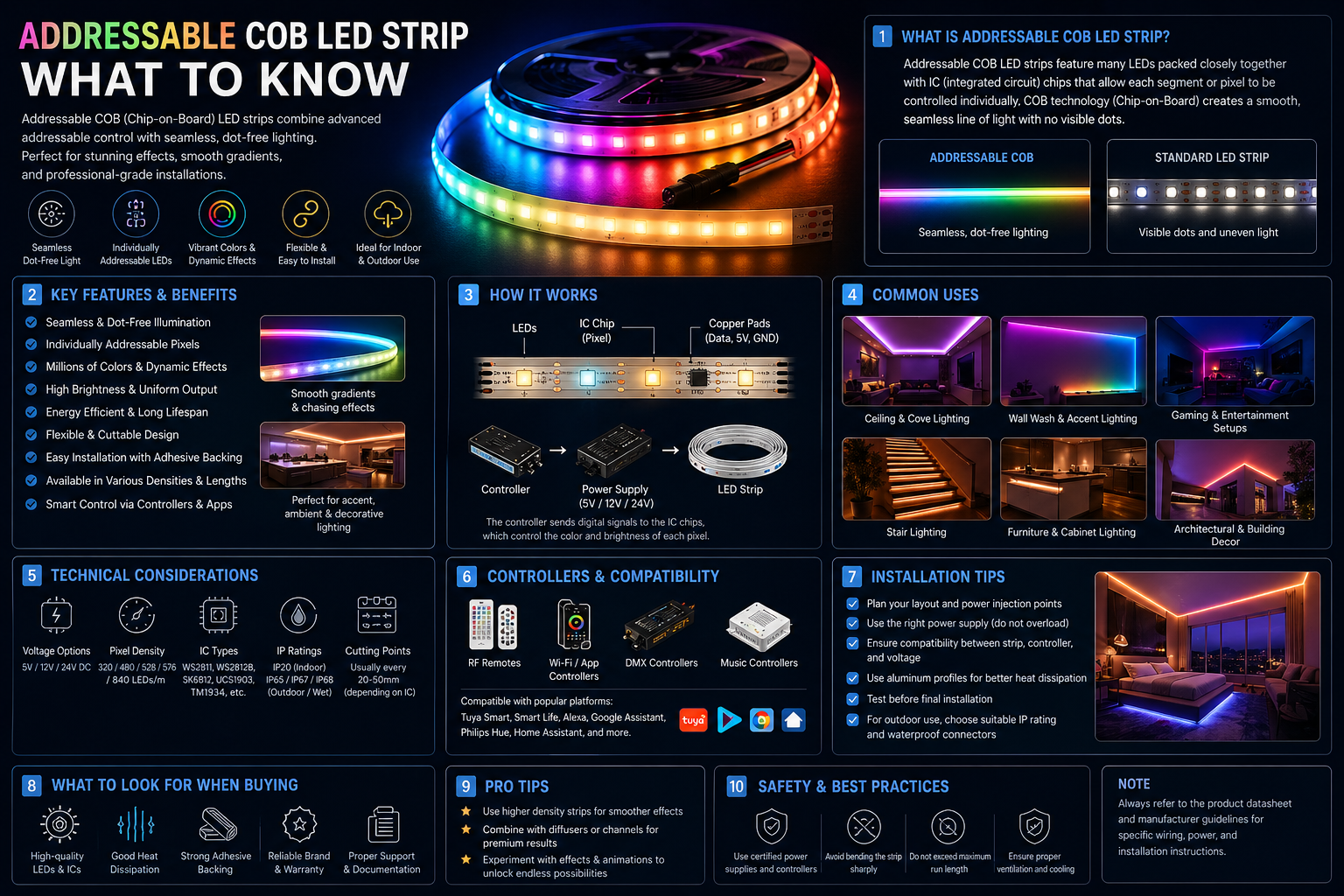
If you have ever liked the clean, dotless look of COB tape lighting but still wanted animated color effects, an addressable cob led strip is the product category worth your attention. It brings together two things that do not usually show up in the same strip - a smooth continuous light line and pixel-level control. For contractors, designers, and homeowners trying to build a polished install instead of a novelty effect, that combination matters.
What makes an addressable cob led strip different?
A standard COB strip is known for eliminating visible diode hotspots. That is why it works so well in shallow aluminum channels, under cabinets, coves, millwork, and other locations where you want a refined finished look. An addressable version adds integrated control logic so sections of the strip can change color or brightness independently.
That means you are not limited to one static color across the whole run. You can create chasing effects, gradients, segmented scenes, and dynamic patterns without the broken, dotted appearance common with many older pixel strips. In the right application, that is a major upgrade in visual quality.
The key detail is this: not every RGB COB strip is addressable. Some RGB COB products change color, but the full strip changes together. A true addressable strip has individually controlled LEDs or controlled pixel groups, usually managed by an IC built into the strip design. If you need animation, scene movement, or programmable effects, that distinction is not optional.
Where an addressable COB LED strip makes the most sense
This type of strip is not for every project, and that is exactly why it helps to understand where it performs best. In premium residential interiors, it is a strong fit for media walls, floating vanities, toe-kick accents, ceiling coves, bars, display shelving, and custom millwork where homeowners want a clean architectural finish with more than one lighting mood.
In commercial settings, it works well in hospitality, retail, salons, offices, and reception areas that benefit from controlled visual energy. Landscapers and outdoor lighting installers can also use it in protected locations when paired with properly rated power components and enclosures for wet or damp environments.
There is a trade-off, though. If the goal is simple task lighting under kitchen cabinets or a reliable white cove light in a hallway, a single-color or tunable white COB strip may be the better choice. Addressable products are best used when the project actually benefits from programmable effects, not just because the feature exists.
Why COB matters for pixel lighting
Pixel lighting has traditionally meant visible points of light. That can be fine for signage, gaming rooms, and entertainment builds, but it is not always acceptable in upscale residential or architectural work. In high-end spaces, visible pixels can look unfinished, especially in channels with shallow diffusers.
COB construction solves that by packing the light source densely and applying phosphor or coating methods that create a more continuous luminous surface. The result is smoother visual output and less spotting. For clients who want dynamic RGB or RGBW effects without the cheap strip-light look, that is the real advantage.
This is also why an addressable COB product often costs more than a basic strip. You are paying for appearance, density, and control capability at the same time.
Power and control are where projects go right or wrong
The strip itself gets the attention, but the success of the install usually depends on the supporting components. An addressable COB LED strip needs the correct voltage, adequate power supply sizing, and a controller that matches the strip's protocol.
Most problems in the field are not caused by the LEDs. They come from underpowered drivers, voltage drop across long runs, incompatible controllers, or poor planning around injection points. If the load is close to the rated output of the power supply, performance can become unstable. If the run is too long without power injection, color shift and dimming can show up toward the end of the strip.
For a clean result, you need to confirm input voltage, watts per foot, total run length, controller type, and whether the strip uses individual addressing or grouped pixels. You also need to think about the installation environment. Indoor millwork, bathroom vanities, soffits, and exterior applications all place different demands on the driver, housing, and wiring approach.
For trade professionals, this is standard planning. For homeowners, it is the difference between buying a strip that looks exciting on paper and getting a system that actually performs.
Controller compatibility matters more than many buyers expect
Addressable strips are not universally interchangeable. Different IC types and signal methods require compatible controllers. Some are built for preset effects and handheld remote control. Others are intended for more advanced programming, app control, or integration into larger lighting systems.
That does not mean the more advanced option is always better. In many residential jobs, the best controller is the one that gives stable output, simple setup, and enough scene control for the client to use every day. If the customer wants a few polished effects and dependable operation, there is no advantage in overcomplicating the system.
Voltage drop is still a real issue
COB construction improves appearance, not electrical physics. Long runs still need proper planning. Depending on strip voltage, wattage, and installation length, you may need power injection at specific intervals to keep color and brightness consistent.
This becomes even more important in RGB, RGBW, and IC-based products, where inconsistent voltage can affect not just intensity but the quality of the color output. A project can look excellent in the first three feet and noticeably weaker farther down the run if the feed strategy is not correct.
How to choose the right addressable COB LED strip
Start with the application, not the effect chart. Ask what the strip needs to do, where it will be installed, how visible it will be, and how the client expects to control it.
If the strip is going into premium cabinetry or a recessed channel in a finished interior, visual smoothness is critical. If it is part of an entertainment feature wall, dynamic effects may be the main priority. If it is outdoors or in a damp area, the right rating and compatible enclosed power components matter just as much as the strip itself.
Then look at the technical basics: strip width, voltage, cut points, color type, and whether it is RGB, RGBW, CCT, or IC-controlled RGB COB. Width matters more than many buyers think because it affects channel selection, connector compatibility, and fit inside architectural details. A 6.5mm strip solves different installation problems than a 10mm or 12mm strip.
You should also consider serviceability. A highly customized lighting setup still needs to be installable, testable, and replaceable if needed. Products that are easy to pair with compatible drivers, transformers, connectors, and controllers save time on the job and reduce callbacks later.
Installation expectations for a polished result
A premium strip can still look average if it is installed poorly. Surface prep, channel selection, wire management, power placement, and heat handling all affect long-term performance. Aluminum channels remain a smart choice in many projects because they improve finish quality and help manage heat.
Before final mounting, test the full system. That includes the strip, controller, dimming or scene behavior, and all planned run lengths. Waiting until the strip is inside millwork or behind finished drywall is how small wiring mistakes turn into expensive rework.
For remodelers and electricians, it also helps to align the lighting plan with the rest of the project schedule. Addressable systems often involve coordination with cabinetry, drywall, finish carpentry, or control integration. The cleanest jobs happen when the wiring path and equipment location are decided early.
Is it worth it?
If you need static white light, probably not. If you want a premium-looking color strip with smoother output than traditional pixel tape, then yes, an addressable COB LED strip can be worth the added planning and cost. It fills a specific gap in the market: dynamic lighting effects that still look appropriate in refined architectural spaces.
That is why this category continues to get attention from both installers and design-minded homeowners. It is not just about motion effects. It is about getting those effects in a format that looks cleaner, more finished, and more suitable for real projects.
At LA LED Lighting, that practical difference matters. Buyers are not just shopping for color. They are choosing a system that has to match the jobsite, the driver, the controller, and the standard of the finished space.
The best lighting decisions usually come from asking one simple question first: do you want a strip that can change color, or a strip that can truly create a lighting experience?