
The controller is where a good RGBW lighting system either performs like a premium installation or turns into a callback. If your strip light can produce clean color and usable white light, but the controls lag, flicker, drop signal, or fail under load, the whole system feels cheap. That is why selecting the right rgbw led strip controller matters just as much as choosing the strip itself.
For electricians, remodelers, and design-focused homeowners, the controller is not just a remote accessory. It determines how the strip responds, how smoothly it dims, how color channels behave, and how easy the system is to install and service later. In high-end homes, offices, bars, retail spaces, and landscape projects, those details show up fast.
What an RGBW LED strip controller actually does
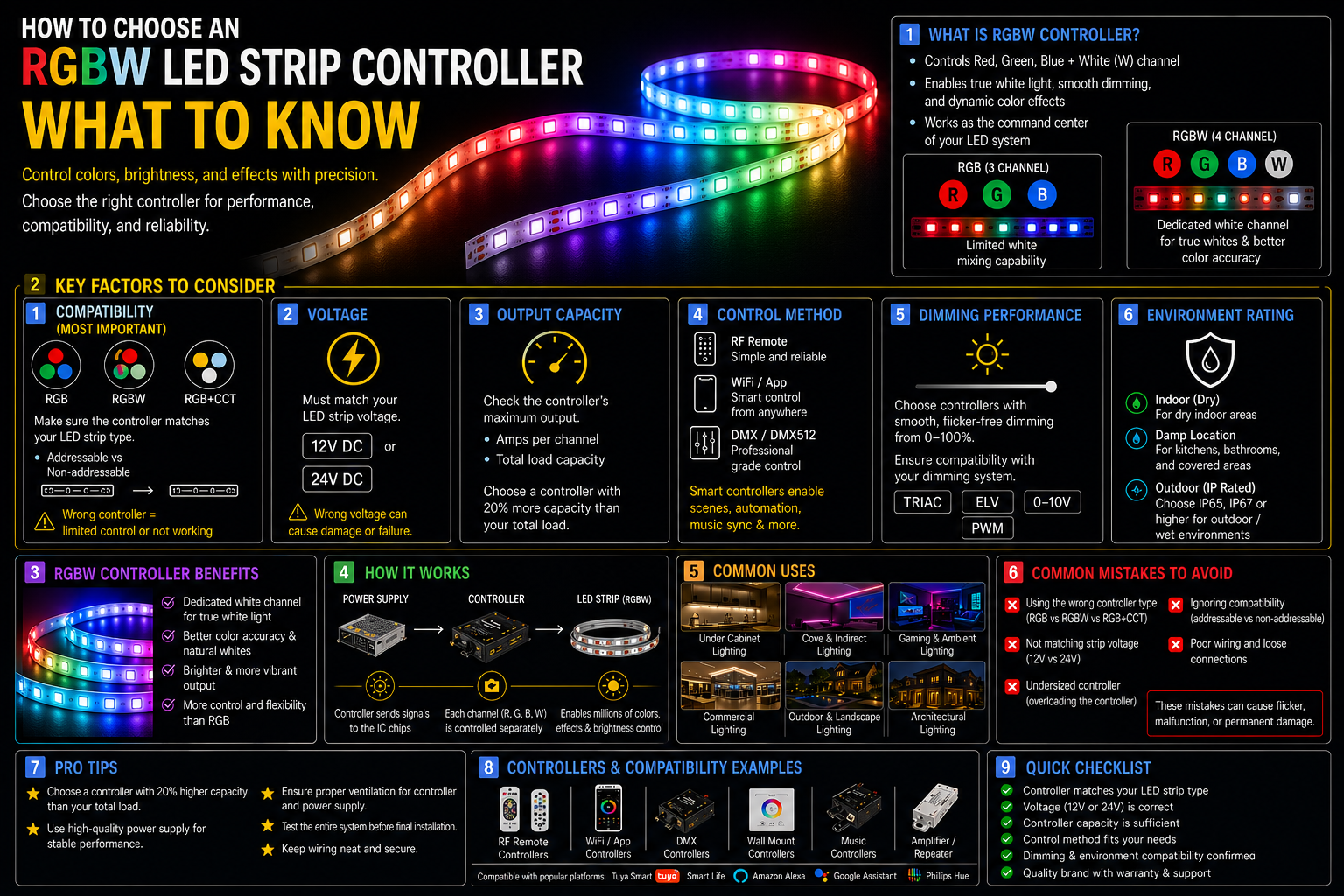
An RGBW LED strip controller manages four separate channels - red, green, blue, and white. That extra white channel is what separates RGBW from basic RGB systems. Instead of mixing red, green, and blue to approximate white, the strip can deliver a dedicated white output that is typically cleaner, more functional, and better suited for task lighting or architectural accents.
That matters in real installations. A restaurant may want saturated colors at night but a clean white during setup and service hours. A homeowner may want warm ambiance for entertaining and straightforward white light for everyday use. A contractor may need one product that handles both decorative scenes and usable illumination without switching fixtures.
The controller is what makes that flexibility possible. It sends the proper signal to each channel, handles dimming behavior, and often determines whether control happens by handheld remote, wall control, app, RF, Wi-Fi, DMX, or another protocol.
Why the right rgbw led strip controller matters
Not all controllers are built for the same job. Some are fine for a small under-cabinet run in a dry location. Others are designed for larger architectural installs where signal stability, output capacity, and control integration matter more than price.
The first issue is load capacity. If the controller cannot handle the total wattage of the connected strip, performance problems start quickly. You may see overheating, unstable dimming, color inconsistency, or early failure. This is a common mistake when buyers focus only on strip length and ignore amperage draw.
The second issue is control quality. A controller can technically power the strip and still produce poor results. Cheap units often show stepped dimming, weak wireless range, delayed response, or limited scene control. That may be acceptable in a low-priority DIY project, but not in a finished kitchen, custom millwork install, office cove, or hospitality application.
The third issue is compatibility. Voltage, wiring layout, control method, and even enclosure conditions need to line up. A 12V strip needs a compatible 12V controller. A 24V run needs a 24V-rated controller. If the system is in a damp or outdoor-adjacent environment, component protection becomes part of the decision too.
Key specifications to check before you buy
The most important starting point is voltage. Match the controller to the strip light and power supply. Mixing 12V and 24V components is one of the fastest ways to create avoidable failures.
Next is channel output. An RGBW controller needs four-channel output, and the per-channel current rating matters. If you are running a longer strip or a higher-output product, the controller must be sized for the real load, not the ideal load printed in a simplified listing. Professionals usually leave margin instead of sizing right at the limit.
Control method comes next. RF remotes are popular because they are simple and reliable. Wi-Fi and app-based systems make sense when users want scene control, scheduling, or smart home convenience. Wall-mounted controls are often the cleanest fit in residential and commercial spaces where users expect a permanent interface. DMX makes more sense in advanced architectural or entertainment-driven projects, where precision and integration are priorities.
Then there is dimming performance. A quality controller should provide smooth, stable dimming across the full range with no visible flicker. That is especially important in premium residential work, restaurants, salons, and office environments where lighting quality is part of the finished result.
Choosing a controller by application
The right choice depends on where the strip is going and how the end user will interact with it.
For under-cabinet or accent lighting in a home, a compact RF or app-based rgbw led strip controller is often the most practical solution. It keeps installation straightforward while giving the homeowner easy access to color changes and white-light use. In these projects, simplicity usually wins. If the control is confusing, the customer will use one setting and ignore the rest.
For custom interiors and high-end residential work, control feel matters more. A premium project should not rely on a flimsy handheld remote with inconsistent response. Better wall controls, better signal stability, and better dimming behavior are worth paying for because they reduce frustration after install.
For commercial and hospitality spaces, scene recall and repeatability become more important. Staff need lighting that behaves the same way every time. If a controller allows saved scenes and dependable switching between color and white modes, it saves time and keeps the lighting aligned with the space.
For outdoor or landscape-adjacent applications, environmental protection matters. The controller location, enclosure, and power components all need to be considered together. A quality strip alone is not enough if the control hardware is left vulnerable to moisture, heat, or service issues.
Common mistakes with RGBW LED strip controller selection
One of the biggest mistakes is treating the controller like a low-priority accessory. It is a core system component. If it fails, the lighting system fails.
Another common mistake is undersizing the controller. Buyers will calculate total strip wattage, then choose a controller with little or no headroom. On paper it works. In the field, heat, startup demand, and real installation conditions can expose the weakness.
Wiring confusion is another issue, especially with RGBW strips that include multiple channels and a common positive or negative layout depending on the product. Installers need to confirm the strip configuration before landing wires. Assuming all RGBW systems are wired the same way can waste time and damage components.
There is also the issue of mismatched expectations. Some customers want rich color effects. Others mostly want excellent white light with occasional color use. That difference affects the controller choice. A system designed for frequent scene changes and app control is not always necessary for a client who just wants reliable white output and a few preset color options.
Wired, wireless, app, or wall control?
There is no single best answer. It depends on the project.
Wireless RF control is a strong choice for many residential installations because it is simple, responsive, and does not always require line-of-sight aiming. App control is attractive for users who want phone-based access, grouped zones, or smart-home-style convenience. The trade-off is that setup can be more involved, and long-term user satisfaction depends on software stability as much as hardware quality.
Wall control is often the most professional-looking solution. It gives the project a finished feel and avoids the problem of remotes disappearing into drawers. For builders, electricians, and designers working on premium interiors, wall-mounted control usually feels more permanent and more intuitive.
Wired control systems and advanced protocols make sense when integration is the goal. Larger homes, commercial projects, and custom environments may require more than basic color change functions. In those cases, the controller should be selected as part of the full control strategy, not as an afterthought.
Reliability, certification, and long-term performance
For trade professionals, reliability is not a marketing phrase. It is the difference between finishing a project once and coming back to troubleshoot it later. A dependable controller should be built for stable output, clear channel control, and compatibility with USA-standard-compliant components.
This is also where product quality matters more than bargain pricing. A lower-cost controller may look similar online, but poor terminals, weak housing, inconsistent output, and questionable internal components show up over time. In finished residential and commercial spaces, replacement costs are usually higher than the price difference between entry-level and professional-grade hardware.
LA LED Lighting serves buyers who care about that difference. For installers and homeowners looking for premium strip lighting systems, the controller should support the same standard as the strip, driver, and overall installation.
How to make the right choice the first time
Start with the strip specifications: voltage, wattage, channel type, and intended run length. Then match the controller to the actual electrical load with safety margin included. After that, choose the control style based on how the client will really use the lighting, not just what sounds advanced.
If the project is residential and design-driven, prioritize smooth dimming and user-friendly control. If it is commercial, think about repeatability and durability. If it is outdoor-adjacent, factor in enclosure protection and service access. And if white light quality matters as much as color, make sure the controller handles the white channel as a true feature, not an afterthought.
A good rgbw led strip controller should feel invisible once installed. The colors respond correctly, the white channel looks clean, the dimming feels smooth, and the user does not have to fight the system. That is the standard worth buying for.