
Tunable White LED Driver: What You Need to Know
A tunable white lighting system is only as good as the driver behind it. Even premium LED strips and architectural fixtures can suffer from flicker, uneven color transitions, dimming issues, and unreliable performance if the driver is not matched correctly.
For contractors, electricians, designers, and homeowners, a tunable white LED driver is more than a power supply. It is the component that determines how smoothly the system shifts between warm and cool white light while maintaining stable brightness and dependable operation.
As tunable white lighting becomes increasingly popular in luxury homes, offices, hospitality spaces, and custom remodels, choosing the right driver has become a critical part of system design.
What Is a Tunable White LED Driver?
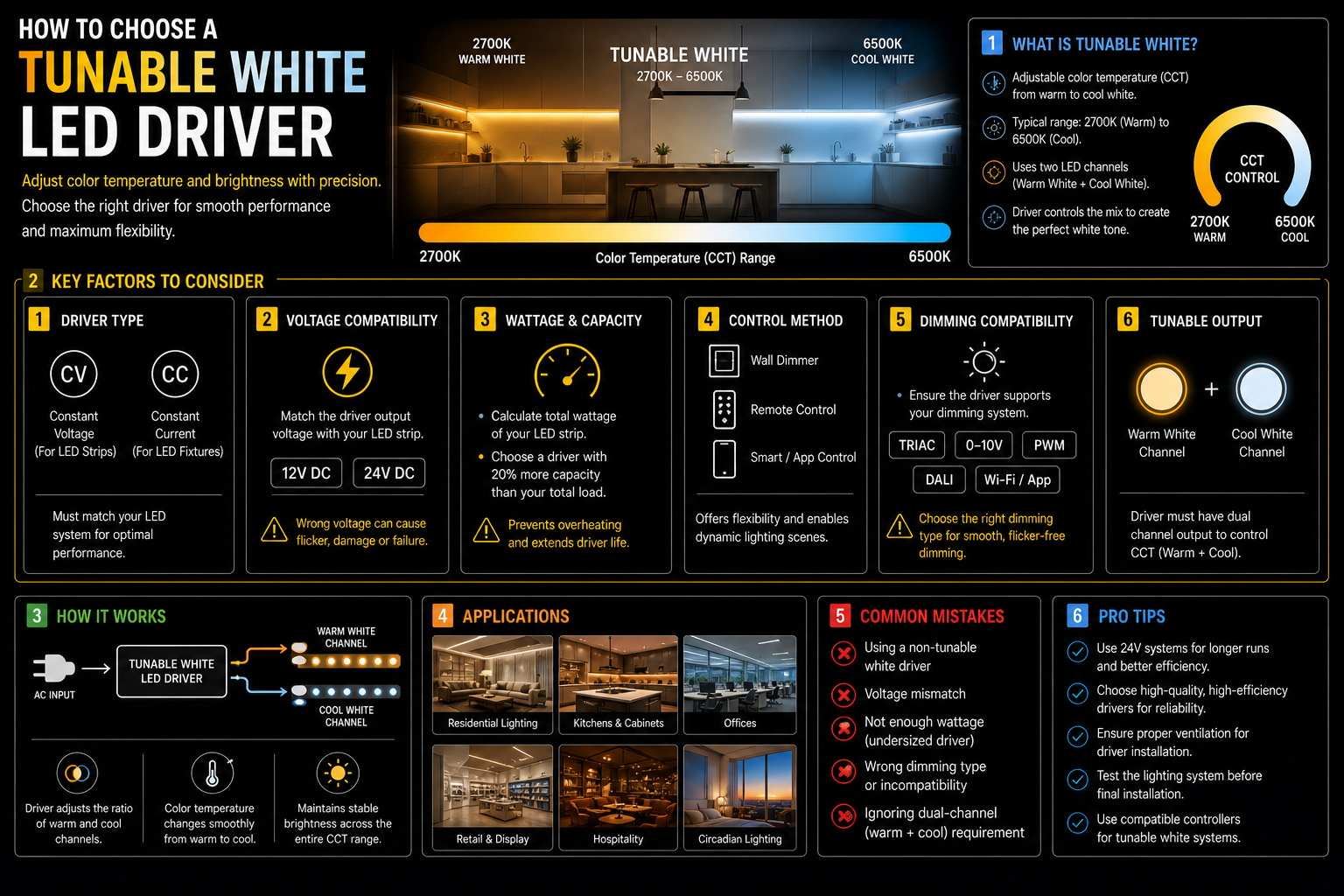
A tunable white LED driver regulates power to an LED fixture or strip while supporting adjustable color temperature control.
Unlike standard LED drivers that power a single white channel, tunable white systems use two channels:
- Warm white LEDs
- Cool white LEDs
The driver works with a controller or compatible control system to blend these channels, allowing users to adjust the color temperature throughout the day.
For example:
- Warm settings create a comfortable, relaxed atmosphere
- Cooler settings support focus, visibility, and daytime activities
The result is one lighting system that can adapt to different tasks, moods, and environments without changing fixtures.
Why Driver Selection Matters
When a project includes tunable white lighting, expectations are typically higher than average.
Homeowners, designers, and clients expect:
- Smooth color temperature transitions
- Stable dimming performance
- Consistent brightness across the tuning range
- Reliable daily operation
A poorly matched driver can create:
- Visible stepping between color temperatures
- Uneven brightness during transitions
- Flickering
- Low-end dimming instability
- Communication issues with controls
In premium residential and commercial projects, these problems are immediately noticeable and often expensive to correct after installation.
Tunable White LED Driver vs Standard LED Driver
A standard LED driver powers a fixed-color lighting system. It may dim, but it does not manage multiple white channels.
A tunable white LED driver or compatible tunable white power system is designed to support dynamic color temperature adjustment by controlling both warm and cool LED channels.
This distinction is important because not every dimmable driver supports tunable white functionality.
A driver may work perfectly for:
- Single-color LED tape
- Standard recessed lighting
- Fixed-CCT fixtures
Yet still be completely unsuitable for a tunable white installation.
Always verify compatibility with the specific lighting system being installed.
How to Choose the Right Tunable White LED Driver
Start With the LED Load
The first step is understanding the requirements of the fixture or strip lighting system.
Confirm:
- Constant voltage or constant current operation
- Input voltage requirements
- Total wattage
- Required control method
Most tunable white LED strip lighting systems use constant voltage power, commonly 24V DC, but specifications should always be verified before selecting a driver.
Calculate Total Load
Add the wattage of all connected fixtures or strip lighting.
Then leave additional capacity for reliable operation.
A common guideline is approximately 20% headroom.
For example:
- Connected load: 100W
- Recommended driver size: 120W or greater
This helps improve thermal performance and long-term reliability.
Confirm Control Compatibility
Control compatibility is one of the most important factors in a tunable white system.
Depending on the project, the driver may need to work with:
- TRIAC dimming
- ELV dimming
- 0-10V controls
- Dedicated tunable white controllers
- Smart lighting systems
The control strategy should determine the driver selection—not the other way around.
Choosing the Right Dimming Method
TRIAC
TRIAC dimming is common in residential remodels where existing wall dimmers remain in place.
Advantages include:
- Familiar operation
- Simplified retrofit installations
- Minimal wiring changes
ELV
ELV dimming often provides smoother performance with many low-voltage LED systems.
It is frequently used in:
- Luxury homes
- Architectural lighting projects
- High-end residential applications
0-10V
0-10V dimming is popular in commercial environments and larger residential projects.
Benefits include:
- Stable low-end dimming
- Scalability
- Integration with building controls
- Consistent multi-zone performance
Dedicated Tunable White Controllers
Many tunable white systems achieve the best results using dedicated controllers designed specifically for color temperature adjustment.
These systems often provide more precise control than traditional dimmers.
Installation Environment Matters
The installation location influences driver selection just as much as electrical specifications.
Consider:
- Dry locations
- Damp locations
- Wet locations
- Enclosed spaces
- Millwork installations
- Ceiling cavities
A compact driver may be ideal for tight architectural details, while larger enclosed units may be better suited for serviceability and environmental protection.
Always verify that the driver is rated for the intended environment.
Don't Overlook Voltage Drop
Long wire runs can affect both brightness and color consistency in tunable white systems.
Symptoms may include:
- Uneven brightness
- Inconsistent color temperature
- Different performance across sections of the same run
Proper planning includes:
- Appropriate wire sizing
- Reasonable run lengths
- Strategic driver placement
- Correct power distribution
Even the best driver cannot compensate for poor wiring design.
Common Applications for Tunable White Lighting
Residential Projects
Tunable white lighting is increasingly popular in:
- Kitchens
- Living rooms
- Bedrooms
- Bathrooms
- Cove lighting
- Custom millwork
- Under-cabinet lighting
Warm tones can create a relaxing evening atmosphere, while cooler tones support daytime tasks and visibility.
Commercial Spaces
Commercial applications include:
- Offices
- Conference rooms
- Hospitality spaces
- Retail environments
- Wellness facilities
- Salons
- Reception areas
The ability to adapt lighting throughout the day makes tunable white systems particularly attractive in these environments.
Common Mistakes to Avoid
One of the biggest mistakes is treating tunable white lighting like standard single-color lighting.
Other common errors include:
- Choosing a standard dimmable driver instead of a tunable white-compatible solution
- Ignoring controller compatibility
- Undersizing the driver
- Failing to account for voltage drop
- Mixing incompatible components
Successful tunable white installations require the driver, controller, and LED load to function as one coordinated system.
What Professionals Look For
Before purchasing a tunable white LED driver, professionals typically verify:
- Output type
- Voltage compatibility
- Wattage capacity
- Control protocol support
- Environmental rating
- UL certification
- Physical size
- Serviceability
A quality driver should install cleanly, integrate with the planned control system, and deliver stable performance long after project completion.
Final Thoughts
A tunable white LED driver is one of the most important components in any adjustable white lighting system. It directly affects color consistency, dimming quality, reliability, and user experience.
The best results come from selecting a driver that matches the LED load, control method, installation environment, and long-term performance requirements of the project.
When the driver, controller, and lighting system are designed to work together, tunable white lighting delivers exactly what it promises: flexible, comfortable illumination that adapts to the space throughout the day.