
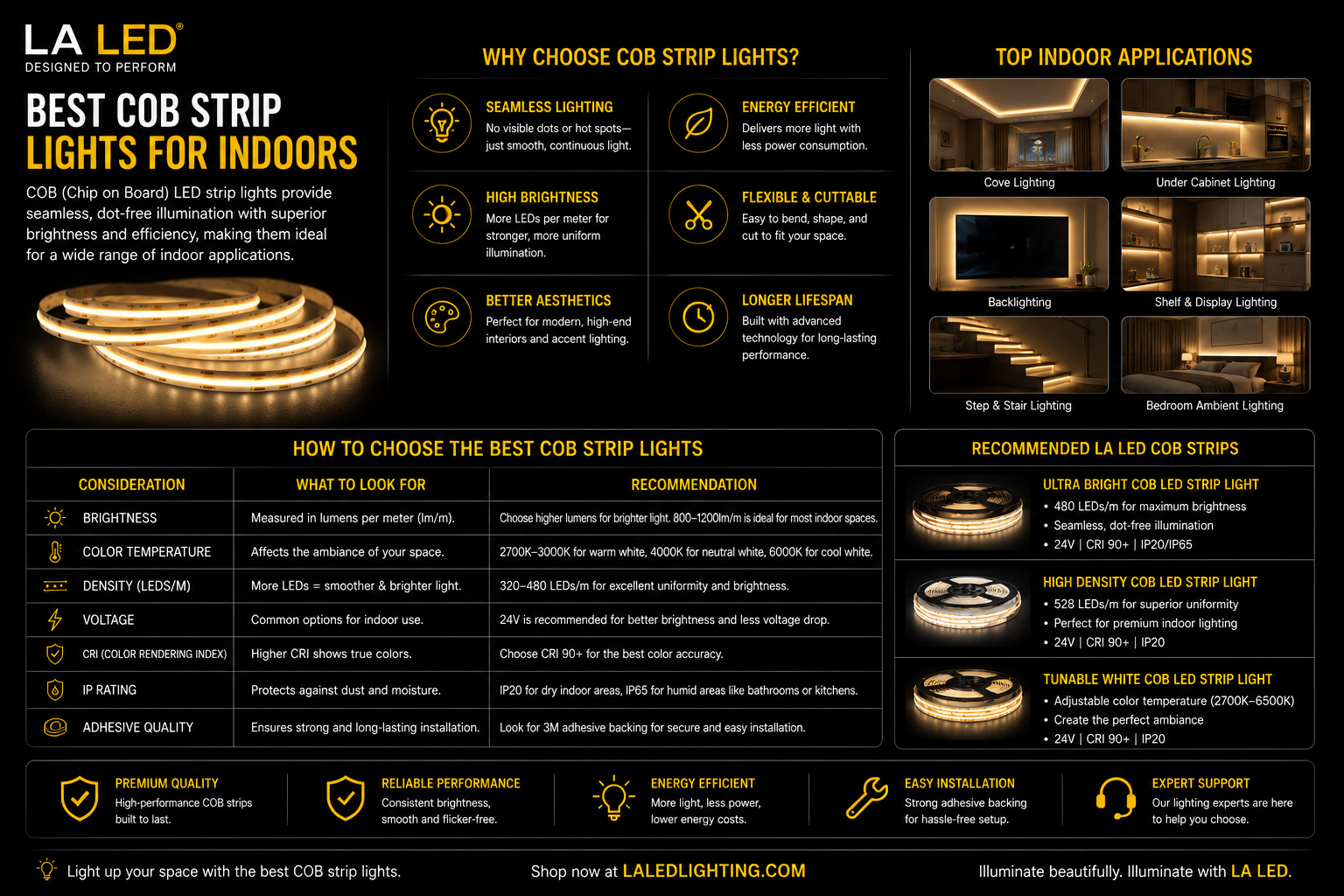
Best COB Strip Lights for Indoor Applications
A strip light can make an interior feel custom and architectural—or immediately reveal every shortcut in the installation. When comparing the best COB strip lights for indoor applications, brightness is only part of the equation. The real goal is smooth light output, dependable dimming, excellent color quality, and a system that works reliably for years.
COB (Chip-on-Board) LED strip lights have become a preferred choice for modern interiors because they create a continuous, dotless line of light. Unlike traditional LED tape, COB strips minimize visible hotspots, making them ideal for kitchens, shelving, millwork, coves, vanities, and other high-visibility applications.
What Makes the Best COB Strip Lights Indoors?
The best indoor COB strip lights combine four essential qualities:
- Uniform, dotless illumination
- Accurate and consistent color
- Smooth dimming performance
- Flexible installation options
A strip may look impressive on a specification sheet, but if it flickers, shows visible hotspots, or doesn't fit the intended profile, the finished result can suffer.
COB technology solves one of the most common complaints about standard LED tape: visible LED dots. This is especially important around reflective materials such as polished stone, glossy tile, glass, and lacquered surfaces where every imperfection becomes noticeable.
Choose the Right Strip for the Application
The best COB strip depends on where it will be installed.
Under-Cabinet Lighting
Kitchen under-cabinet lighting is one of the most popular COB applications. A high-quality COB strip paired with an aluminum channel creates smooth, shadow-free task lighting while maintaining a clean appearance across countertops and backsplashes.
Shelving and Millwork
Built-in cabinetry, floating shelves, and display niches benefit greatly from COB lighting. Since the strip is often close to eye level, the continuous light line helps create a more polished and architectural finish.
Bathroom Vanities and Mirrors
Backlit mirrors, vanity lighting, and recessed niches all benefit from even illumination. In these applications, color quality and dimming performance are just as important as brightness.
Cove and Accent Lighting
COB strips work exceptionally well in ceiling coves, wall reveals, media walls, and architectural accents where the goal is soft indirect lighting rather than direct task illumination.
Selecting the Right Color Temperature
Color temperature has a major impact on how a room feels.
Warm White (2700K–3000K)
Ideal for:
- Living rooms
- Bedrooms
- Hospitality-inspired interiors
- Warm wood finishes
Neutral White (3500K–4000K)
Common for:
- Kitchens
- Bathrooms
- Offices
- Contemporary interiors
Tunable White
For maximum flexibility, tunable white COB strips allow users to adjust color temperature throughout the day. This is especially useful in multi-purpose spaces where lighting needs change between daytime tasks and evening relaxation.
Dimming Performance Matters
Even the best COB strip can disappoint if paired with the wrong driver or dimmer.
For premium indoor installations, smooth dimming should be considered essential. Depending on the project, this may involve:
- TRIAC dimming
- ELV dimming
- MLV dimming
- 0-10V control
The strip, driver, controller, and dimmer should always be treated as one complete system. Compatibility issues often lead to flickering, buzzing, poor low-end dimming, or inconsistent performance.
Don't Overlook Strip Width and Cut Points
Many buyers focus on brightness and color while overlooking physical installation requirements.
Strip width affects:
- Channel compatibility
- Recessed profile selection
- Millwork integration
- Custom architectural details
Narrower strips are often preferred for tight reveals and custom cabinetry, while wider options may be suitable for larger channels and higher-output applications.
Cut points are equally important. Flexible cut increments allow installers to maintain symmetry and avoid awkward gaps in cabinetry, shelving, and architectural details.
Where COB Lighting Performs Best Indoors
Kitchens
- Under cabinets
- Above cabinets
- Inside glass-front cabinets
- Island details
Closets and Built-Ins
- Wardrobes
- Display shelving
- Custom cabinetry
- Decorative millwork
Bathrooms
- Vanity lighting
- Mirror backlighting
- Recessed niches
- Toe-kick lighting
Living Areas
- Ceiling coves
- Media walls
- Stair details
- Floating architectural features
Are COB Strip Lights Always Worth It?
Not every project requires COB technology.
If the strip will be completely hidden inside a deep cove or behind a heavy diffuser, a traditional LED strip may be sufficient. However, in most modern interiors where the light source or reflection is visible, COB strips provide a noticeably cleaner and more premium appearance.
The higher initial cost is often justified by:
- Better visual quality
- Reduced hotspotting
- Improved architectural appearance
- Greater customer satisfaction
What Professionals Look For
Experienced installers typically evaluate COB strip systems in this order:
- Application
- Output level
- Color temperature
- Strip width
- Dimming compatibility
- Driver selection
- Mounting method
This approach helps avoid one of the most common mistakes: selecting a strip first and trying to make the rest of the system work around it.
Final Thoughts
The best COB strip lights for indoor applications are the ones that fit both the space and the lighting goals. A successful installation is not defined by brightness alone. It depends on smooth illumination, proper color temperature, reliable dimming, and thoughtful integration into the architecture.
Whether you're lighting kitchen cabinets, custom shelving, bathroom vanities, or ceiling coves, a quality COB strip paired with compatible drivers and controls can create a clean, professional result that feels built into the space rather than added afterward.
When chosen correctly, COB lighting disappears into the design while making the entire room look more finished, comfortable, and refined.