
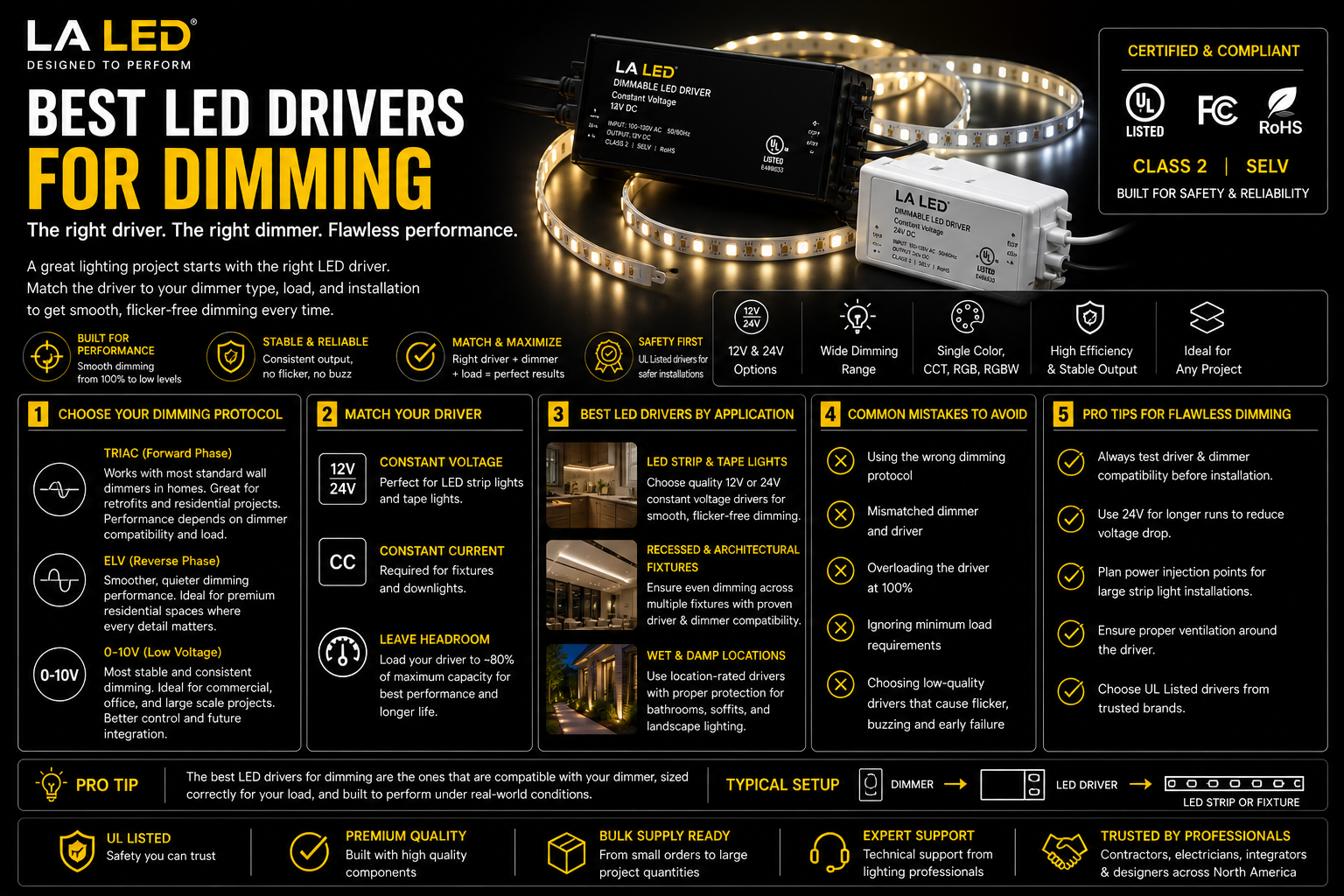
Best LED Drivers for Dimming: What to Look For
A dimmer that buzzes, lights that flicker at low levels, or an LED strip that drops out before reaching full brightness often points to one issue: the wrong driver. If you're searching for the best LED drivers for dimming, the goal is not simply finding a dimmable driver. It's finding one that matches your dimmer, LED load, voltage, and installation requirements.
Whether you're installing COB strip lighting in a custom kitchen, upgrading office lighting, or powering outdoor architectural fixtures, driver selection has a direct impact on performance. The right driver delivers smooth dimming, stable output, and long-term reliability. The wrong one creates callbacks, troubleshooting, and frustration.
What Makes a Good Dimmable LED Driver?
The best dimmable LED drivers are designed for the specific control method being used and properly matched to the LED load.
Three factors matter most:
- Dimming protocol compatibility
- Correct output voltage or current
- Proper load sizing
Many dimming issues begin when installers focus only on wattage while overlooking compatibility. A driver may be labeled dimmable, but if it doesn't support the dimming method being used, performance will suffer.
Match the Driver to the Dimming Method
Different dimming systems communicate in different ways. The driver must be designed to interpret the control signal correctly.
TRIAC Dimmable Drivers
TRIAC, also known as forward-phase dimming, remains one of the most common options in residential applications because it works with many existing wall dimmers.
Benefits include:
- Easy retrofit compatibility
- Familiar residential controls
- Minimal rewiring requirements
A quality TRIAC-compatible driver can provide excellent results for recessed lighting, under-cabinet lighting, and LED strip applications. However, performance depends heavily on both the driver and the dimmer being compatible.
ELV Dimmable Drivers
ELV (Electronic Low Voltage) or reverse-phase dimming is often preferred in premium residential projects where dimming quality is especially important.
Advantages include:
- Smoother low-end dimming
- Reduced audible noise
- Better performance with many electronic LED loads
- Improved stability at lower brightness levels
ELV systems are commonly used in architectural lighting, luxury kitchens, media rooms, floating vanities, and custom millwork applications.
0-10V Dimmable Drivers
For commercial, office, and larger residential projects, 0-10V dimming is often the most reliable solution.
Benefits include:
- Precise control
- Consistent performance across multiple fixtures
- Excellent scalability
- Easy integration with advanced lighting controls
Because 0-10V uses a dedicated low-voltage control signal, it generally provides smoother and more predictable dimming than phase-cut systems when properly installed.
Choose the Correct Driver Type
Before selecting a dimmable driver, determine whether the LED product requires constant voltage or constant current power.
Constant Voltage Drivers
Most LED strip lights, COB tape lights, RGB, RGBW, and tunable white systems use constant voltage drivers.
Common outputs include:
- 12V DC
- 24V DC
If your LED strip requires 24V, the driver must provide a 24V output.
Constant Current Drivers
Many downlights, specialty fixtures, and integrated LED modules require constant current drivers.
Common outputs include:
- 350mA
- 500mA
- 700mA
- 1050mA
These fixtures must be paired with drivers that match the specified current requirements.
Size the Driver Correctly
Driver sizing affects both dimming performance and longevity.
Calculate the total wattage of the connected LED load, then leave additional capacity. Most professionals recommend approximately 20% headroom.
For example:
- LED load: 80W
- Recommended driver size: 96W–100W minimum
This margin helps reduce heat buildup and supports more stable operation over time.
Oversizing excessively is not ideal either, particularly in some dimming applications where very light loads can affect performance. The goal is proper sizing with reasonable reserve capacity.
Best LED Drivers for Different Applications
LED Strip Lighting
Strip lighting quickly exposes poor driver performance. Low-quality drivers often cause:
- Flicker
- Low-end instability
- Inconsistent brightness
- Poor dimming response
For premium COB strip lighting, choose a dimmable constant voltage driver designed specifically for the intended control method.
Recessed Lighting
Downlights require consistent dimming across multiple fixtures.
A quality dimmable driver should:
- Dim smoothly
- Maintain brightness consistency
- Avoid premature dropout
- Match the selected dimmer protocol
Consistency is especially important in kitchens, living rooms, offices, and large open spaces where uneven dimming becomes obvious.
Outdoor and Damp Locations
Bathrooms, exterior soffits, and landscape lighting require drivers rated for environmental exposure.
Look for:
- Damp or wet location ratings
- Enclosed housings
- Integrated junction boxes when required
- Reliable thermal protection
Environmental protection is just as important as dimming compatibility in these applications.
Common Dimming Problems and Their Causes
Flickering
Often caused by:
- Incompatible dimmers
- Driver mismatch
- Load issues
- Poor connections
Buzzing
Typically indicates:
- Phase-cut compatibility issues
- Low-quality drivers
- Dimmer-driver mismatch
Dropout at Low Levels
Usually caused by:
- Minimum load limitations
- Poor low-end dimming capability
- Incorrect driver selection
Uneven Brightness
Can result from:
- Voltage drop
- Long wire runs
- Overloaded drivers
- Poor power distribution
What Professionals Look For
Before purchasing a dimmable driver, professionals typically verify:
- UL certification
- Dimming protocol compatibility
- Output voltage or current
- Wattage capacity
- Environmental rating
- Physical size and mounting requirements
Clear specifications save time and help avoid expensive compatibility problems later.
When It's Worth Paying More
Not every project requires premium dimming performance. Utility rooms and basic applications may function perfectly well with a standard dimmable driver.
However, for:
- Luxury homes
- Architectural lighting
- Hospitality projects
- High-end kitchens
- Custom millwork
- Client-facing commercial spaces
Investing in a higher-quality driver is often worthwhile. Better dimming behavior, improved reliability, and fewer service calls typically justify the added cost.
Final Thoughts
The best LED driver for dimming is the one that matches the control system, LED load, and installation environment. Smooth dimming isn't just about getting the lights to respond—it's about getting them to respond quietly, consistently, and predictably across the entire dimming range.
Choose based on compatibility, certification, driver type, and application requirements rather than price alone, and you'll end up with a lighting system that performs the way it should from day one.