
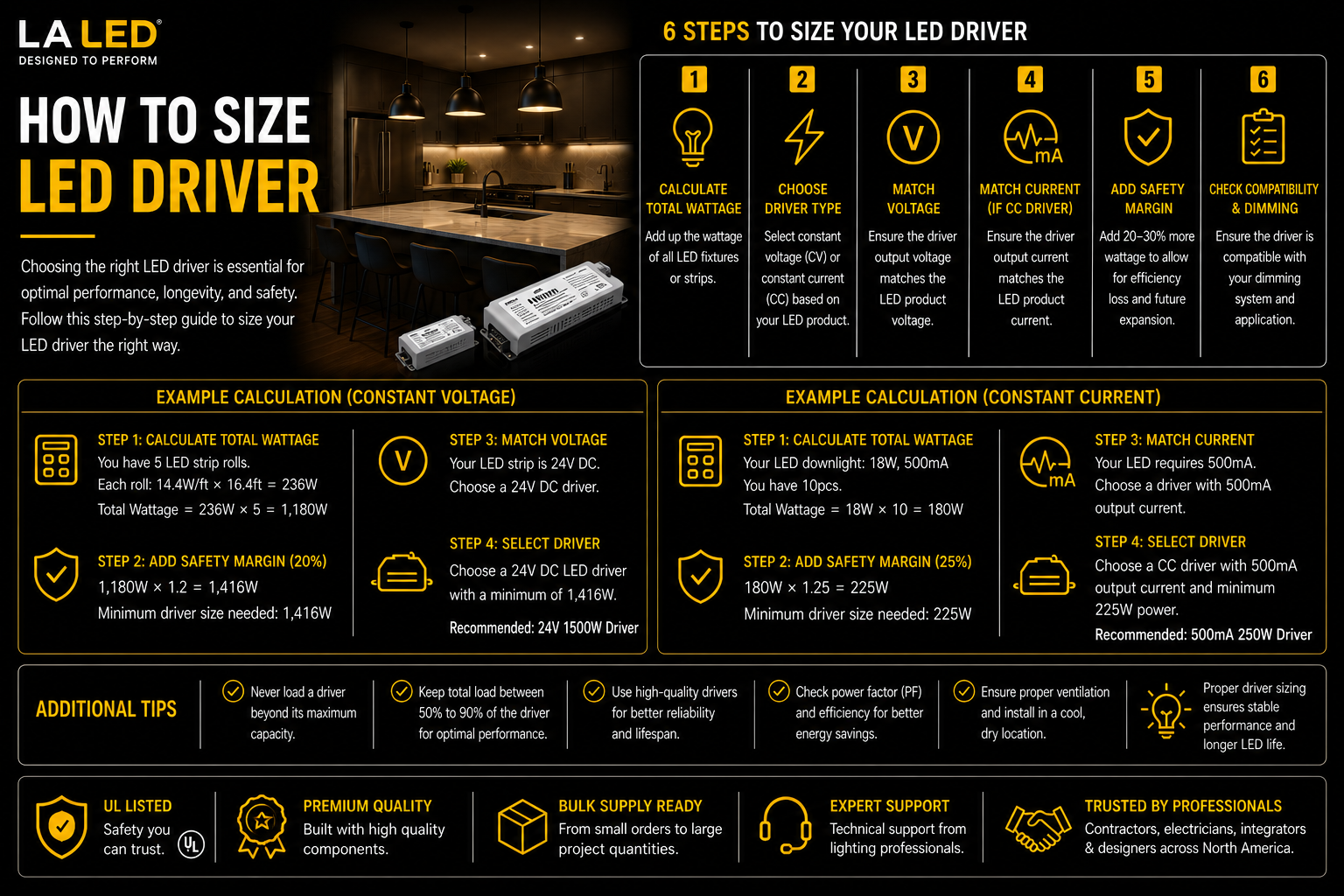
How to Size an LED Driver
Choosing the right LED driver is essential for reliable lighting performance. A driver that is too small can cause flickering, overheating, dropouts, or early failure. A driver that is too large can also create issues, especially with dimming systems or tight installation spaces.
The goal is simple: match the driver to the LED load, then leave enough headroom for stable long-term operation.
Start With the LED Product
Before choosing a driver, check the specifications of the LED strip, fixture, or module you are powering.
Look for:
- Voltage or current requirement
- Total wattage
- Constant voltage or constant current type
- Dimming method
- Indoor, damp, or wet location rating
Most LED strip lights use constant voltage drivers, usually 12V DC or 24V DC. Many downlights and specialty LED fixtures use constant current drivers, such as 350mA, 500mA, or 700mA.
These driver types are not interchangeable.
Step 1: Match the Driver Type
If the LED product is rated for 12V or 24V DC, use a constant voltage driver with the same output voltage.
Examples:
- 12V LED strip = 12V driver
- 24V COB strip = 24V driver
A selectable constant-voltage unit such as the 60W 5-in-1 Dimmable LED Driver (12V / 24V) covers either case on smaller runs.
If the fixture requires constant current, match the current rating exactly and confirm the driver voltage range fits the fixture.
Example:
A fixture rated 700mA with an 18-36V range needs a 700mA constant current driver that supports that voltage range.
Step 2: Calculate Total Wattage
For LED strip lights, multiply:
Watts per foot × Total feet = Total wattage
Example:
4.4 watts per foot × 16 feet = 70.4 watts
If you have multiple runs on one driver, add all sections together.
Example:
3 runs × 8 feet × 5 watts per foot = 120 watts total
A combined load like that needs a 150W 5-in-1 Dimmable LED Driver or larger once headroom is added.
Always calculate based on the actual installed length, not the full roll size.
Step 3: Add Headroom
Do not size the driver at the exact load. A good rule is to add about 20% extra capacity.
Example:
70.4W × 1.2 = 84.48W
In this case, choose the next available driver size, such as 96W or 100W.
This extra capacity helps:
- Reduce heat
- Improve reliability
- Extend driver life
- Support stable dimming
- Prevent overload issues
The best driver is not the largest one available. It is the correctly matched driver with reasonable reserve capacity.
Step 4: Check Dimming Compatibility
Dimming often causes more problems than wattage.
If the project requires dimming, confirm the driver supports the correct dimming method.
Common options include:
- TRIAC
- ELV
- MLV
- 0-10V
A driver that works with ELV may not work correctly with TRIAC. A 0-10V system requires compatible 0-10V controls and wiring.
A driver that accepts every common protocol, such as the 200W 5-in-1 Dimmable LED Driver, removes this decision from the specification process. You can also browse the full 0-10V dimmable LED driver range for commercial, architectural, and premium residential projects.
Step 5: Consider Installation Conditions
Driver sizing is not only about voltage and watts. The installation environment also matters.
Check whether the driver will be installed in:
- Dry locations
- Damp locations
- Wet locations
- Enclosed cabinets
- Ceiling cavities
- Outdoor enclosures
Drivers installed in hot, tight, or enclosed spaces may need more capacity and better ventilation. For damp and wet locations, specify a sealed unit such as the 96W Dimmable LED Transformer (24V, IP65).
For wet-location products, remember: wet location does not mean suitable for submersion unless specifically rated for that use.
How to Size an LED Driver for Strip Lights
For LED strip lighting, use this simple process:
- Confirm strip voltage: 12V or 24V.
- Multiply watts per foot by total installed length.
- Add about 20% headroom.
- Choose a driver with the correct voltage and wattage.
- Confirm dimming compatibility.
- Verify location rating and physical size.
For COB, RGB, RGBW, or CCT strip lights, also confirm controller compatibility and total system load.
Common Driver Sizing Mistakes
Avoid these common problems:
- Choosing by wattage only
- Ignoring voltage requirements
- Mixing constant voltage and constant current drivers
- Skipping wattage headroom
- Using incompatible dimmers
- Forgetting voltage drop on long runs
- Installing indoor drivers in damp or wet locations
A 100W driver is not automatically correct just because the load is under 100W. Voltage, driver type, dimming method, and environment must all match.
What If Two Driver Sizes Could Work?
Sometimes two driver sizes are close.
If your load is 78W and your options are 80W or 96W, the 96W driver is usually the safer choice, especially if the driver will be dimmed, enclosed, or used for long operating hours. The 96W Compact Dimmable LED Transformer (24V) fits that case and is small enough for cabinet and millwork installations.
For premium residential and commercial projects, conservative sizing helps reduce callbacks and improves long-term reliability.
Final Thoughts
Sizing an LED driver correctly starts with the LED product. Match the driver type, voltage or current, total wattage, dimming method, and installation environment before ordering.
For most LED strip lighting projects, calculate the actual load and add about 20% headroom. This gives the driver room to operate reliably without overheating or running at its limit.
A properly sized LED driver helps prevent flicker, buzzing, shutdowns, and premature failure. When the power supply is matched correctly, the lighting system performs smoothly and disappears into the project the way good lighting should.