
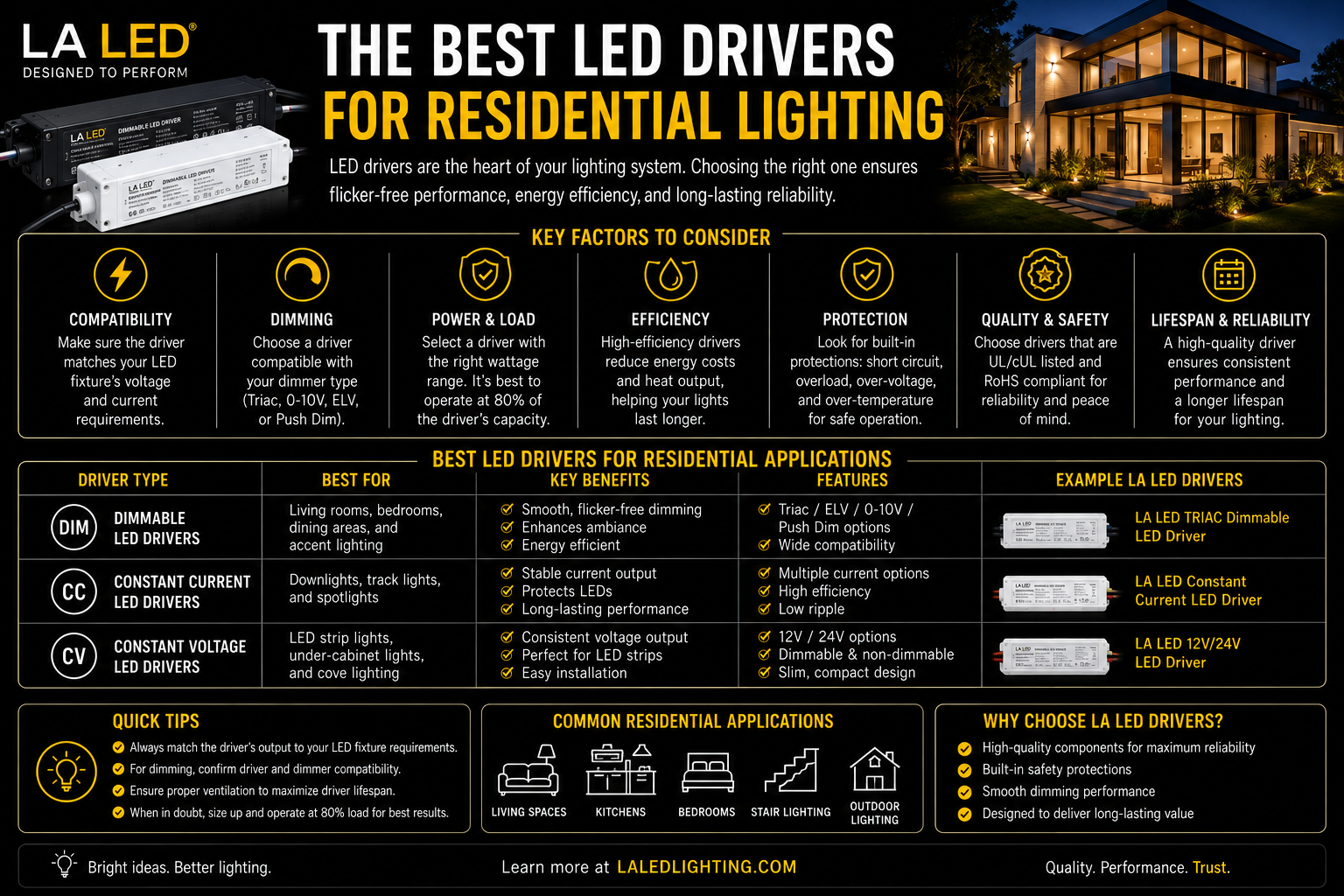
Best LED Drivers for Residential Lighting Projects
A buzzing dimmer, flickering LED strip, or downlight that cuts out unexpectedly often points to one overlooked component: the driver. While homeowners typically focus on fixtures and brightness, experienced installers know that driver quality plays a major role in lighting performance.
Choosing the best LED driver for a residential project means finding a product that delivers stable power, supports the correct dimming method, and provides reliable long-term operation. When matched correctly, a quality driver helps eliminate flicker, improve dimming performance, and reduce service calls after installation.
What Makes a Good Residential LED Driver?
The best LED drivers are not necessarily the most expensive or highest wattage options. The right choice is one that matches the LED load, supports the desired controls, and performs consistently in the installation environment.
Key features to look for include:
- UL-listed or recognized certification
- Consistent output voltage or current
- Reliable dimming performance
- Proper thermal management
- Suitable enclosure and location rating
- Long-term reliability
Whether you're installing under-cabinet lighting, recessed fixtures, cove lighting, or outdoor accents, driver compatibility should always come before price.
Constant Voltage vs. Constant Current
Before selecting a driver, determine which type your lighting system requires.
Constant Voltage Drivers
Constant voltage drivers provide a fixed output voltage, typically:
- 12V DC
- 24V DC
These drivers are commonly used for:
- LED strip lights
- COB tape lights
- RGB and RGBW lighting
- Architectural accent lighting
- Under-cabinet systems
Constant Current Drivers
Constant current drivers provide a fixed output current, such as:
- 350mA
- 700mA
- 1050mA
They are commonly used with:
- LED downlights
- Integrated fixtures
- Specialty LED modules
The driver type must match the fixture specifications exactly. Constant voltage and constant current systems are not interchangeable.
Dimming Compatibility Is Critical
Most residential LED complaints are caused by dimming issues rather than LED failures.
A quality driver should be designed for the control method being used.
Common residential dimming protocols include:
- TRIAC
- ELV
- MLV
- 0-10V
For many remodels, TRIAC and ELV remain the most common options. ELV often provides smoother low-end dimming with modern LED loads, while TRIAC can be a practical solution when working with existing wall dimmers.
The best residential drivers deliver:
- Smooth dimming curves
- Stable low-level performance
- Minimal flicker
- Quiet operation
- Reliable startup behavior
Always verify driver and dimmer compatibility before ordering.
Proper Driver Sizing Matters
Driver sizing affects both performance and longevity.
For most LED strip lighting applications:
- Calculate the total connected wattage.
- Add approximately 20% headroom.
- Select a driver that comfortably supports the load.
For example:
- Total LED load: 80W
- Recommended driver size: 96W–120W
This extra capacity helps reduce operating temperatures and improves long-term reliability.
However, wattage is only one factor. Run length, voltage drop, wire size, and driver location should also be considered during system design.
Indoor and Outdoor Residential Applications
Today's residential projects often include lighting in a variety of environments:
- Kitchens
- Bathrooms
- Stairways
- Living rooms
- Outdoor patios
- Landscape lighting
- Architectural details
The driver should be rated appropriately for its installation location.
Some projects benefit from compact drivers that fit inside cabinetry or millwork, while others require enclosed units designed for damp or wet conditions. Selecting the proper enclosure and environmental rating helps ensure reliable performance over time.
The Driver Should Support the Entire System
An LED driver is only one part of the lighting system. It must work correctly with:
- LED strips or fixtures
- Dimmers
- Controllers
- Wire runs
- Connectors
- RGB or tunable-white controls
This becomes especially important with advanced systems such as:
- RGB lighting
- RGBW lighting
- Tunable white lighting
- Architectural strip lighting
The best residential installations are built around compatibility from start to finish rather than mixing unrelated components and hoping they work together.
What Professionals Look For
Experienced electricians and lighting contractors typically evaluate drivers based on:
Reliability
Will it operate consistently without flicker, noise, or premature failure?
Installation Simplicity
Can it fit the available space and be wired efficiently?
Compatibility
Does it work with the specified dimmer, controller, and LED load?
Certification
Is it UL-listed and suitable for residential code requirements?
Long-Term Availability
Can matching drivers or replacements be sourced later if needed?
These factors often matter more than the initial purchase price.
Common Red Flags
When comparing LED drivers, watch for:
- Unclear dimming specifications
- Missing certifications
- Vague voltage or current ratings
- Unrealistic wattage claims
- Poor technical documentation
It is also wise to avoid pairing premium LED strips or architectural fixtures with low-quality power supplies. The short-term savings rarely justify the risk of flicker, failure, or future troubleshooting.
Final Thoughts
The best LED drivers for residential projects are the ones that disappear into the system by doing their job flawlessly. They provide stable power, support smooth dimming, operate quietly, and deliver years of dependable performance.
When selecting a driver, focus on:
- Compatibility first
- Reliability second
- Price third
A properly matched driver protects the entire lighting system and helps ensure the finished space performs exactly as intended. Whether you're powering under-cabinet lighting, architectural LED strips, recessed fixtures, or outdoor accents, choosing the right driver is one of the smartest decisions you can make during the project.