
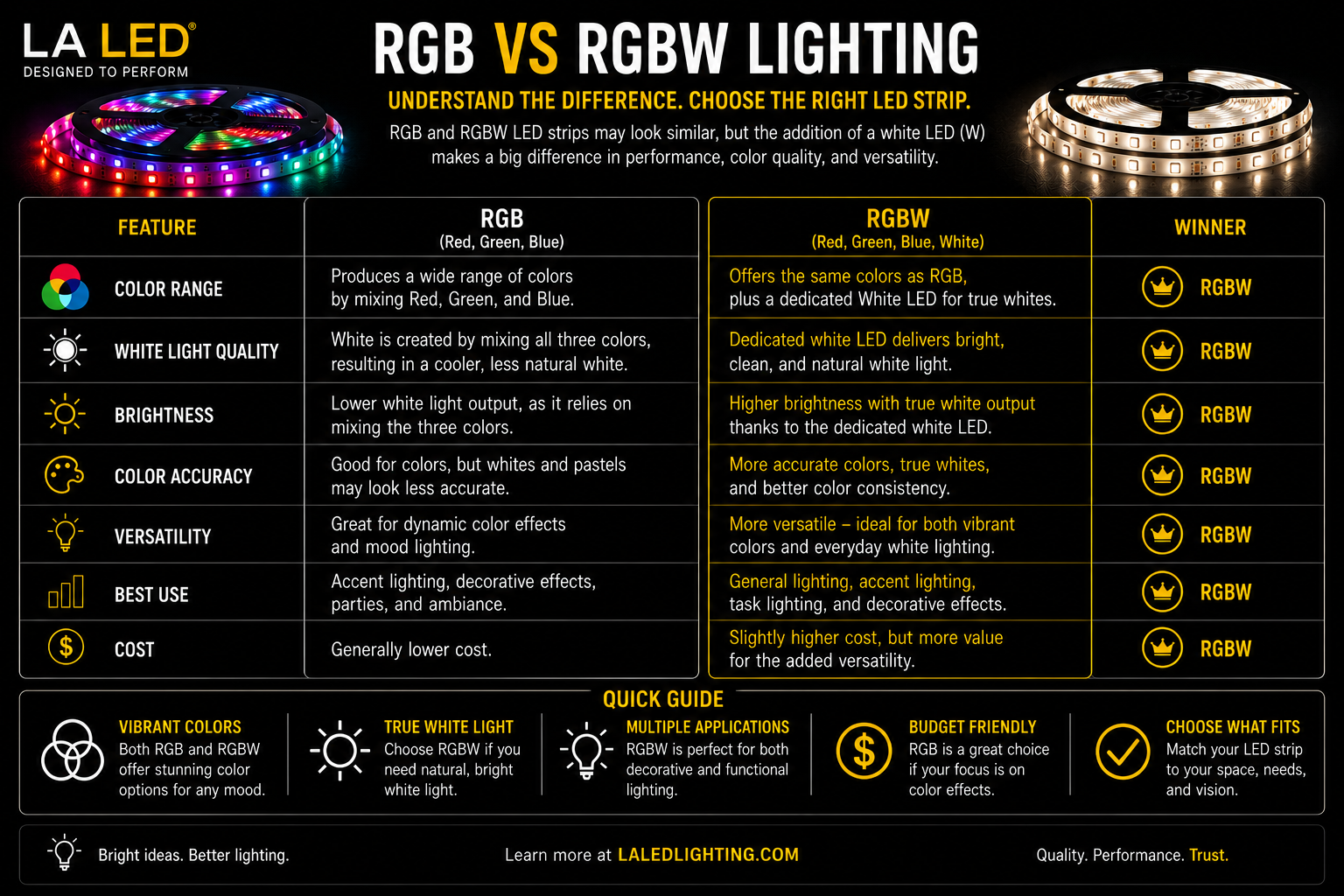
RGB vs RGBW Lighting: Which Should You Choose?
If you have ever installed color-changing LED strip lights and felt disappointed by the white setting, you already understand the key difference between RGB and RGBW lighting. The choice is not just about one extra letter. It is about whether the system can produce clean, usable white light in addition to color effects.
For homeowners, contractors, and lighting installers, choosing between RGB and RGBW affects the strip, controller, wiring, driver, and final appearance of the project.
What Is RGB Lighting?
RGB lighting uses three LED colors:
- Red
- Green
- Blue
By mixing these three colors, RGB LED strips can create a wide range of color effects. They are commonly used for:
- Entertainment lighting
- Gaming rooms
- Accent lighting
- Backlighting
- Bars and lounges
- Decorative lighting
RGB can also create a version of white by mixing red, green, and blue together. However, this white often looks slightly tinted, cool, or uneven.
What Is RGBW Lighting?
RGBW lighting includes the same red, green, and blue channels, plus a dedicated white LED channel.
That white channel is the main advantage.
Instead of simulating white by blending colors, RGBW strips can produce true white light while still offering color-changing effects.
RGBW is ideal for projects that need both:
- Decorative color scenes
- Practical white illumination
RGB vs RGBW: The Main Difference
The biggest difference is white light quality.
RGB creates white by mixing colors.
RGBW creates white using a dedicated white LED.
This makes RGBW better for everyday lighting applications where the white setting actually matters.
Why RGB White Often Looks Poor
RGB can technically create white, but it is usually not the same quality as a true white LED.
RGB white may appear:
- Slightly blue
- Slightly pink
- Uneven
- Less natural
- Less comfortable for daily use
That may be fine behind a TV or under a bar counter, but it can look wrong in kitchens, offices, display shelves, coves, and architectural lighting.
When RGB Lighting Makes Sense
RGB is a good choice when color effects are the main goal.
Choose RGB for:
- Game rooms
- Media rooms
- Party lighting
- Holiday lighting
- Accent walls
- Decorative backlighting
- Budget-friendly color projects
If the system will rarely be used for white light, RGB can be a practical and cost-effective option.
When RGBW Is the Better Choice
RGBW is the better option when the lighting needs to be useful as well as decorative.
Choose RGBW for:
- Kitchen lighting
- Cove lighting
- Retail displays
- Outdoor architectural accents
- Built-in shelving
- Hospitality spaces
- Premium residential projects
RGBW gives you color effects when you want them and clean white light when you need normal illumination.
Control and Wiring Differences
RGB and RGBW systems require different controllers.
An RGB strip typically uses three color channels.
An RGBW strip uses four channels:
- Red
- Green
- Blue
- White
That means RGBW requires:
- An RGBW-compatible controller
- Proper wiring
- Correct connectors
- A driver sized for the total load
Do not assume RGB and RGBW components are interchangeable.
Driver and Power Requirements
RGBW strips may draw more power than RGB strips because they include an additional white channel.
Before ordering, confirm:
- Strip voltage
- Total wattage
- Controller capacity
- Driver size
- Wire length
- Voltage drop
For longer runs, proper driver sizing and wire planning are especially important.
Recommended Product
For color-changing and architectural LED strip projects, explore:
COB LED Strip Lights
https://laledlighting.com/collections/cob-led-strip-lights
For dimming and commercial control applications, explore:
0-10V Dimmable LED Drivers
https://laledlighting.com/collections/0-10v-dimmable-led-drivers
Which Looks Better in Finished Spaces?
For pure color effects, both RGB and RGBW can look impressive when product quality is good.
For everyday use, RGBW usually looks better because most spaces spend more time in white light than color mode.
This is especially true in:
- Kitchens
- Living rooms
- Offices
- Retail displays
- Outdoor architectural lighting
- Hospitality interiors
RGBW feels more complete because it works as both accent lighting and functional lighting.
How to Choose Between RGB and RGBW
Choose RGB if:
- You mainly want color effects
- White light quality is not important
- The project is decorative
- Budget is the priority
Choose RGBW if:
- You need clean white light
- The space is used daily
- The project is residential or architectural
- You want better long-term flexibility
Final Thoughts
RGB and RGBW lighting both have a place in LED strip projects. RGB is ideal for decorative color effects, entertainment spaces, and budget-friendly accent lighting. RGBW is the better choice when the lighting also needs to provide clean, useful white light.
The best way to decide is to ask what the lights need to do when the color effects are turned off. If white light quality matters, RGBW is usually the smarter investment. If color is the only goal, RGB may be enough.