
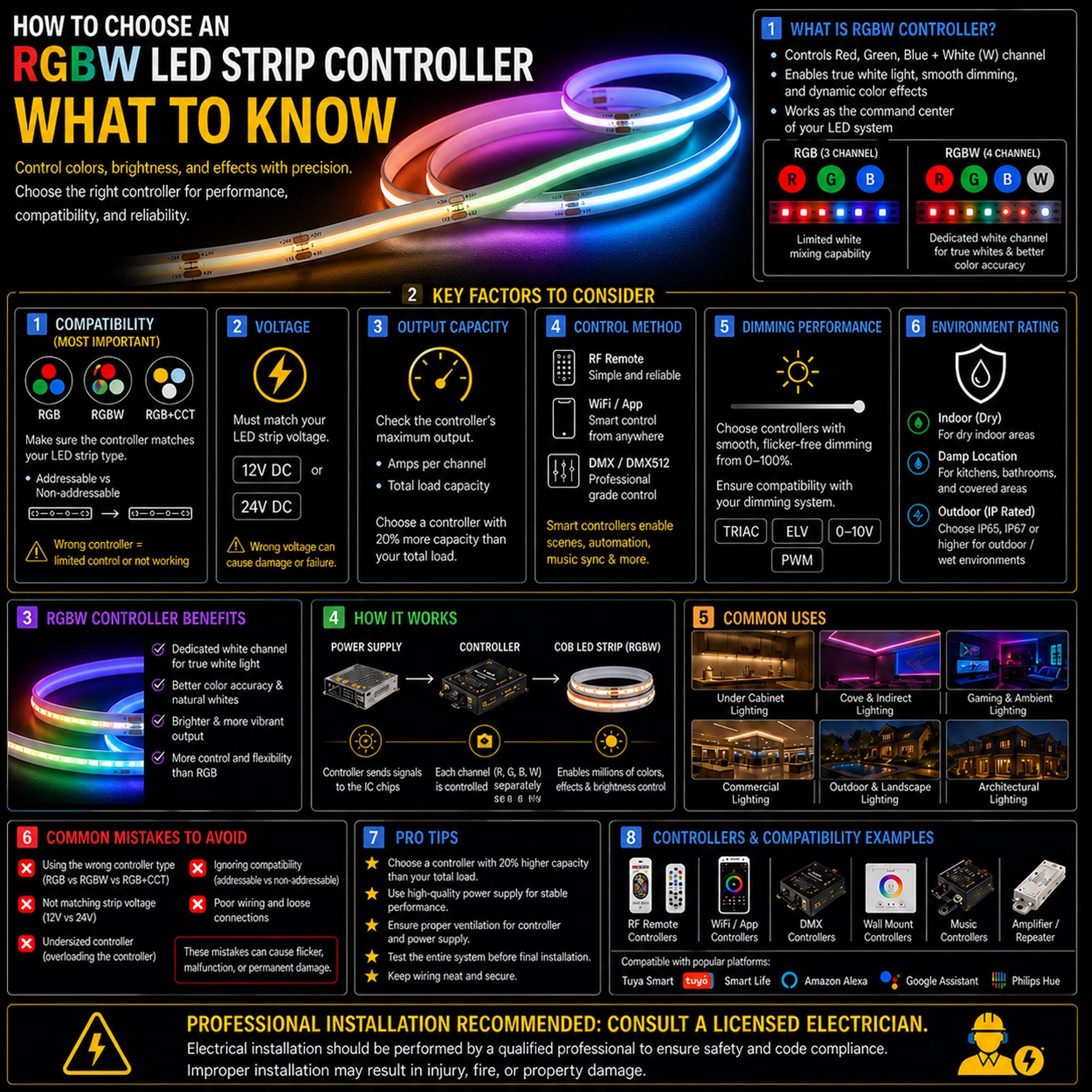
RGBW LED Strip Controller: How to Choose the Right One
A premium RGBW lighting system is only as good as the controller behind it. You can install high-quality strip lighting, use a reliable power supply, and carefully plan every detail of the project, but if the controller lags, flickers, loses signal, or struggles under load, the entire installation feels compromised.
That is why choosing the right RGBW LED strip controller matters. It is not simply an accessory. It is the component that determines how the system responds, how smoothly it dims, how accurately colors are reproduced, and how easy the lighting is to control every day.
For electricians, contractors, designers, and homeowners investing in architectural lighting, the controller is often the difference between a system that feels refined and one that becomes a source of frustration.
What an RGBW LED Strip Controller Does
An RGBW LED strip controller manages four independent channels:
- Red
- Green
- Blue
- White
The dedicated white channel is what separates RGBW lighting from traditional RGB systems.
Instead of blending red, green, and blue LEDs to imitate white light, RGBW strips use a separate white LED channel that delivers cleaner, more usable illumination. This allows the same lighting system to provide both vibrant color effects and practical white lighting for everyday use.
The controller regulates each channel independently, making it possible to:
- Adjust color output
- Dim brightness levels
- Create lighting scenes
- Switch between color and white modes
- Integrate with smart controls and automation systems
Without the proper controller, even premium RGBW strips cannot perform as intended.
Why Controller Selection Matters
Many buyers spend considerable time comparing strip lights but treat the controller as an afterthought. In reality, the controller is one of the most important components in the entire system.
A poor-quality controller can create:
- Delayed response
- Unstable dimming
- Limited wireless range
- Color inconsistencies
- Flickering
- Premature failure
In custom homes, hospitality environments, offices, retail displays, and architectural lighting projects, those issues become obvious quickly.
The right controller helps ensure that lighting remains responsive, stable, and predictable long after installation is complete.
Start With Voltage Compatibility
The first specification to verify is voltage.
Your controller must match both the LED strip and the power supply.
Most RGBW systems operate on:
- 12V DC
- 24V DC
A 24V RGBW strip requires a 24V-compatible controller. A 12V strip requires a 12V-compatible controller.
Mixing voltages is one of the fastest ways to create performance problems or damage components.
Before comparing features, confirm that all system components operate on the same voltage platform.
Make Sure the Controller Can Handle the Load
Every controller has a maximum current and wattage rating.
If the controller is undersized, the system may experience:
- Overheating
- Unstable performance
- Reduced lifespan
- Color inconsistency
- Unexpected shutdowns
This becomes especially important with:
- Long strip runs
- High-output RGBW tape lights
- Commercial installations
- Multiple zones connected to one controller
Professionals typically leave headroom rather than operating controllers at their maximum rated capacity. That additional margin helps improve reliability and long-term performance.
Choosing the Right Control Method
The best controller depends largely on how users will interact with the lighting system.
RF Remote Control
RF controllers remain one of the most popular options for residential applications.
Benefits include:
- Simple operation
- Reliable signal transmission
- No direct line-of-sight requirement
- Fast installation
RF systems work particularly well for under-cabinet lighting, shelving, media rooms, and accent lighting projects.
Wi-Fi and App Control
App-based controllers provide additional flexibility.
They often support:
- Scene programming
- Scheduling
- Zone control
- Smart home integration
- Remote access
These systems are ideal for homeowners who want greater control and customization.
The trade-off is that long-term satisfaction depends on both hardware quality and software reliability.
Wall-Mounted Controllers
Wall controls are often preferred in premium residential and commercial environments.
Advantages include:
- Permanent control location
- Clean appearance
- Familiar operation
- Professional finish
For luxury homes and custom interiors, wall-mounted controls frequently provide the most polished user experience.
DMX and Advanced Control Systems
DMX controllers are commonly used in:
- Hospitality projects
- Entertainment venues
- Commercial installations
- Architectural lighting systems
These environments often require advanced programming, precise control, and integration with larger lighting systems.
Dimming Performance Matters
One of the easiest ways to identify a low-quality controller is poor dimming performance.
A quality RGBW LED strip controller should provide:
- Smooth dimming transitions
- Stable low-end operation
- Flicker-free performance
- Consistent color output while dimming
This becomes particularly important in:
- Restaurants
- Offices
- Luxury residences
- Hospitality environments
- Media rooms
Good dimming should feel natural and predictable, not stepped or abrupt.
Choosing a Controller by Application
Residential Accent Lighting
For shelving, media walls, under-cabinet lighting, and decorative accents, compact RF or app-controlled systems are often the most practical choice.
They provide flexibility without adding unnecessary complexity.
High-End Residential Projects
Custom homes typically benefit from higher-quality control systems with:
- Better signal reliability
- Cleaner dimming performance
- Wall-mounted interfaces
- Expanded scene control
In these environments, user experience matters just as much as technical performance.
Commercial and Hospitality Spaces
Restaurants, retail stores, offices, and hospitality projects often require repeatable lighting scenes and dependable operation.
The ability to save presets and switch between white-light and color-light modes quickly can make day-to-day operation significantly easier.
Outdoor and Landscape Applications
Outdoor installations require additional consideration.
The controller itself may need:
- Protected placement
- Weather-resistant enclosures
- Proper ventilation
- Service accessibility
The entire control system should be selected with environmental conditions in mind.
Common RGBW Controller Mistakes
One of the most common mistakes is treating the controller as a secondary component.
Other frequent issues include:
- Choosing the wrong voltage
- Undersizing the controller
- Ignoring load calculations
- Selecting the wrong control protocol
- Misunderstanding RGBW wiring layouts
- Prioritizing price over reliability
Many RGBW strips use common-positive or common-negative configurations. Always verify wiring requirements before installation.
Assuming all RGBW systems are wired the same way can lead to wasted time, troubleshooting, and damaged equipment.
Reliability and Long-Term Performance
For professionals, reliability is one of the most important purchasing criteria.
A dependable RGBW LED strip controller should offer:
- Stable output
- Strong signal performance
- Quality terminals and connections
- Consistent dimming behavior
- Long-term durability
Certified, USA-standard-compliant components help reduce service issues and support dependable system performance.
This is particularly important in finished residential and commercial spaces where replacing failed components can become costly and disruptive.
How to Choose the Right RGBW LED Strip Controller
The simplest approach is to follow a clear process:
- Confirm strip voltage.
- Calculate total load requirements.
- Select a controller with appropriate capacity and headroom.
- Choose the control method that fits the project.
- Verify wiring compatibility.
- Consider environmental conditions.
- Prioritize reliability and long-term performance.
The best controller is not necessarily the most advanced or the most expensive. It is the one that matches the lighting system, the installation environment, and the way the end user will interact with the lighting every day.
Final Thoughts
An RGBW LED strip controller should disappear into the background once the installation is complete. The colors should respond instantly, the white channel should perform cleanly, and dimming should feel smooth and predictable.
When the strip, power supply, and controller are properly matched, the result is a lighting system that feels effortless to use and performs the way it was designed to.
That is ultimately what separates a professional RGBW installation from one that merely powers on.