
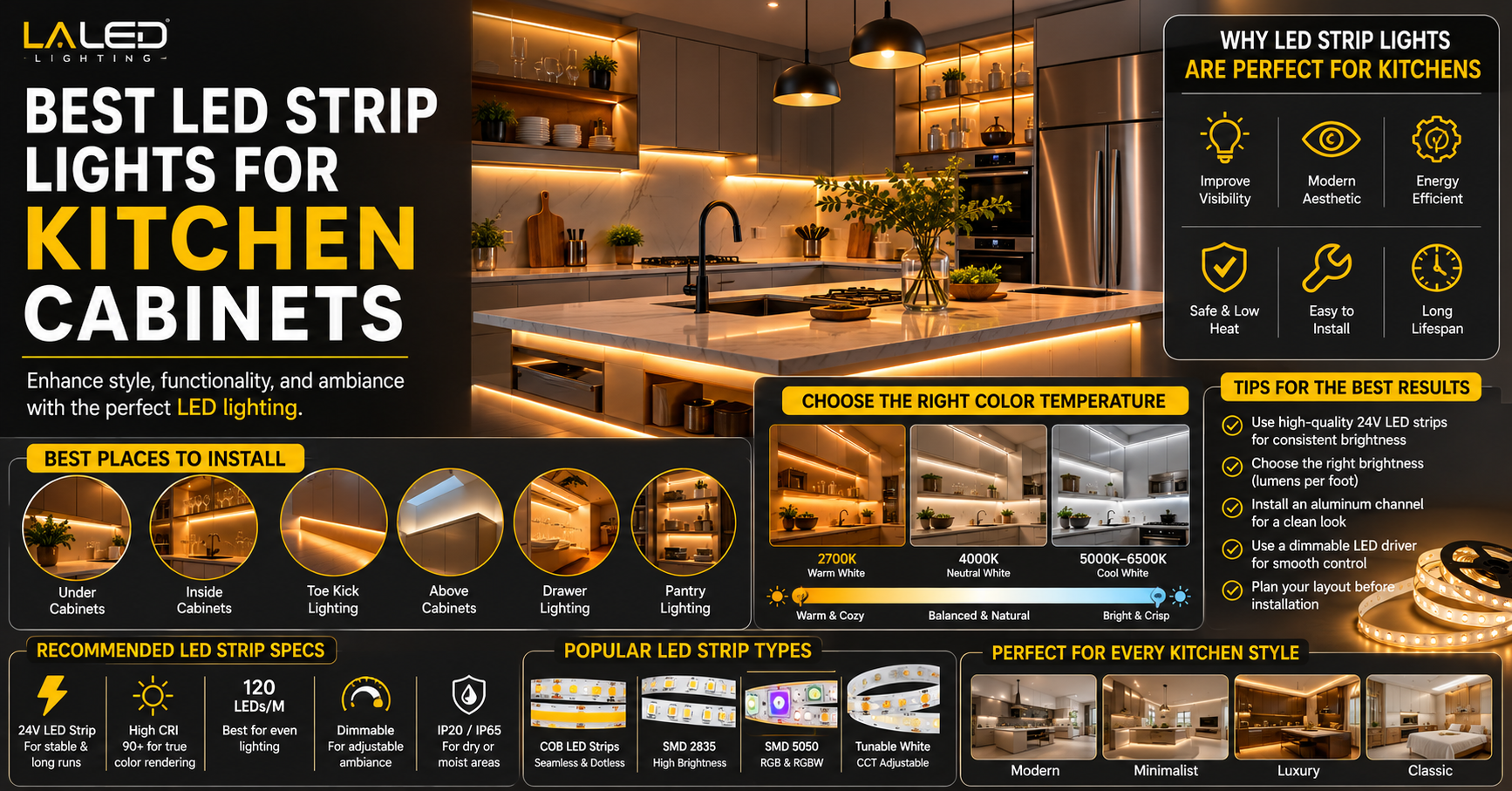
Best LED Strip Lights for Kitchen Cabinets
Under-cabinet lighting can make a kitchen feel brighter, cleaner, and more expensive. But when the wrong LED strip is installed, the problems show quickly: visible dots on the backsplash, uneven color, harsh glare, flickering, or a driver that does not fit cleanly inside the cabinet area.
Choosing the best LED strip lights for kitchen cabinets is about more than brightness. The right system should provide smooth light, dependable dimming, proper color temperature, and components that work together reliably.
For homeowners, contractors, and designers, under-cabinet lighting is one of the most important details in a kitchen remodel. It improves food prep visibility, highlights countertops and backsplashes, and gives the room a polished architectural finish.
What Makes the Best LED Strip Lights for Kitchen Cabinets?
The best LED strip lights for kitchen cabinets should provide:
-
Smooth, even illumination
-
Minimal visible hotspots
-
Reliable dimming
-
Proper color temperature
-
Correct driver compatibility
-
Clean installation with hidden wiring
-
Long-term performance
The LED strip itself is only one part of the system. The driver, dimmer, channel, diffuser, connectors, and mounting location all affect the final result.
COB vs SMD LED Strips for Kitchen Cabinets
COB LED Strip Lights
For most premium kitchen cabinet installations, COB LED strip lights are the best choice.
COB stands for Chip on Board. This design places many LED chips close together to create a smoother, more continuous line of light. The result is a cleaner appearance with fewer visible dots compared to traditional LED tape.
COB strips are especially useful under kitchen cabinets because countertops, tile, stone, and glossy surfaces can reflect individual LED points.
COB LED strips are ideal for:
-
High-end kitchens
-
Under-cabinet task lighting
-
Modern cabinetry
-
Reflective countertops
-
Shallow aluminum channels
-
Clean dotless illumination
Recommended Product
COB LED Strip Lights
https://laledlighting.com/collections/cob-led-strip-lights
These are a strong choice for kitchen cabinet lighting where smooth, professional-looking illumination matters.
SMD LED Strip Lights
SMD LED strips can still work well, especially when they are hidden behind a cabinet lip or installed inside an aluminum channel with a diffuser.
They may be a practical choice when:
-
Budget is the priority
-
The strip is fully concealed
-
A diffuser will hide the diode points
-
Maximum brightness is more important than dotless appearance
However, for visible or reflective kitchen applications, COB usually provides a cleaner result.
How Bright Should Kitchen Cabinet LED Strips Be?
Kitchen cabinet lighting should be bright enough for food prep but not so harsh that it creates glare.
The best brightness depends on:
-
Countertop color
-
Cabinet depth
-
Ceiling lighting
-
Backsplash reflectivity
-
Whether the lighting is for task use or ambiance
For task lighting, choose a strip bright enough to illuminate the full counter depth evenly. For mood lighting, use a dimmable system so the light can be lowered in the evening.
A dimmable LED strip system is usually the best option because it gives you flexibility. You can use full brightness for cooking and cleaning, then lower the light for a softer nighttime look.
Best Color Temperature for Kitchen Cabinet Lighting
Color temperature changes how the kitchen feels and how materials appear.
2700K
Warm and soft. Best for traditional kitchens, warm wood cabinets, and cozy evening lighting.
3000K
The most popular choice for residential kitchens. It feels warm but still clean enough for task lighting.
3500K
A great option for modern kitchens. It gives a brighter, cleaner appearance without feeling too cold.
4000K
Crisp and task-focused. Better for commercial kitchens, utility spaces, or very modern designs.
For most homes, 3000K or 3500K is the safest choice for under-cabinet LED strip lighting.
Why the Driver and Dimmer Matter
A high-quality LED strip can still perform poorly if it is paired with the wrong driver or dimmer.
Common problems include:
-
Flickering
-
Buzzing
-
Poor low-end dimming
-
Lights shutting off unexpectedly
-
Driver overheating
-
Uneven brightness
Before ordering, confirm:
-
Strip voltage, usually 12V or 24V
-
Total wattage
-
Driver capacity
-
Dimming method
-
Installation location
-
Available space for the driver
For kitchen cabinet lighting, a properly sized dimmable LED driver is just as important as the strip itself.
Recommended Driver Option
For projects requiring professional dimming control, explore:
0-10V Dimmable LED Drivers
https://laledlighting.com/collections/0-10v-dimmable-led-drivers
These drivers are useful for architectural lighting, commercial kitchens, larger residential projects, and dimming systems where smooth control is important.
Use Aluminum Channels for a Cleaner Finish
Aluminum channels are highly recommended for under-cabinet LED strip lighting.
They help:
-
Protect the LED strip
-
Improve heat management
-
Hide the strip from direct view
-
Create a cleaner finished appearance
-
Reduce glare
-
Support longer system life
Even when using COB strips, aluminum channels make the installation look more professional.
With SMD strips, channels and diffusers are even more important because they help soften visible diode points.
Where to Mount LED Strips Under Cabinets
Placement affects both appearance and performance.
For most kitchens, mount the strip near the front underside of the cabinet. This sends light across the countertop instead of only lighting the backsplash.
If the strip is mounted too far back, the backsplash may become bright while the working area stays shadowed.
If the strip is mounted too far forward without a channel or diffuser, the light source may be visible from normal standing angles.
The best placement depends on cabinet depth, countertop finish, and sightlines.
Single Color, Tunable White, RGB, or RGBW?
For most kitchen cabinet lighting, single-color white is the best choice.
It is simple, reliable, and ideal for everyday use.
Single Color White
Best for task lighting and most residential kitchens.
Tunable White
Good for premium kitchens where the homeowner wants warmer light at night and cleaner light during the day.
RGB or RGBW
Better for accent lighting, bars, display areas, or entertainment spaces. RGB and RGBW are usually not the best choice for primary kitchen task lighting.
For serious kitchen lighting, white light quality should come first.
Common Mistakes to Avoid
Choosing the Cheapest Strip
Low-cost strips often have poor color consistency, weak adhesive, visible dots, and shorter life.
Ignoring the Driver
The driver must match the strip voltage, total wattage, and dimming method.
Skipping Aluminum Channels
Bare strip lighting can look unfinished and may not manage heat as well.
Mixing Color Temperatures
If your under-cabinet lights are 4000K but your pendants are 2700K, the kitchen may feel inconsistent.
Forgetting About Dimming
A dimmable system gives you much better control for cooking, cleaning, and nighttime use.
Final Thoughts
The best LED strip lights for kitchen cabinets are the ones that provide smooth, even illumination, match the kitchen’s design, and work reliably with the correct driver and dimmer.
For a premium result, start with high-quality COB LED strip lights, use aluminum channels, choose 3000K or 3500K color temperature, and pair the system with a properly sized dimmable driver.
When the strip, driver, dimmer, and installation method are matched correctly, under-cabinet lighting becomes more than an accessory. It becomes part of the kitchen’s finished design.