
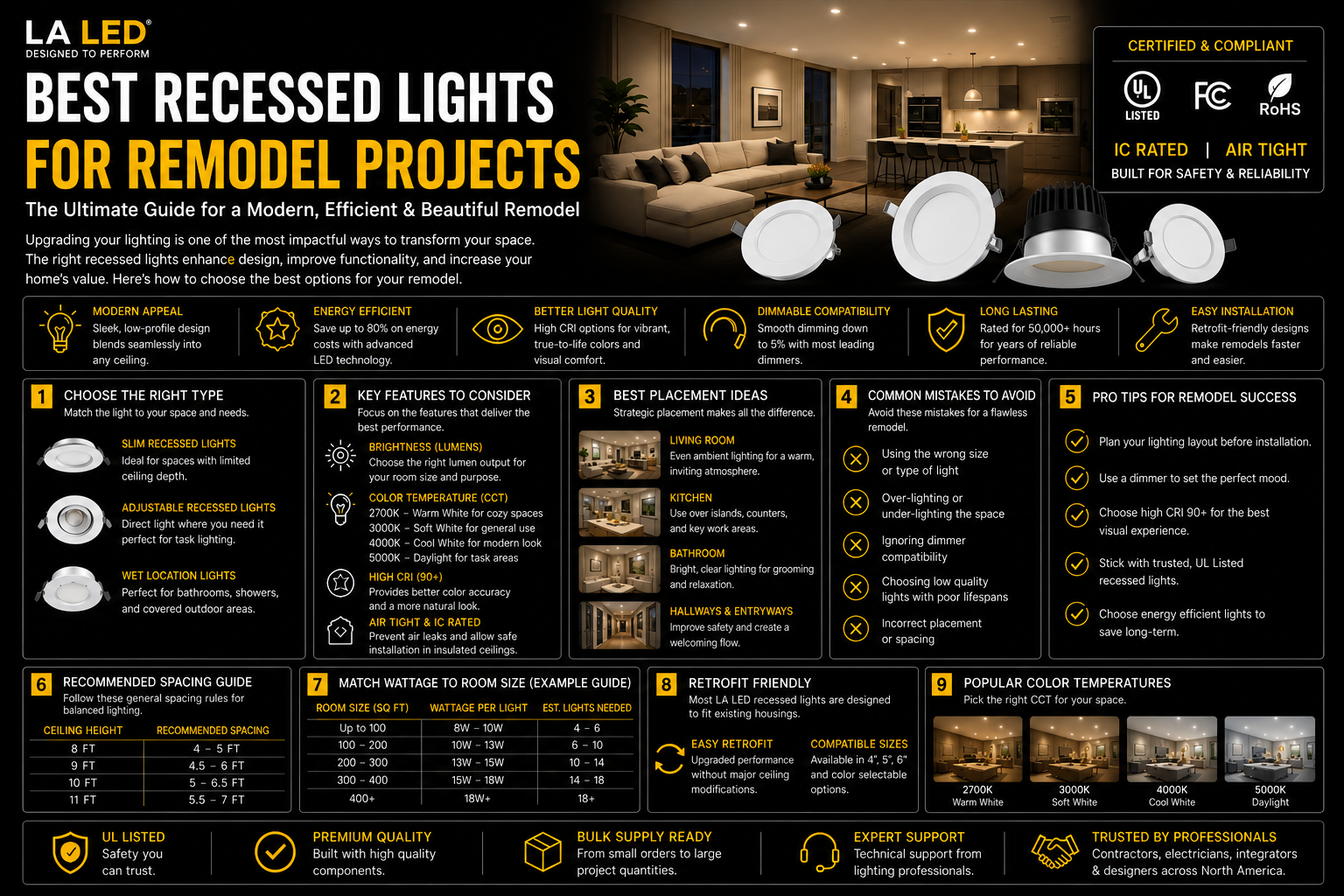
Best Recessed Lights for Remodel Projects
Recessed lighting can make or break a remodel. The right fixture blends seamlessly into the ceiling, provides balanced illumination, and works reliably for years. The wrong one can create glare, dimming issues, installation headaches, and costly callbacks.
Whether you're renovating a kitchen, updating a bathroom, replacing outdated can lights, or upgrading a commercial space, selecting the right recessed lighting is about more than brightness alone. Ceiling conditions, dimming compatibility, insulation requirements, and overall finish quality all play a role.
What Makes the Best Recessed Lights for Remodel Work?
Unlike new construction, remodel projects come with limitations. Existing framing, insulation, ductwork, and ceiling depth often dictate what can be installed.
That's why canless LED downlights and slim wafer fixtures have become popular choices. They require minimal ceiling space, install through a simple cutout, and eliminate the need for bulky recessed housings.
The best recessed lights for remodel applications typically offer:
- Slim or low-profile design
- IC-rated construction for insulation contact
- Airtight performance
- Smooth dimming compatibility
- Reliable LED drivers
- Wet or damp location ratings when required
- UL-listed certification for safety and code compliance
Start With the Ceiling Conditions
Before choosing a fixture, evaluate the ceiling itself.
Consider:
- Available cavity depth
- Joist spacing
- Existing wiring
- Insulation contact requirements
- Moisture exposure
- Air-sealing needs
If the fixture will be covered by insulation, choose an IC-rated model. For bathrooms, showers, soffits, or covered outdoor areas, verify the appropriate damp or wet location rating.
A fixture that fits the room aesthetically but fails the installation requirements can quickly turn into a project delay.
4-Inch vs. 6-Inch Recessed Lights
Fixture size impacts both appearance and performance.
4-Inch Recessed Lights
For most modern residential remodels, 4-inch fixtures are the preferred option.
Benefits include:
- Cleaner architectural appearance
- Better scale for kitchens and living spaces
- Less visual clutter on the ceiling
- Easier integration into modern designs
They work particularly well in kitchens, bathrooms, hallways, bedrooms, and open-concept living areas.
6-Inch Recessed Lights
Six-inch fixtures remain useful in:
- Larger rooms
- Commercial spaces
- Higher ceilings
- Utility areas
They provide broader light distribution but can appear more utilitarian compared to smaller fixtures.
For many remodel projects, 4-inch canless LED downlights strike the best balance between performance and aesthetics.
When Slim Wafer Lights Make Sense
Slim wafer lights are often the easiest solution when ceiling depth is limited.
They're ideal for:
- Remodels with shallow ceiling cavities
- Tight framing conditions
- Areas with ductwork or plumbing obstructions
- Fast retrofit installations
However, fixture quality matters. Lower-grade wafers can produce glare, uneven diffusion, and less comfortable light output.
For premium projects, look for models with quality optics, smooth dimming performance, and refined trim design.
When Architectural Downlights Are Worth the Upgrade
In higher-end projects, regressed or architectural downlights often provide a more polished result.
A regressed fixture positions the light source deeper inside the housing, reducing glare and improving visual comfort.
Benefits include:
- Better glare control
- More refined appearance
- Higher-end architectural look
- Improved visual comfort
These fixtures are especially popular in:
- Luxury homes
- Living rooms
- Dining areas
- Hospitality spaces
- Designer remodels
While they cost more than standard wafer lights, the visual upgrade can be significant.
Dimming Compatibility Matters
Few things frustrate homeowners more than recessed lights that flicker, buzz, or shut off at low dim levels.
Always verify compatibility between:
- Fixture
- Driver
- Dimmer
Most residential remodels use TRIAC dimming, while higher-end projects may use ELV or 0-10V controls.
Smooth dimming, quiet operation, and stable low-end performance are often what separate professional-grade lighting from budget fixtures.
If the project includes tunable white lighting, compatibility becomes even more important because both the driver and control system must work together properly.
Choosing the Right Color Temperature
Color temperature has a major impact on how a room feels.
General recommendations include:
- 2700K: Warm and comfortable living spaces
- 3000K: Popular choice for kitchens and whole-home remodels
- 3500K: Balanced and slightly crisper appearance
- 4000K: Common in offices and commercial environments
Many remodelers prefer selectable-CCT fixtures because they allow adjustments during final installation. Others prefer dedicated color temperatures for maximum consistency throughout the project.
Focus on Light Quality, Not Just Wattage
LED fixtures should be evaluated by light quality rather than wattage alone.
Key factors include:
- Lumen output
- Beam spread
- Optic quality
- Color consistency
- Ceiling height
- Room layout
A fixture with excellent optics and balanced distribution often performs better than a higher-output fixture with poor beam control.
In kitchens, even countertop illumination is essential. In hallways, proper spacing prevents scalloping. In living areas, layered lighting usually creates a better result than relying solely on high-output downlights.
Reliability Matters
Lighting problems become expensive after the ceiling is closed.
Look for fixtures with:
- Quality thermal management
- Reliable LED drivers
- Secure electrical connections
- Consistent trim finishes
- Long-term performance ratings
For contractors and remodelers, product consistency is just as important as performance. Every fixture should dim the same way, match in color, and deliver uniform output throughout the installation.
How to Choose the Best Recessed Lights for Remodel Projects
For most remodel applications, an IC-rated, airtight, dimmable LED canless downlight is the safest starting point.
For premium projects, consider upgrading to regressed architectural fixtures with enhanced glare control and cleaner aesthetics.
Before purchasing, verify:
- Ceiling depth and installation requirements
- IC and airtight ratings
- Wet or damp location suitability
- Dimming compatibility
- Color temperature
- Fixture size
- Driver quality and reliability
The best recessed light is not necessarily the least expensive option. It is the one that fits the ceiling, works with the controls, complements the room design, and performs reliably for years.
When the fixture, driver, dimmer, and application all work together, recessed lighting becomes nearly invisible—and that's exactly what great lighting should do.