
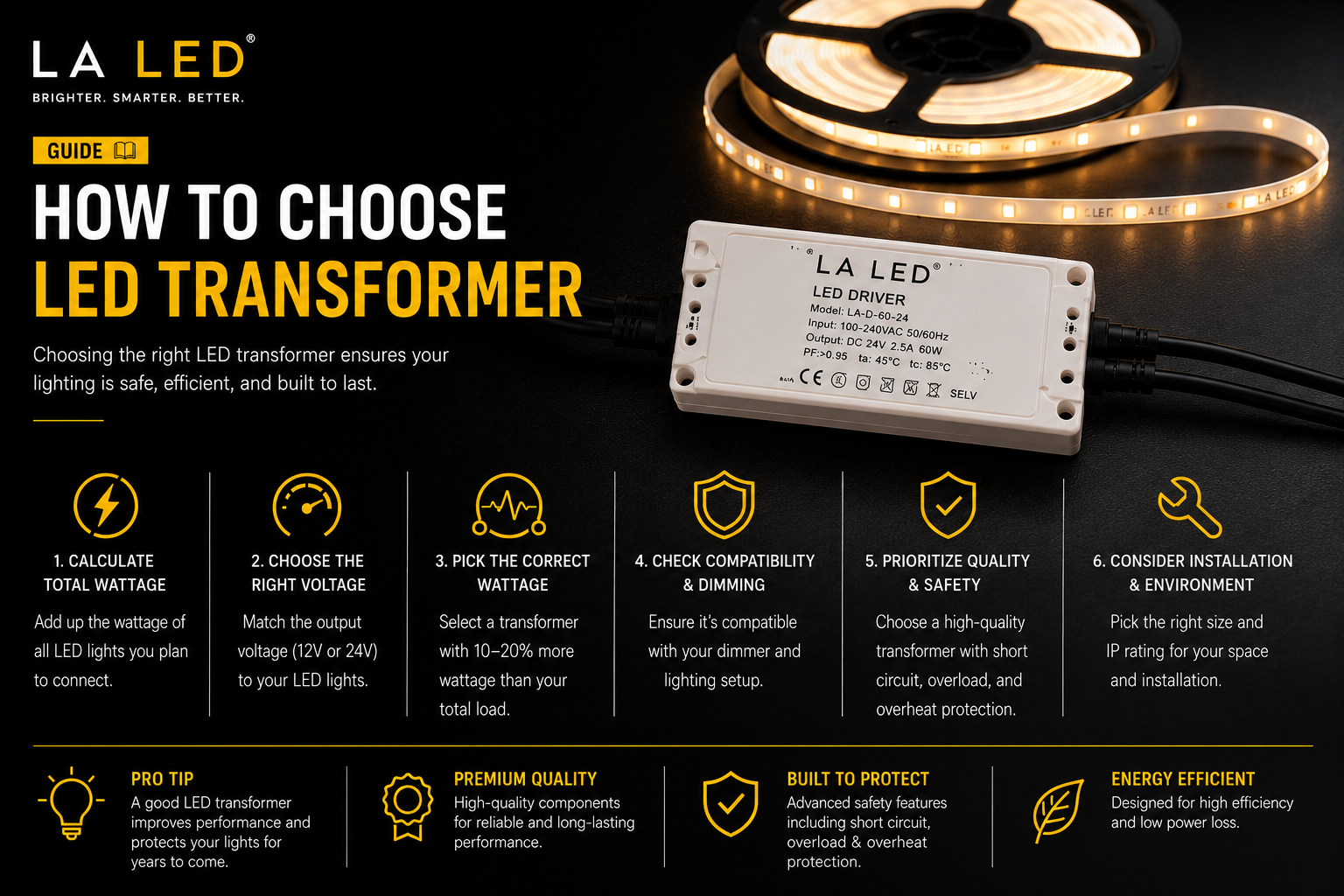
How to Choose an LED Transformer
Choosing the right LED transformer is essential for reliable lighting performance. A transformer that is too small, incorrectly matched, or installed in the wrong environment can cause flickering, overheating, dimming problems, or early LED failure.
Whether you are installing LED strip lights, under-cabinet lighting, landscape lighting, or architectural accent lighting, the right transformer must match the electrical requirements of the LEDs and the real conditions of the installation.
Start With the LED Product
Before choosing a transformer, check the specifications of the LED strip or fixture you are powering.
Look for:
- Input voltage
- Total wattage
- Constant voltage or constant current requirement
- Dimming compatibility
- Indoor, damp, or wet location requirements
Most LED strip lighting uses constant voltage power, usually 12V DC or 24V DC. Many recessed fixtures and specialty LED modules may require a constant current LED driver instead.
This distinction matters because transformers and drivers are not always interchangeable.
Match the Output Voltage Exactly
Voltage is the first requirement to confirm.
A 12V LED product needs a 12V power source.
A 24V LED product needs a 24V power source.
Using the wrong voltage can damage the LEDs or prevent the system from working correctly. A selectable unit such as the 60W 5-in-1 Dimmable LED Driver (12V / 24V) can be set to either output, which is useful when the strip has not been finalized yet.
For longer LED strip runs, 24V systems are often preferred because they help reduce voltage drop and maintain more consistent brightness over distance.
Calculate Wattage and Add Headroom
After voltage is matched, calculate the total wattage of the connected LED load.
For LED strip lights, multiply:
Watts per foot × Total feet = Total wattage
Example:
16 feet × 5 watts per foot = 80 watts
A good rule is to choose a transformer with about 20% extra capacity. For an 80W load, a 100W or 120W transformer is usually a better choice than an 80W unit running at full capacity. The 100W 5-in-1 Dimmable LED Driver matches that example directly, and the 96W Compact Dimmable LED Transformer (24V) covers the same load where installation space is limited.
This extra headroom helps the transformer run cooler, improve reliability, and extend system life.
Check Dimming Compatibility
If the lights need to dim, the transformer must support the same dimming method as the control system.
Common dimming types include:
- TRIAC
- ELV
- MLV
- 0-10V
These systems are not interchangeable. A dimmable wall switch and a dimmable transformer must be compatible with each other and with the LED load.
For commercial, architectural, or advanced residential projects, 0-10V dimming is often a strong option. A transformer that accepts all four protocols, such as the 200W 5-in-1 Dimmable LED Driver, avoids the mismatch entirely, and the full 0-10V dimmable LED driver range covers projects requiring smooth, professional-grade control.
Know Whether You Need a Transformer or Driver
Many people use the words transformer and driver interchangeably, but the correct product depends on the lighting system.
Use a constant voltage transformer or power supply for:
- LED strip lights
- COB tape lights
- Under-cabinet lighting
- Cove lighting
- Low-voltage accent lighting
Use a constant current LED driver for:
- Some downlights
- LED modules
- Integrated fixtures
- Specialty luminaires
Always follow the fixture or strip light specifications before choosing the power component.
Consider the Installation Location
A transformer that works in a dry indoor cabinet may not be suitable for a bathroom, exterior soffit, garage, or landscape project.
Check whether the transformer is rated for:
- Dry locations
- Damp locations
- Wet locations
For wet-location products, remember: wet location does not mean suitable for submersion unless the product is specifically rated for that use.
Outdoor and landscape projects also require attention to moisture, heat, enclosure type, and wire run distance. A sealed unit such as the 96W Dimmable LED Transformer (24V, IP65) is built for those conditions rather than an indoor transformer placed inside a protective box.
Plan for Wire Distance and Voltage Drop
If the transformer is mounted far from the LED load, voltage drop can reduce performance.
Common symptoms include:
- Dimmer light at the far end
- Uneven brightness
- Color inconsistency
- Flickering
To reduce voltage drop:
- Use 24V products when appropriate
- Keep wire runs shorter
- Use proper wire gauge
- Split long runs into multiple feeds
- Place the transformer closer to the load when possible
Choose Quality and Certified Components
Not all LED transformers are built to the same standard. For residential remodels, commercial interiors, and high-end custom work, quality and certification matter.
Look for:
- UL-listed or recognized components
- Clear voltage and wattage ratings
- Reliable dimming specifications
- Proper enclosure ratings
- Compatibility with your LED system
A quality transformer helps reduce flicker, improve dimming, and prevent unnecessary service calls.
Quick Selection Checklist
Before purchasing, confirm:
- LED type: strip, fixture, RGB, RGBW, CCT, or single color
- Output voltage: 12V or 24V
- Total wattage
- Extra capacity headroom
- Dimming method
- Indoor, damp, or wet location rating
- Physical size and installation space
- Controller compatibility if using RGB, RGBW, or tunable white
On that last point, a controller that covers every strip type, such as the MiBoxer WL5 WiFi 5-in-1 LED Controller (12-48V), works with single color, CCT, RGB, RGBW, and RGB+CCT strips, so the controller does not have to be re-selected if the strip type changes.
Final Thoughts
The best LED transformer is not the largest or cheapest option. It is the one that matches the voltage, wattage, dimming method, and installation environment of your project.
When these details are correct, your LED lighting system will perform more reliably, dim more smoothly, and last longer. Whether you are lighting kitchen cabinets, outdoor accents, coves, or commercial spaces, choosing the right transformer from the start helps prevent flicker, overheating, and costly troubleshooting later.