
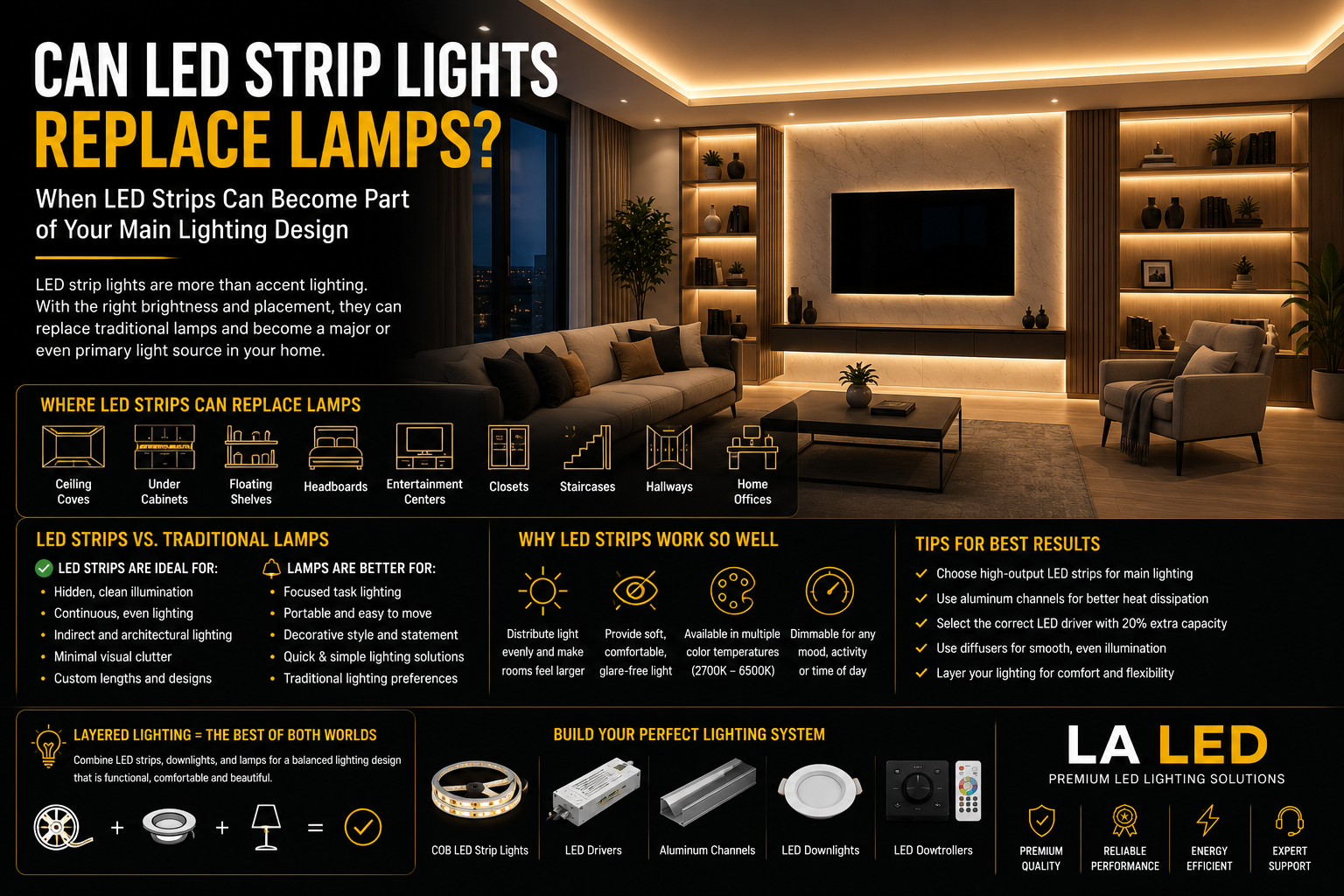
LED strip lights have changed the way homeowners think about lighting. Instead of relying only on ceiling fixtures, floor lamps, and table lamps, LED strips can be hidden inside ceilings, cabinets, shelves, walls, and furniture to create clean and modern illumination.
But can LED strip lights actually replace traditional lamps?
In some rooms and applications, yes. Properly designed LED strip lighting can provide enough illumination to serve as a major or even primary light source. However, lamps still have advantages for certain activities and lighting styles.
The best solution depends on how much light you need, where the LED strips are installed, and how the room is used.
Can LED Strips Provide Enough Light for a Room?
Yes—but not every LED strip is designed for primary illumination.
Decorative LED strips may produce enough light for ambiance but not enough to comfortably illuminate an entire room.
Higher-output LED strips can provide significantly more usable light when installed correctly.
When determining whether LED strips can replace lamps, consider:
- Lumens per foot or meter
- Total installed strip length
- Room size
- Ceiling height
- Placement of the strips
- Wall and ceiling colors
- Type of diffuser or aluminum channel
- Desired brightness
The total light output matters much more than simply how many feet of LED strip you install.
Where Can LED Strips Replace Lamps?
LED strip lighting can work particularly well in areas where indirect or integrated illumination is preferred.
Popular applications include:
- Ceiling coves
- Under kitchen cabinets
- Floating shelves
- Built-in cabinets
- Entertainment centers
- Headboards
- Closets
- Hallways
- Staircases
- Home offices
- Architectural features
In these applications, LED strips can sometimes eliminate the need for additional lamps altogether.
Living Rooms
In a living room, LED strip lights can provide beautiful ambient illumination when installed in ceiling coves, behind entertainment centers, or inside architectural details.
However, a floor or table lamp may still be useful beside a sofa or reading chair.
Rather than thinking of LED strips and lamps as competitors, combining them can create a more comfortable and flexible lighting environment.
Bedrooms
Bedrooms are particularly well suited to LED strip lighting.
LED strips can be installed:
- Behind the headboard
- Around ceiling coves
- Beneath the bed
- Inside closets
- Under floating shelves
With sufficient light output, ceiling cove lighting can provide much of the room's general illumination.
A bedside lamp or dedicated reading light may still be preferable when focused task lighting is needed.
Kitchens
In kitchens, LED strips can often replace small task lamps completely.
Under-cabinet LED lighting provides direct illumination across countertops without occupying valuable workspace.
LED strips can also be installed above cabinets, inside glass-front cabinets, along toe kicks, and within architectural ceiling features.
For most kitchens, however, under-cabinet lighting works best as part of a layered system that also includes ceiling or recessed lighting.
Home Offices
LED strips can provide excellent ambient and desk lighting, especially when installed beneath shelves or cabinets.
However, detailed work may require more focused task lighting.
A combination of indirect LED lighting and a dedicated desk light can reduce shadows while maintaining comfortable overall illumination.
LED Strips vs. Traditional Lamps
Traditional lamps and LED strip lights serve different purposes.
LED strips are particularly effective when you want:
- Hidden illumination
- Clean architectural lines
- Continuous lighting
- Minimal visual clutter
- Indirect lighting
- Custom installation lengths
Traditional lamps are useful when you want:
- Focused task lighting
- Portable illumination
- Decorative fixtures
- Easy repositioning
- A traditional interior design element
Neither option is automatically better. The ideal choice depends on the room and its function.
COB LED Strips Create a Cleaner Look
COB LED strip lights are especially suitable for modern interiors because they produce a smooth, continuous line of illumination with minimal visible spotting.
This makes them ideal for:
- Ceiling coves
- Shelving
- Cabinets
- Furniture
- Architectural details
When paired with the appropriate aluminum channel and diffuser, COB LED strips can create a clean, professionally integrated lighting effect.
Indirect Lighting Can Make a Room Feel Larger
One advantage LED strips have over traditional lamps is their ability to distribute light across large surfaces.
For example, a hidden LED strip inside a ceiling cove can illuminate the ceiling rather than shining directly into the room.
The reflected light creates softer illumination and can visually make the ceiling feel higher and the room more spacious.
This technique is frequently used in modern and luxury interior lighting.
Brightness Still Matters
A beautiful LED installation won't replace a lamp if it doesn't produce enough usable light.
Before designing the system, check the light output of the LED strip.
A low-output decorative strip may look beautiful around a ceiling but provide very little functional illumination.
Higher-output strips may be more appropriate when the LED lighting will contribute significantly to the room's general illumination.
Choose the Right Color Temperature
Color temperature also affects how comfortable the room feels.
For residential spaces:
2700K – Warm and cozy
3000K – Warm but slightly cleaner
4000K – Neutral and more contemporary
5000K – Cooler and brighter in appearance
For living rooms and bedrooms, 2700K–3000K is generally preferred.
Kitchens, workspaces, and some modern interiors may benefit from 3000K–4000K.
Dimming Makes LED Strip Lighting More Versatile
If LED strips are replacing or supplementing traditional lamps, dimming becomes especially useful.
A dimmable lighting system allows the same installation to provide brighter illumination during activities and softer lighting in the evening.
For example, you could use:
- Higher brightness while cleaning
- Medium brightness while entertaining
- Low brightness while watching television
- Soft illumination late at night
Always make sure the LED strip, driver, dimmer, and controller are compatible with one another.
Don't Rely on One Type of Lighting Everywhere
Even if LED strips can provide enough brightness, completely eliminating every other light source isn't always the best lighting design.
Professional interiors typically use layered lighting.
This can include:
- LED strip lighting for ambient illumination
- Downlights for general lighting
- Lamps for task lighting
- Accent lighting for artwork and architectural details
Each layer serves a different purpose.
The result is a room that feels more comfortable, flexible, and visually interesting.
Choose the Correct LED Driver
If you're installing larger amounts of LED strip lighting, selecting the correct driver is essential.
The driver must:
- Match the strip voltage
- Provide sufficient wattage
- Support dimming when required
- Be suitable for the installation environment
As a general design guideline, leaving approximately 20% additional driver capacity can help avoid continuously operating the power supply at its maximum rated load.
Always follow the specifications for the LED strip and driver being installed.
Final Thoughts
So, can LED strip lights replace lamps?
In many applications, yes—but they don't have to.
Properly designed LED strip lighting can provide significant ambient and general illumination while creating a clean, modern appearance that traditional lamps cannot easily achieve.
However, lamps remain useful for focused task lighting, decorative purposes, and areas where portable illumination is desirable.
For many homes, the best approach is a combination of LED strip lighting, downlights, and strategically placed lamps.
By layering these different light sources, you can create a space that's brighter, more comfortable, and visually sophisticated.
FAQ
Can LED strip lights be used as the main light in a room?
Yes, if the LED strips provide sufficient total light output and are positioned correctly. Low-output decorative strips may not provide enough illumination on their own.
Are COB LED strips bright enough for room lighting?
Some COB LED strips can provide substantial light output, but brightness varies by product. Always check the lumens and wattage specifications before designing the system.
Can LED strips replace bedside lamps?
They can provide ambient bedside lighting, particularly behind a headboard or beneath shelves. A dedicated reading light may still be preferable for reading.
Can under-cabinet LED strips replace kitchen task lamps?
Yes. Properly positioned LED strips can provide excellent countertop task lighting and eliminate the need for separate countertop lamps.
Should I use LED strips or recessed lights?
They serve different purposes. Recessed lights provide direct general illumination, while LED strips are excellent for indirect and architectural lighting. Combining both often produces the best result.
Are dimmable LED strips better for living spaces?
Dimming provides greater flexibility because you can adjust the same lighting system for different activities and times of day.