
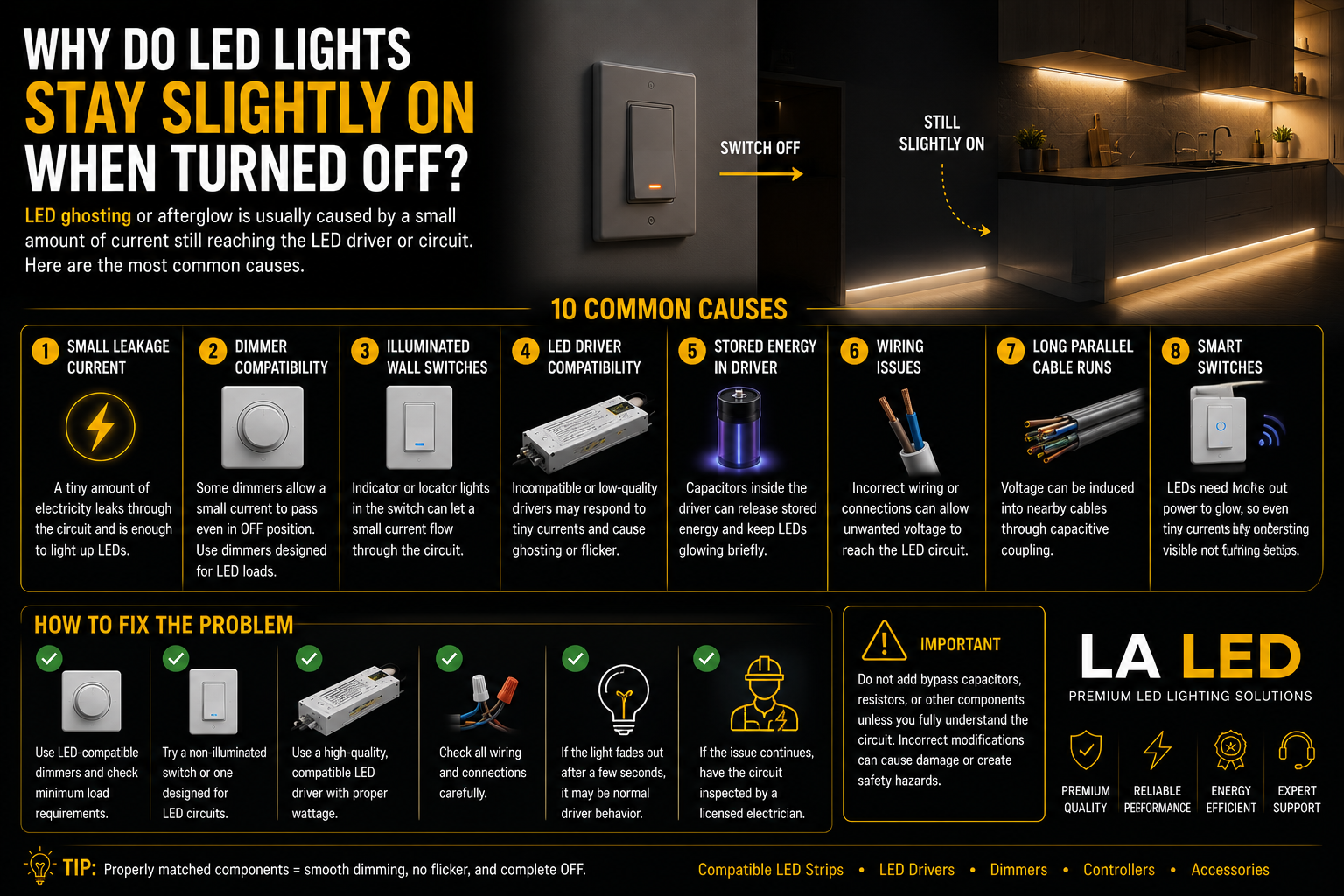
You turn off your LED lights, but instead of going completely dark, they continue to produce a faint glow.
Sometimes the light remains slightly illuminated continuously. Other times, you may notice a brief flash or occasional flicker even though the wall switch is off.
So, why do LED lights stay slightly on when turned off?
This phenomenon is often called LED ghosting or afterglow. In many cases, a very small amount of electrical current is still reaching the LED driver or lighting circuit. Because LEDs require very little power to produce light, even a tiny current can sometimes create a visible glow.
There are several possible causes.
1. Small Leakage Current
LEDs are extremely energy-efficient and require much less electrical power than traditional incandescent bulbs.
Because of this sensitivity, a very small leakage current that would never illuminate an incandescent lamp may be enough to make LEDs glow faintly.
The current may come from the switch, dimmer, wiring, driver, or another component in the circuit.
2. The Dimmer May Be the Cause
Dimmer compatibility is one of the first things to investigate when LED lights glow after being switched off.
Some electronic dimmers allow a tiny amount of current to pass through the circuit even in their OFF position.
With traditional lighting, this amount of electricity may be insignificant. But an LED driver can sometimes respond to that small current.
The result may be:
- A faint continuous glow
- Occasional flashing
- Pulsing
- Delayed shutoff
Using a dimmer specifically designed and tested for LED loads can help reduce these problems.
3. Illuminated Wall Switches
Some wall switches contain a small indicator or locator light so you can find the switch in the dark.
Depending on the switch design and circuit configuration, the indicator may allow a tiny current to pass through the lighting circuit.
With sensitive LED lighting, that current can sometimes cause the LEDs to remain faintly illuminated.
If the problem started after installing a new illuminated switch, the switch may be worth investigating.
4. LED Driver Compatibility
LED strip lights and other low-voltage LED products typically rely on an LED driver or transformer.
The driver's internal electronics can affect how the lighting behaves when switched off.
An incompatible or low-quality driver may:
- Store residual electrical energy
- Respond poorly to very small leakage currents
- Produce flickering
- Cause LEDs to remain faintly illuminated
- Create inconsistent dimming behavior
A properly matched, high-quality LED driver is important for reliable performance.
5. Stored Energy in the Driver
Some LED drivers contain capacitors that temporarily store electrical energy.
After the power is switched off, the stored energy may continue powering the LEDs for a short period.
If your LEDs glow briefly and then gradually fade completely, stored energy inside the driver may be the explanation.
A short afterglow can therefore be different from an LED that remains illuminated continuously.
6. Wiring Issues
Incorrect wiring can also cause unusual LED behavior.
Depending on the electrical system, problems involving the switched conductor, neutral, grounding, or wiring configuration may allow unwanted voltage to appear on the lighting circuit.
Electrical wiring should not be modified simply to experiment with a solution.
If the cause isn't obvious from the lighting components, have the circuit inspected by a qualified electrician.
7. Long Parallel Cable Runs
In some installations, long electrical cables run beside each other for significant distances.
A small voltage can sometimes be induced into an adjacent conductor through capacitive coupling.
For traditional lighting this may go unnoticed, but highly efficient LEDs can sometimes respond to very small amounts of electrical energy.
This situation is more likely to require professional diagnosis.
8. Smart Switches Can Contribute
Smart switches often need a small amount of electricity to operate their internal electronics, wireless communication, or indicator lights.
Some designs may allow a small current through the lighting circuit even when the lights appear to be switched off.
Depending on the LED driver and lighting load, this can result in ghosting or occasional flashing.
Compatibility between the smart switch and LED lighting system is therefore important.
9. Very Small LED Loads
Dimmers and electronic switches often have minimum-load requirements.
A lighting system consisting of only a short LED strip or a very low-wattage fixture may fall below the operating range of the dimmer.
Possible symptoms include:
- Poor dimming
- Flickering
- Lights not turning fully off
- Limited dimming range
- Unexpected flashing
Always check the manufacturer's minimum and maximum load specifications.
10. Why LEDs Show the Problem More Easily
Traditional incandescent lamps require considerably more energy before their filaments become visibly illuminated.
LEDs are different.
They can respond to extremely small electrical currents. That's why a wiring or control characteristic that was invisible with an older lamp can suddenly become noticeable after switching to LED lighting.
The LED itself isn't necessarily defective.
How Can You Stop LED Lights from Glowing When Off?
The correct solution depends on the cause.
Start by checking:
- LED driver compatibility
- Dimmer compatibility
- Minimum dimmer load
- Smart switch compatibility
- Whether the switch contains an indicator light
- Wiring and connections
- Whether the glow disappears after several seconds
If the installation uses LED strips, confirm that the LED strip, driver, dimmer, and controller are designed to work together.
If the glow continues or the cause isn't clear, a licensed electrician can measure the circuit and identify whether unwanted voltage or current is present.
Don't Randomly Add Electrical Components
You may find online suggestions recommending resistors, capacitors, bypass devices, or other components as quick fixes for LED ghosting.
These solutions should not be installed without understanding the electrical circuit and the specifications of the lighting and control equipment.
The correct solution depends on the cause of the unwanted current.
For permanent electrical installations, modifications should be performed by a qualified professional.
Choosing the Right LED Driver Matters
For LED strip lighting systems, the driver plays a major role in overall performance.
A quality LED driver that's properly matched to the strip and dimming system can help provide:
- Smooth dimming
- Stable brightness
- Reliable startup
- Consistent operation
- Proper shutoff
When selecting a driver, consider voltage, wattage, dimming technology, load requirements, and compatibility with the wall control.
Final Thoughts
If your LED lights stay slightly illuminated after being switched off, it doesn't automatically mean the LEDs are failing.
A small leakage current, incompatible dimmer, smart switch, illuminated wall switch, driver behavior, low electrical load, or wiring configuration may be responsible.
The first step is to determine whether the LEDs glow only briefly or remain illuminated continuously.
A short fade after shutoff may simply result from stored energy inside the driver. Continuous glowing or repeated flashing deserves further investigation.
Using compatible LED strips, drivers, dimmers, and controllers—and having electrical issues inspected professionally—can help ensure that your LED lighting operates correctly both when it's on and when it's supposed to be off.
FAQ
Why do my LED lights glow when the switch is off?
A small electrical current may still be reaching the LED circuit. Because LEDs require very little energy, this can sometimes produce a faint visible glow.
Is it normal for LED lights to glow briefly after turning them off?
A brief afterglow can occur because some LED drivers store a small amount of energy in internal components. If the light fades quickly, this may be normal driver behavior.
Can an LED dimmer cause lights to stay slightly on?
Yes. Some dimmers allow a small current to pass through the circuit even when switched off, particularly when the LED load is very low or the components aren't fully compatible.
Can a smart switch cause LED ghosting?
Yes. Some smart switches require a small amount of continuous power for their electronics, which can contribute to LED ghosting with certain lighting systems.
Does LED ghosting mean my LED strip is defective?
Not necessarily. The problem may originate from the dimmer, driver, switch, wiring, or another component rather than the LED strip itself.
Should I call an electrician if my LED lights stay on?
If the glow is continuous, accompanied by unusual flickering, or cannot be traced to a known compatible component, having the electrical circuit inspected by a qualified electrician is the safest approach.