
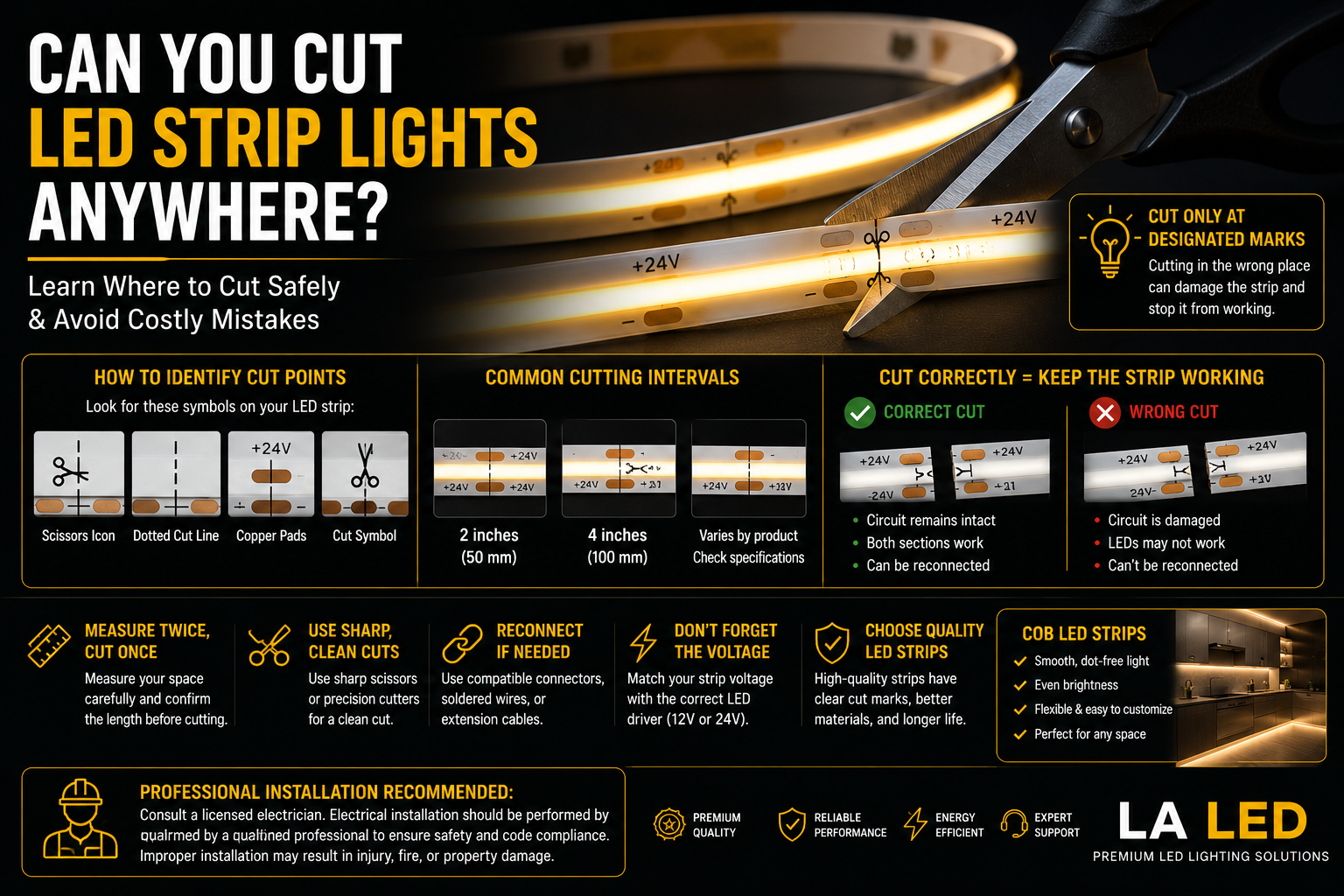
LED strip lights are designed to be flexible and customizable, making them one of the most versatile lighting solutions for homes and commercial spaces. One of the biggest advantages of LED strips is that they can often be shortened to fit your project perfectly.
However, many homeowners ask the same question before making the first cut:
Can you cut LED strip lights anywhere?
The simple answer is no.
LED strip lights can only be cut at specific cutting points marked by the manufacturer. Cutting anywhere else may permanently damage the strip and prevent part—or all—of it from working properly.
Understanding how and where to cut your LED strip will help ensure a clean installation and reliable performance.
What Are LED Strip Cutting Marks?
Most LED strip lights include clearly marked cutting lines along the strip.
These cut points are usually identified by:
- A scissors icon
- A dotted cutting line
- Copper solder pads
- Printed cut symbols
These locations are designed so the electrical circuit remains intact after cutting.
Always inspect the strip carefully before using scissors.
Why Can't You Cut Anywhere?
Inside every LED strip is a printed circuit board that distributes power to each LED.
If you cut through the circuit instead of at the designated cut mark, you may:
- Break the electrical pathway
- Damage copper traces
- Prevent the remaining LEDs from working
- Make the strip impossible to reconnect
A few extra seconds spent locating the correct cut point can save you from replacing the entire strip.
How Often Can LED Strips Be Cut?
The distance between cutting points depends on the product.
For example:
- Some COB LED strips can be cut every 2 inches (50 mm).
- Others every 4 inches (100 mm).
- Some specialty products have even shorter cutting intervals.
Always refer to the product specifications before cutting.
What Happens After You Cut?
When cut correctly:
- The section connected to the power supply continues to operate normally.
- The removed section can often be reused with compatible connectors or wiring.
- Both sections remain usable if reconnected properly.
When cut incorrectly:
- The circuit may be permanently damaged.
- Part of the strip may stop working.
- Warranty coverage may not apply if the strip is modified improperly.
Can You Reconnect a Cut LED Strip?
Yes.
Many LED strip lights can be reconnected using:
- LED strip connectors
- Soldered wire connections
- Corner connectors
- Extension cables
The correct connector depends on:
- Strip width
- Voltage
- Number of color channels (single color, RGB, RGBW, CCT)
Always use connectors specifically designed for your LED strip.
Use Sharp, Clean Cuts
For the best results:
- Use sharp scissors or precision cutters.
- Cut directly on the marked line.
- Avoid bending the strip while cutting.
- Keep the strip clean and dry.
Clean cuts improve connector fit and reduce installation problems.
Don't Forget the Voltage
Cutting a strip doesn't change its voltage requirements.
Always match:
- 12V strips with a 12V LED driver
- 24V strips with a 24V LED driver
Never connect different voltages together.
Measure Twice, Cut Once
One of the most common installation mistakes is cutting before confirming measurements.
Before cutting:
- Measure the installation area carefully.
- Test the strip while it's still connected.
- Locate the nearest cutting mark.
- Confirm the final length.
A few minutes of planning can prevent costly mistakes.
Choose Quality LED Strip Lights
Premium LED strip lights are easier to install because they include:
- Clearly marked cut points
- Durable circuit boards
- High-quality copper pads
- Reliable connectors
- Consistent brightness
High-quality COB LED strips also provide a smooth, dot-free line of light that looks more professional after installation.
Final Thoughts
LED strip lights offer incredible flexibility, but they cannot be cut just anywhere.
Always cut only at the manufacturer's designated cutting marks to protect the electrical circuit and ensure reliable performance.
With careful planning, proper tools, and quality components, cutting LED strip lights is a simple process that allows you to create a custom lighting installation that fits your space perfectly.
FAQ
Can I cut LED strip lights anywhere?
No. LED strip lights should only be cut at the designated cutting marks printed on the strip.
What happens if I cut an LED strip in the wrong place?
Cutting outside the marked cut point can damage the electrical circuit and prevent the strip from working correctly.
Can I reconnect LED strip lights after cutting them?
Yes. Most LED strips can be reconnected using compatible connectors or soldered wire connections.
How do I know where to cut my LED strip?
Look for the scissors symbol, dotted cut line, or copper solder pads printed on the strip.
Can every LED strip be cut?
Most LED strip lights are cuttable, but the cutting interval varies by product. Always check the manufacturer's specifications.