
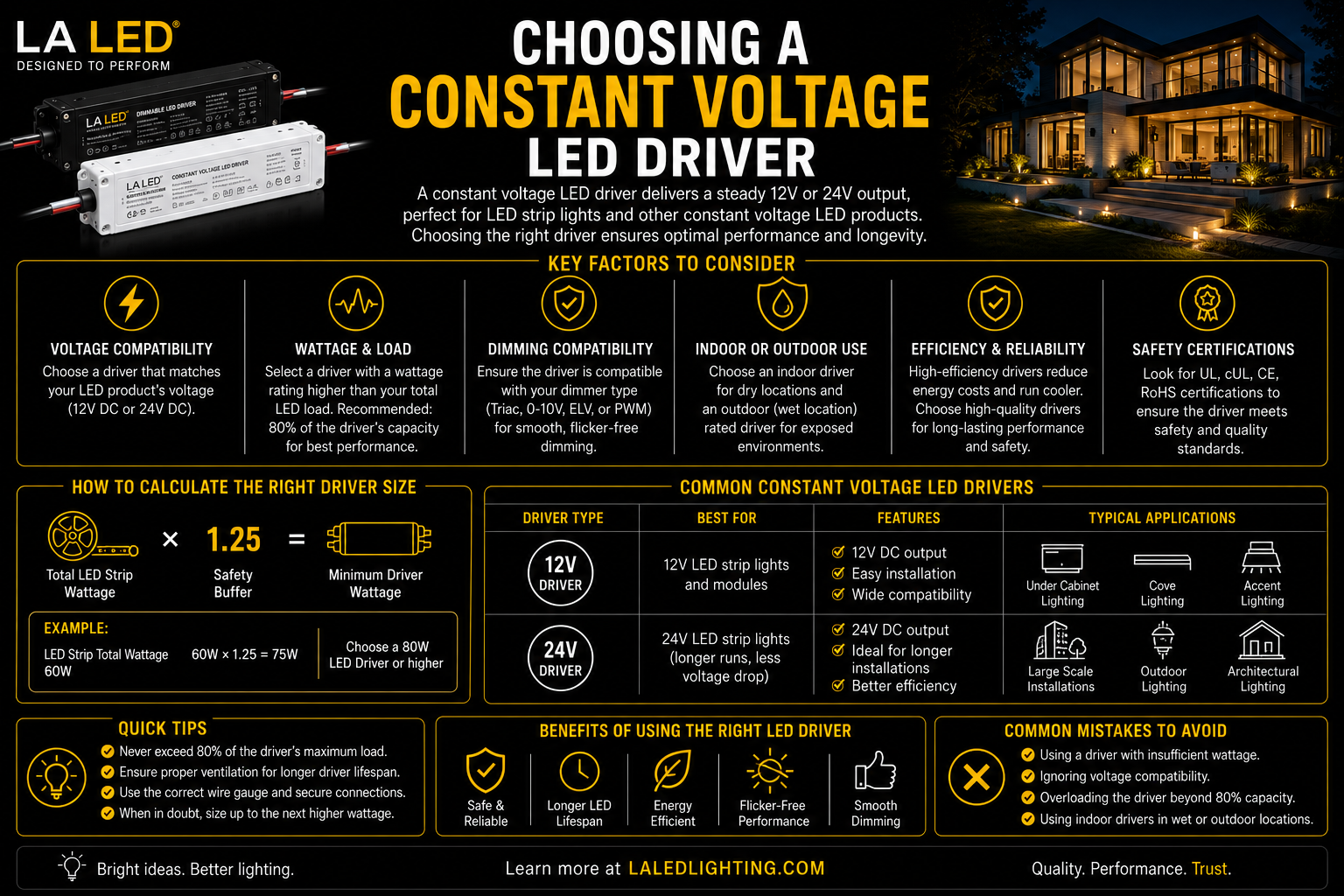
Constant Voltage LED Driver: Everything You Need to Know
If your LED strip lights flicker, dim unevenly, or fail prematurely, the problem often starts with the power supply. A constant voltage LED driver is one of the most important components in any low-voltage lighting system, helping ensure stable performance, smooth dimming, and long-term reliability.
Whether you're installing under-cabinet lighting, architectural strip lights, cove lighting, or landscape accents, choosing the right driver is just as important as choosing the LED strip itself.
What Is a Constant Voltage LED Driver?
A constant voltage LED driver converts line voltage into a fixed low-voltage DC output, most commonly 12V DC or 24V DC. It maintains a steady voltage while allowing the connected LED load to draw the current it requires.
This makes constant voltage drivers the standard choice for:
- LED strip lights
- COB LED strips
- Tape lighting
- RGB and RGBW systems
- Tunable white lighting
- Architectural accent lighting
- Under-cabinet lighting
For example, a 24V LED strip requires a 24V constant voltage driver, while a 12V strip requires a 12V driver.
Constant Voltage vs Constant Current
Many buyers confuse these two driver types, but they serve different purposes.
Constant Voltage Drivers
Constant voltage drivers provide a fixed voltage output, typically 12V or 24V DC. The LED product regulates its own current draw.
They are commonly used for:
- LED strip lighting
- Tape lighting
- Architectural lighting
- Accent lighting
- RGB and RGBW systems
Constant Current Drivers
Constant current drivers provide a fixed current output, such as:
- 350mA
- 700mA
- 1050mA
The driver adjusts voltage automatically to maintain that current.
They are commonly used for:
- LED modules
- Downlights
- Integrated fixtures
- Specialty luminaires
The two driver types are not interchangeable.
How to Choose the Right Voltage
Always start with the LED product specifications.
If the strip or fixture requires:
- 12V DC → Use a 12V constant voltage driver
- 24V DC → Use a 24V constant voltage driver
Never assume the voltage.
A 12V strip connected to a 24V driver can be permanently damaged, while a 24V strip connected to a 12V driver may not operate correctly.
12V vs 24V Systems
Both options have advantages.
12V Systems
- Common in smaller installations
- Compatible with many legacy products
- Ideal for shorter runs
24V Systems
- Better for longer runs
- Reduced voltage drop
- More consistent brightness
- Often preferred for architectural lighting
Many modern LED strip lighting systems use 24V because of its improved performance over distance.
How to Size a Constant Voltage LED Driver
Once voltage is confirmed, calculate the total wattage of the connected load.
For example:
- LED strip wattage: 5W per foot
- Run length: 20 feet
- Total load: 100W
A good practice is to add approximately 20% headroom.
In this example, a 120W driver would be a better choice than a 100W driver operating at maximum capacity.
Proper sizing helps:
- Reduce heat
- Improve reliability
- Extend driver life
- Support stable dimming performance
Dimming Compatibility Matters
Many LED lighting problems are actually dimming compatibility issues.
The driver must match the control method being used.
Common dimming types include:
- TRIAC
- ELV
- MLV
- 0-10V
A driver with the correct voltage and wattage can still perform poorly if it is paired with an incompatible dimmer.
Symptoms may include:
- Flickering
- Buzzing
- Limited dimming range
- Dropouts at low levels
- Lights that won't fully turn off
For premium residential and commercial projects, matching the dimmer and driver is essential.
Indoor, Damp, and Wet Location Installations
The installation environment should always be considered before selecting a driver.
Different projects may require:
- Dry-location drivers
- Damp-location drivers
- Wet-location drivers
- Compact drivers for tight spaces
- Drivers with integrated junction boxes
Bathrooms, exterior lighting, landscape installations, and outdoor architectural projects often require additional protection against moisture and environmental exposure.
Proper ventilation is also important. Even high-quality drivers perform best when installed according to manufacturer guidelines.
Why Driver Quality Matters
A quality LED strip can only perform as well as the driver powering it.
UL-certified, code-compliant drivers help provide:
- Stable voltage output
- Reliable dimming
- Longer service life
- Better thermal performance
- Consistent brightness
- Improved safety
This is especially important in luxury homes, commercial projects, offices, and architectural installations where performance issues become highly visible.
Common Mistakes to Avoid
Choosing by Wattage Alone
Always match voltage first, then calculate wattage requirements.
Ignoring Dimming Compatibility
Not all dimmable drivers work with every dimmer.
Leaving No Headroom
Operating a driver at maximum capacity can reduce reliability and lifespan.
Forgetting About Voltage Drop
Long wire runs and poor system design can affect brightness and performance, even with the correct driver.
Mixing Premium LEDs with Low-Quality Drivers
High-performance strip lighting deserves a properly matched power supply. Using low-quality drivers often results in flicker, noise, and premature failure.
Final Thoughts
A constant voltage LED driver is more than a simple power supply. It is the foundation of a reliable LED lighting system.
When selecting a driver, focus on:
- Correct output voltage
- Proper wattage capacity
- Dimming compatibility
- Environmental rating
- Certification and quality
Whether you're installing under-cabinet lighting, architectural strip lights, cove lighting, or commercial LED systems, choosing the right constant voltage LED driver helps ensure smooth performance, reliable operation, and a lighting system that performs the way it was designed to.