
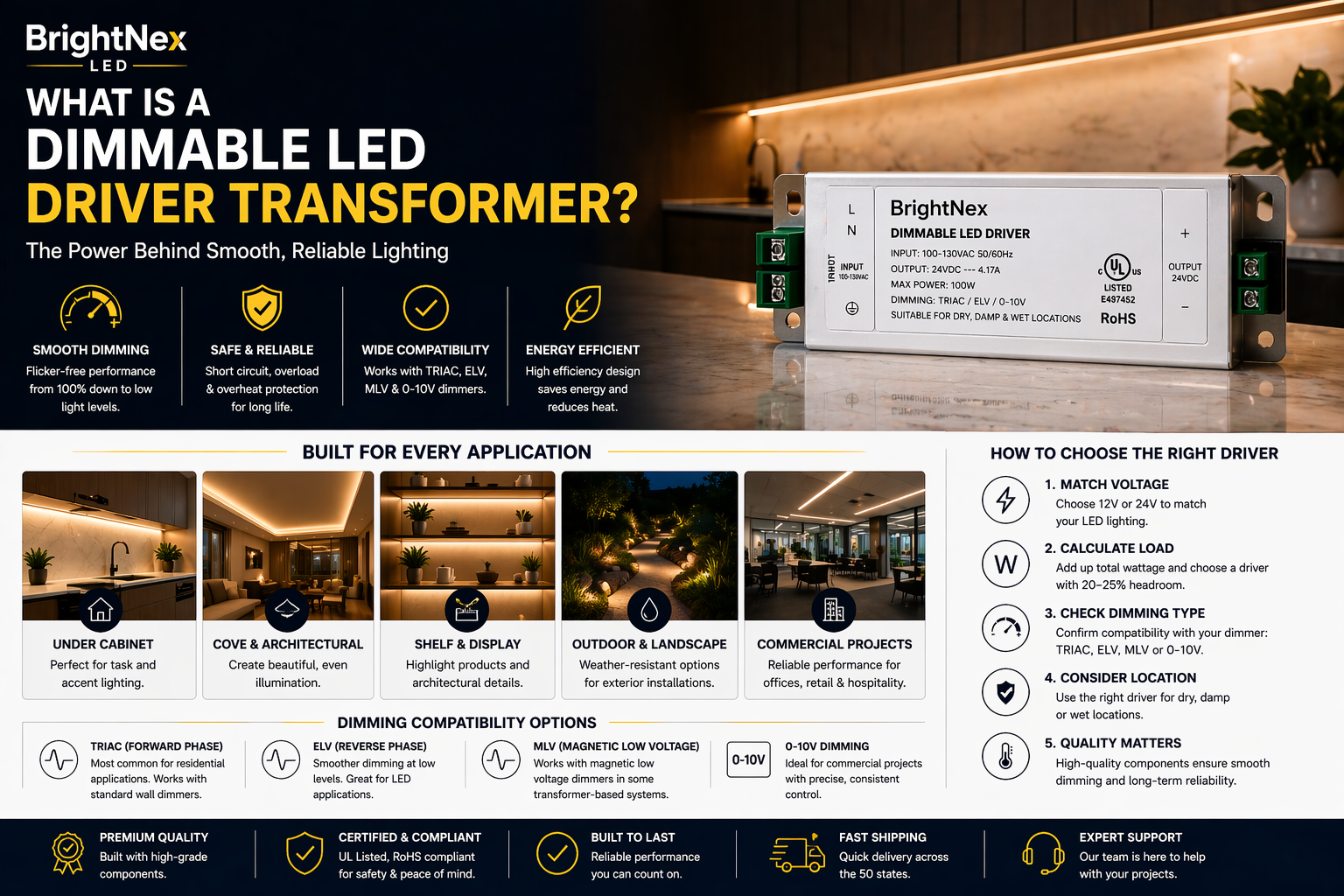
Choosing a Dimmable LED Driver Transformer
A dimmable LED driver transformer plays a critical role in lighting performance. While fixtures and LED strips get most of the attention, the driver is responsible for delivering stable power and smooth dimming. Choosing the wrong driver can lead to flickering, buzzing, limited dimming range, or premature system failure.
Whether you're installing under-cabinet lighting, COB LED strips, recessed downlights, or landscape lighting, selecting the correct dimmable driver is essential for achieving professional results.
What Is a Dimmable LED Driver Transformer?
Many people use the terms LED driver and transformer interchangeably. Although they serve similar purposes, an LED driver does more than simply reduce voltage. It regulates power to ensure LEDs operate safely, efficiently, and consistently.
In low-voltage LED lighting systems, a dimmable LED driver transformer converts incoming AC power to the DC voltage required by LED fixtures while supporting compatible dimming controls.
The most important factor is not what the unit is called, but whether it matches:
-
The LED load
-
The required output voltage
-
The dimming method
-
The installation environment
Why Dimming Compatibility Matters
A dimmer, LED driver, and lighting fixture must work together as a complete system. When one component is incompatible, problems often appear immediately.
Common symptoms include:
-
Flickering lights
-
Buzzing sounds
-
Limited dimming range
-
Lights shutting off at low levels
-
Uneven brightness
Not all dimmable drivers support the same control methods. The most common dimming protocols include:
TRIAC Dimming
TRIAC dimming is commonly used in residential applications and works with many standard wall dimmers. It is often the simplest solution for retrofit projects.
ELV Dimming
ELV (Electronic Low Voltage) dimming typically provides smoother low-end dimming and better performance with modern LED systems.
0-10V Dimming
Widely used in commercial and architectural projects, 0-10V dimming offers precise control and excellent scalability across multiple fixtures.
MLV Dimming
Magnetic Low Voltage dimming is less common in modern LED installations but may still be found in older systems.
How to Choose the Right Dimmable LED Driver
Match the Voltage
The driver's output voltage must match the lighting product exactly.
-
12V LED strips require a 12V driver
-
24V LED strips require a 24V driver
Never assume voltage compatibility.
Calculate Total Wattage
Add the wattage of all connected fixtures and leave additional capacity for reliable operation.
For example:
-
LED Load: 80W
-
Recommended Driver: 100W to 120W
Providing extra headroom improves efficiency, reduces heat, and helps extend driver lifespan.
Verify the Dimming Method
Before purchasing a driver, confirm which dimming protocol your project uses.
If a TRIAC dimmer is already installed, select a compatible TRIAC dimmable driver. If the project is being designed from scratch, choose the dimmer and driver together to ensure compatibility.
Consider Installation Conditions
Indoor applications have different requirements than outdoor installations.
For bathrooms, landscape lighting, exterior soffits, and other demanding environments, choose a driver with the appropriate wet-location or damp-location rating.
Constant Voltage vs Constant Current Drivers
One of the most common mistakes is selecting the wrong driver type.
Constant Voltage Drivers
Constant voltage drivers provide a fixed output voltage such as:
-
12V DC
-
24V DC
These are commonly used for:
-
LED strip lights
-
COB LED strips
-
Under-cabinet lighting
-
Cove lighting
Constant Current Drivers
Constant current drivers regulate output current and are commonly used for:
-
Recessed downlights
-
Specialty LED fixtures
-
LED modules
These two driver types are not interchangeable.
Best Applications for Dimmable LED Drivers
Dimmable LED drivers are ideal for:
Under-Cabinet Lighting
Adjust task lighting during cooking and create softer ambient lighting in the evening.
COB LED Strip Lighting
Smooth dimming is especially important with COB strips because their continuous light output makes flicker more noticeable.
Architectural Lighting
Cove lighting, shelf lighting, wall washing, and accent lighting benefit from precise dimming control.
Commercial Spaces
Retail stores, offices, hospitality venues, and restaurants often rely on 0-10V dimming systems for reliable performance across multiple fixtures.
Outdoor Lighting
Landscape lighting and exterior installations can use dimmable drivers to create comfortable evening illumination while maintaining energy efficiency.
Recommended Products for Dimmable Lighting Projects
At LA LED Lighting, we offer professional-grade solutions designed for smooth, reliable dimming performance:
-
Dimmable LED Drivers
-
TRIAC Dimmable Drivers
-
0-10V Dimmable Drivers
-
COB LED Strip Lights
-
Waterproof LED Drivers
-
Under-Cabinet Lighting Systems
-
Recessed LED Downlights
Choosing compatible components from the start helps eliminate flicker, reduce callbacks, and improve long-term reliability.
Final Thoughts
A dimmable LED driver transformer is one of the most important components in any LED lighting system. The right driver delivers smooth dimming, stable performance, and long-term reliability, while the wrong driver can create frustrating problems that are difficult to troubleshoot.
By matching voltage, wattage, dimming protocol, and installation requirements, you can create a lighting system that performs beautifully from day one and continues to operate reliably for years to come.