
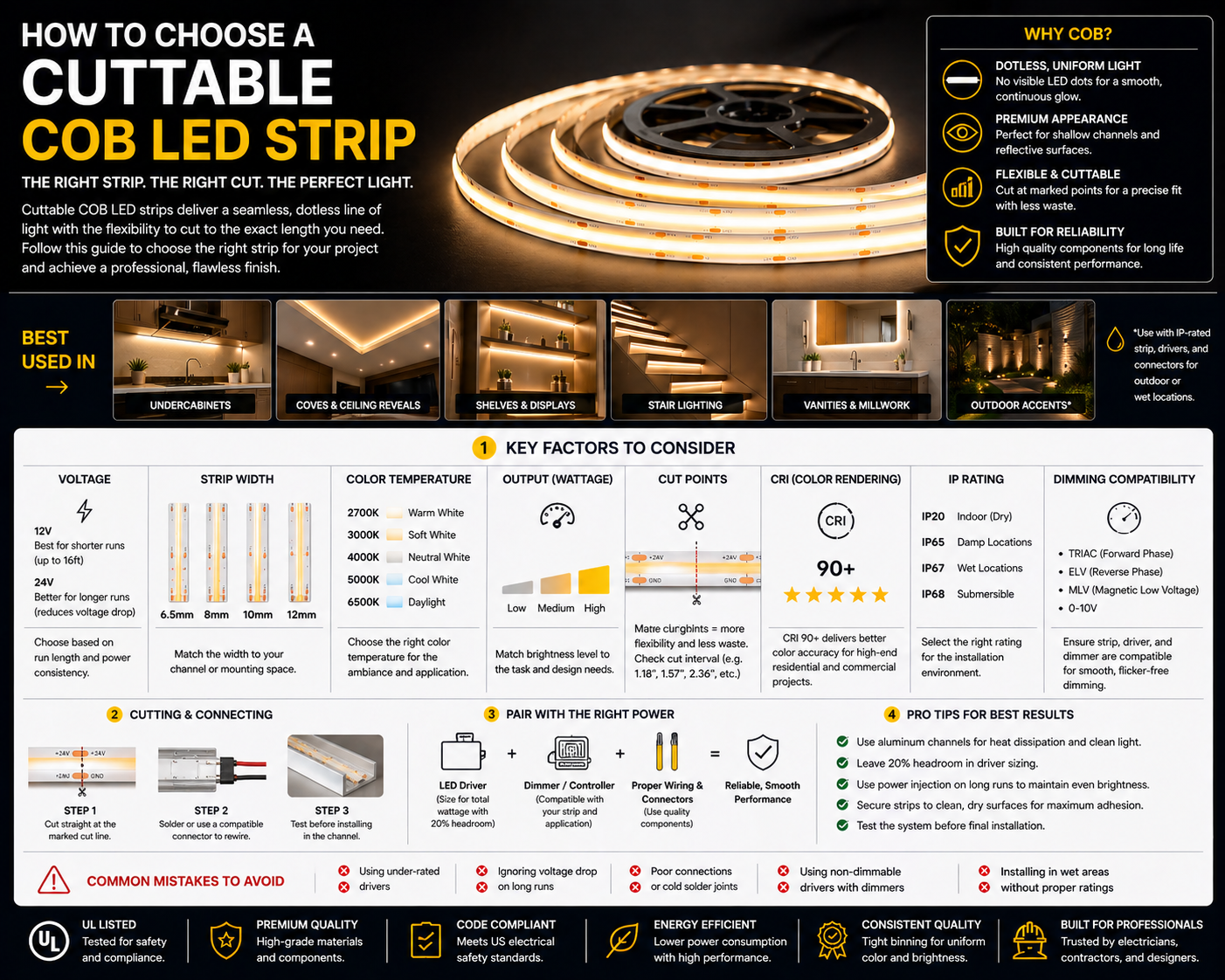
A bad tape light layout usually shows up at the end of the job - dark gaps at the corner, visible dots under the lens, or a run that lands two inches past where it should stop. That is where a cuttable COB LED strip earns its keep. When you need clean, continuous light and precise fitment, the ability to cut the strip to the right length is not a small feature. It is the difference between a polished installation and one that looks forced.
COB strip lighting has become a go-to option for undercabinet lighting, cove applications, millwork, display shelving, and architectural accents because it solves one of the most common complaints about standard strip lights: spotting. Instead of spaced diodes that can show through shallow channels or reflective surfaces, COB technology creates a more uniform, dotless appearance. For design-conscious homeowners and trade professionals, that finish matters.
What makes a cuttable COB LED strip different
A cuttable COB LED strip is designed with marked cut points so the run can be shortened without damaging the remaining section. That sounds basic, but in real installations it gives you control over layout, waste, and finish quality. You can fit a cabinet bay, niche, toe kick, reception desk, or stair detail more accurately without trying to hide extra length.
The COB part refers to chip-on-board construction, where the light-emitting elements are packed much more densely than on a typical SMD strip. The result is smoother output with fewer visible hot spots. In many architectural applications, that means you can achieve a cleaner line of light even in low-profile aluminum channels or behind shallow diffusers.
Not all cut intervals are the same. Some strips allow very short cuts for tighter project tolerances, while others require longer increments. That detail matters when you are planning custom cabinetry, floating vanities, or linear reveals where every inch counts. It also affects how much leftover material you will have at the end of a run.
Where cuttable COB LED strip works best
The most common use is undercabinet lighting, where consistent task light and a finished look matter equally. A cuttable COB LED strip lets you stop neatly before a range hood, bridge small cabinet breaks, or size each section properly without creating uneven brightness.
It also performs well in coves, shelves, closets, and display lighting. In those settings, the dotless effect is often the main selling point. If the strip will be visible directly or reflected in glossy stone, glass, or painted surfaces, COB usually delivers a more refined result than older strip formats.
For commercial projects, the same logic applies. Retail shelving, hospitality millwork, office accents, and reception features all benefit from smooth illumination and accurate fit. Landscapers and outdoor installers may also use COB strip in protected or rated applications, but that is where enclosure choice, driver location, and wet-location compatibility need closer review.
How to choose the right cuttable COB LED strip
The first question is voltage. Most buyers are deciding between 12V and 24V systems, and the right answer depends on run length, voltage drop tolerance, and component compatibility. Shorter residential runs often work well on 12V, while longer architectural runs generally benefit from 24V because it helps maintain more consistent brightness over distance.
Next is strip width. If you are working with compact channels, narrow reveals, or slim cabinet details, width matters more than people expect. Common options such as 6.5mm, 8mm, 10mm, and 12mm each suit different profiles and connector types. Choosing the wrong width can slow the install or force compromises with mounting hardware and lenses.
Color temperature is another practical decision. Warm white often fits residential millwork and hospitality settings, while neutral or cooler whites can be better for task areas and commercial use. If the project calls for flexibility, CCT tunable options are worth considering, but they require the right controller and compatible power setup.
Then there is output. Brighter is not always better. A toe kick, bar shelf, or niche light may only need subtle accent output, while a kitchen task light or retail shelf may need considerably more. Matching brightness to the application helps avoid glare, over-lighting, and unnecessary power demand.
Dimming, drivers, and compatibility
A cuttable COB LED strip is only as reliable as the power system behind it. This is where many problems start. Flicker, drop-off, poor dimming response, and early failure are often tied to mismatched drivers, overloaded circuits, or low-grade components rather than the strip itself.
If dimming is part of the plan, confirm compatibility from the start. Depending on the project, that may mean TRIAC, ELV, MLV, or 0-10V dimming. Residential remodels often need a strip and driver combination that works with existing wall dimmers. Commercial jobs may require 0-10V control or a more specialized system. The right driver selection protects performance and saves time on callbacks.
Driver size matters too. You need enough wattage headroom for the total load, and in many installations you also need a compact housing that fits the available cavity or junction box location. For damp or wet environments, enclosure rating and placement are not optional details. They are core parts of system reliability.
This is one reason professionals often buy strip lights and power components from the same specialist supplier. It reduces guesswork on compatibility and keeps the install aligned with US standards and certification expectations.
Installation details that affect the final result
Even a premium strip can disappoint if the installation is rushed. Surface prep is one of the biggest issues. Adhesive-backed strip lighting needs a clean, stable mounting surface. Dust, oil, textured paint, and temperature extremes can all reduce bond strength.
Channel selection also affects performance and appearance. Aluminum channels help manage heat, protect the strip, and deliver a more finished presentation. In many applications they are the best choice, especially where the strip is visible or where long-term reliability matters.
Cutting must happen only at the designated cut marks. Cutting outside those points can ruin the circuit section and create unnecessary waste. After cutting, connection method matters just as much. Soldered joints can be very secure, but quality connectors can speed up the job when they are correctly matched to strip width and PCB design.
For longer runs, plan power injection and voltage drop before the install begins. That is especially important on bright strips or projects with multiple sections. A cleaner wiring plan usually means more consistent output and fewer service issues later.
When COB is the right choice - and when it is not
COB is a strong fit when visual smoothness is the priority. If the strip will be seen directly, reflected in polished surfaces, or installed in a shallow profile, COB usually makes sense. It is also a solid choice for upscale residential work where clients notice finish details.
That said, not every project needs it. If the strip will sit deep inside a frosted channel where diode spacing will never be visible, a standard strip may still be acceptable depending on budget and output targets. RGB, RGBW, or pixel-controlled applications may also push you toward a different product family based on the control effect you want.
The point is not that COB is always better. It is that a cuttable COB LED strip solves specific problems very well: visible dotting, awkward fitment, and a less refined finished look.
Why buyers look for certified, project-ready options
For contractors and serious DIY buyers, strip lighting is not just about lumens and color temperature. It is about whether the system will install cleanly, dim correctly, meet expectations, and stay reliable over time. That is why UL-listed or otherwise compliance-focused components matter, especially in residential remodels, commercial interiors, and premium custom work.
Buyers also need product depth. One project may call for single-color COB in a narrow width, while another needs RGBW, CCT tuning, or 110V COB for a different installation method. Having access to matching drivers, transformers, controllers, wire, and connectors saves time and avoids mixed-component problems.
LA LED Lighting serves that kind of buyer - professionals and homeowners who want dependable architectural lighting with real compatibility behind it, not a generic strip light listing and a guess.
If you are specifying or buying for a project, start with the finish you want, the controls you need, and the installation conditions you actually have on site. A cuttable COB LED strip is at its best when the whole system is chosen with the same level of care.