
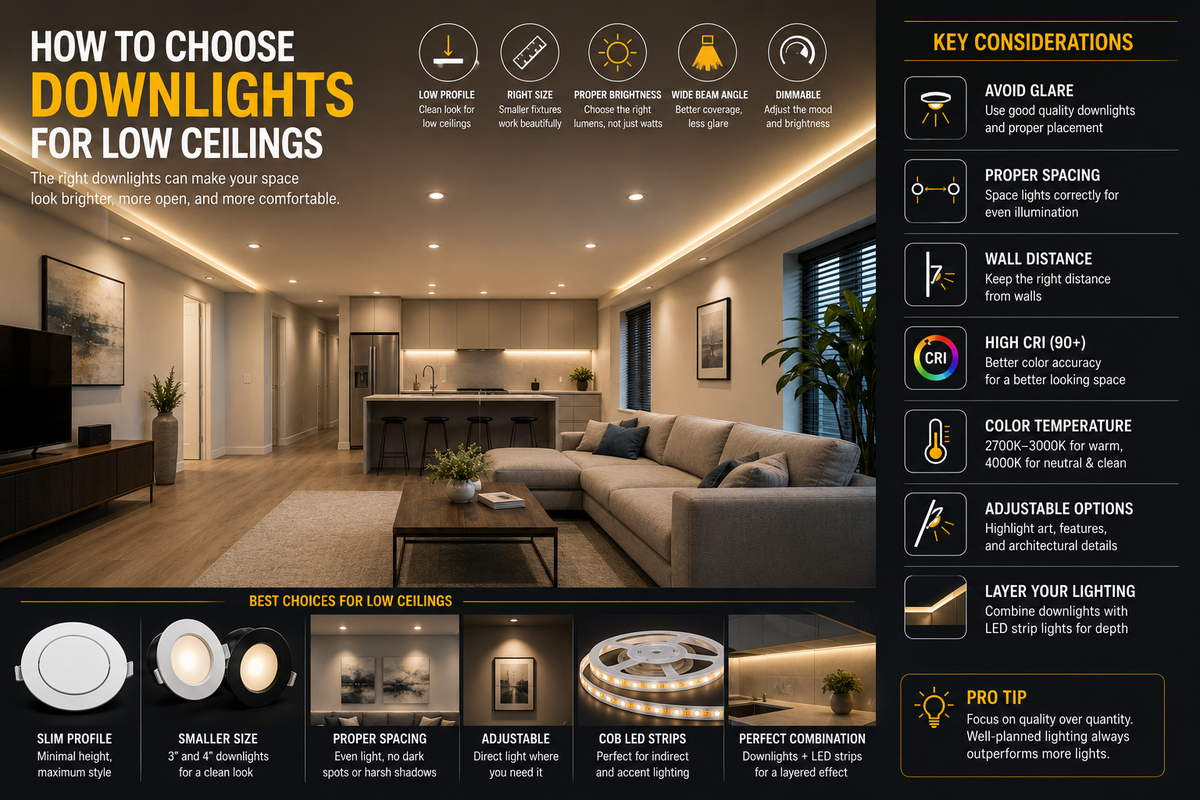
Low ceilings can make lighting design surprisingly challenging.
Install fixtures that are too large or too numerous, and the ceiling can look crowded.
Use lights that are too bright or poorly positioned, and you may experience uncomfortable glare.
Use too few, and the room can feel dark and uneven.
So, how do you choose the right downlights for a low ceiling?
The key is not simply buying the brightest downlight available.
For lower ceilings, you need to consider the entire lighting design:
- Fixture size
- Fixture depth
- Light output
- Beam angle
- Spacing
- Color temperature
- Glare
- Dimming
- Room dimensions
- Other light sources
When these elements work together, downlights can actually help a low-ceiling room feel cleaner, brighter, and more spacious.
Why Are Low Ceilings Different?
The closer a light fixture is to the people and surfaces below it, the more noticeable its light distribution can become.
With a higher ceiling, light has more distance to spread before reaching the room.
With a low ceiling, downlights are closer to:
- Your eyes
- Furniture
- Countertops
- Walls
- Floors
That means poor fixture placement or excessive brightness can become much more obvious.
This is why more light isn't necessarily better.
Good low-ceiling lighting is about control and balance.
1. Choose a Low-Profile Downlight
The physical design of the fixture matters.
For low ceilings, recessed or slim-profile LED downlights are usually preferable to fixtures that extend significantly below the ceiling.
A slim downlight keeps the visual plane of the ceiling clean.
This can help the room feel:
- Less cluttered
- More modern
- More open
- Visually taller
Slim LED downlights can also be useful where the available space above the drywall is limited, depending on the specific fixture and installation requirements.
Always verify the required clearance and installation specifications before selecting a fixture.
2. Consider Smaller Downlights
Large fixtures aren't always the best choice for a low ceiling.
Smaller downlights can create a more refined appearance and reduce the visual impact of the lighting hardware.
For example, 3-inch or 4-inch downlights can work beautifully in many residential spaces.
Smaller fixtures are particularly attractive in:
- Kitchens
- Hallways
- Bedrooms
- Bathrooms
- Closets
- Small living rooms
At the smallest end, the 3 Inch Black Trim LED Recessed Light (6W, 3CCT) keeps the ceiling visually quiet, and the 4 Inch Flat Panel LED Downlight (9W, 5CCT) steps up the output while staying compact.
However, fixture diameter alone shouldn't determine your choice.
A smaller downlight can still produce significant light output.
Always check the lumens.
3. Don't Choose Downlights Based on Wattage Alone
With LED lighting, wattage primarily tells you how much electrical power the fixture consumes.
It doesn't directly tell you how bright the room will be.
For brightness, look at:
Lumens
Two downlights with similar wattage may produce different amounts of light depending on their efficiency and design.
For low ceilings, this becomes especially important because overly bright fixtures positioned close to occupants can create uncomfortable lighting.
Choose the light output based on the room rather than simply selecting the highest wattage available.
4. Pay Attention to Glare
Glare is one of the biggest issues with low-ceiling downlights.
Because the fixtures are closer to eye level than they would be in a high-ceiling room, an intense light source can feel uncomfortable.
To reduce glare, consider:
- Proper fixture placement
- Appropriate brightness
- Good optical design
- Wider light distribution where appropriate
- Dimming
- Avoiding unnecessary fixtures
You want the room to feel bright, not the individual LEDs to feel painfully bright.
That's an important distinction.
5. Beam Angle Matters
Beam angle describes how widely a downlight distributes its light.
A narrow beam concentrates illumination into a smaller area.
A wider beam spreads it over a larger area.
For general lighting in a low-ceiling room, wider light distribution can often help create more even illumination and reduce harsh pools of light.
Narrower or adjustable beams can be useful when you intentionally want to highlight:
- Artwork
- Cabinets
- Architectural features
- Decorative walls
- Specific surfaces
The right beam angle depends on the purpose of the fixture.
6. Avoid the “Spotlight Everywhere” Effect
One common mistake is installing many narrow-beam downlights across a low ceiling.
This can create individual circles of light rather than a comfortable, evenly illuminated room.
You may end up with:
Bright spot → Dark area → Bright spot → Dark area
Instead, the light patterns should overlap appropriately.
The goal is:
Smooth, balanced illumination.
This is especially important in rooms with ceilings around 8 feet high.
7. Don't Install Too Many Downlights
Another common mistake is assuming that more fixtures automatically produce better lighting.
They don't.
Too many downlights can:
- Make the ceiling look cluttered
- Increase glare
- Waste electricity
- Make the room excessively bright
- Create an “airport runway” appearance
For low ceilings, fewer properly selected fixtures can often look better than a ceiling filled with lights.
8. How Far Apart Should Downlights Be?
There's no universal spacing that works for every room.
Spacing depends on:
- Ceiling height
- Beam angle
- Fixture output
- Room dimensions
- Wall colors
- Furniture layout
- Desired brightness
- Other light sources
A common starting concept is to relate fixture spacing to ceiling height, but this should never replace the photometric information for the actual downlight.
For a low ceiling, light beams generally don't have as much vertical distance to spread.
This means spacing and beam angle need to be considered together.
9. Don't Put Downlights Too Close to the Wall
Fixture distance from the wall can significantly affect how a room looks.
If a downlight is placed too close to a wall, it may create:
- Harsh bright patches
- Uneven scalloping
- Unwanted shadows
Place it too far away, and the walls may appear dark.
Wall illumination matters because brighter vertical surfaces can help a low-ceiling room feel more open.
Rather than thinking only about lighting the floor, consider how the downlights illuminate the entire visual space.
10. Use Wall Lighting to Make the Room Feel Larger
This is an important design trick.
If all the light points straight down toward the floor, the walls and ceiling may remain relatively dark.
That can visually compress the room.
Lighting walls, artwork, cabinetry, and architectural features can make the space feel more dimensional.
In a low-ceiling room, good lighting design isn't simply:
Ceiling → Floor
Think:
Ceiling + Walls + Surfaces + Architecture
This creates a more layered environment.
11. Adjustable Downlights Can Be Very Useful
Not every downlight has to point straight down.
An adjustable or tiltable downlight allows you to direct illumination toward specific areas.
This can be particularly useful for:
- Artwork
- Feature walls
- Kitchen cabinets
- Shelving
- Fireplaces
- Architectural details
The 4 Inch Multi-Direction LED Recessed Light (9W, 5CCT) tilts up to 90 degrees, which is what makes wall washing and artwork lighting possible from a recessed fixture.
Using a few adjustable fixtures strategically can create depth without adding more lights.
This can be especially effective in rooms with low ceilings.
12. Choose the Right Color Temperature
Color temperature can dramatically change the atmosphere of the room.
For most residential spaces:
2700K
Warm and relaxing.
Good for:
- Bedrooms
- Living rooms
- Dining areas
3000K
Warm but slightly cleaner and more contemporary.
Excellent for:
- Kitchens
- Living rooms
- Bedrooms
- Hallways
- General residential lighting
4000K
Cleaner and more neutral.
Often suitable for:
- Kitchens
- Bathrooms
- Offices
- Work areas
For many homes, 3000K is a very versatile choice.
13. CCT-Selectable Downlights Give You More Flexibility
If you're unsure about the best color temperature, consider CCT-selectable downlights.
Depending on the fixture, one downlight may offer several selectable color temperatures.
For example:
2700K / 3000K / 3500K / 4000K / 5000K
This allows the color temperature to be selected during installation rather than committing to one option before seeing the light in the room.
The 6 Inch Slim Flat Panel LED Downlight (12W, 5CCT) works exactly this way, with the color temperature chosen at the fixture during installation.
This can be particularly helpful during renovations.
14. Consider CRI Too
Color temperature isn't the only specification affecting how the room looks.
CRI—or Color Rendering Index—describes how naturally colors appear under the light source.
For residential areas where appearance matters, CRI 90+ is often an excellent choice.
High-quality color rendering can improve the appearance of:
- Skin tones
- Furniture
- Wood
- Food
- Artwork
- Countertops
- Interior finishes
A room can have plenty of light and still look disappointing if the lighting quality is poor.
15. Dimming Is Especially Valuable with Low Ceilings
Dimming gives you control over the intensity of your lighting.
This is particularly useful when fixtures are relatively close to the occupied area.
You might want:
100% brightness for cleaning or detailed tasks.
60–70% for normal everyday use.
20–40% for relaxing in the evening.
Instead of trying to select one perfect fixed brightness level, dimmable downlights allow the same room to adapt to different situations.
Make sure the downlights and dimmer are compatible.
16. Don't Rely Only on Downlights
This is probably one of the most important recommendations.
A low-ceiling room doesn't need to be illuminated entirely with recessed lights.
Combining downlights with other lighting types can create a much more attractive result.
For example:
Downlights + COB LED Strip Lighting
can work extremely well.
The downlights provide general or task illumination, while concealed COB strips can add indirect ambient light.
17. Use COB LED Strips to Make a Low Ceiling Feel Better
Indirect LED lighting can be especially useful with low ceilings.
COB LED strips can be installed in:
- Ceiling details
- Wall recesses
- Shelves
- Cabinets
- TV walls
- Architectural features
Instead of directing all the light downward, indirect lighting can illuminate surrounding surfaces.
A continuous COB light source also creates a smooth visual effect without obvious LED dots.
The Indoor Dotless Dimmable COB LED Strip (10mm, 24V) is well suited to this, with 480 LEDs per meter and approximately CRI 90, and the wider COB LED strip light range covers 2700K through 5000K.
This can make the lighting design feel more sophisticated while reducing dependence on numerous ceiling fixtures.
18. What Downlights Work Well in a Low-Ceiling Kitchen?
Kitchen lighting needs to provide both general and task illumination.
For a low-ceiling kitchen, consider:
- Compact downlights
- Appropriate wide light distribution
- 3000K–4000K color temperature
- CRI 90+ where possible
- Dimmable fixtures
- Under-cabinet COB lighting
Don't try to make the ceiling downlights perform every lighting task.
Under-cabinet lighting can illuminate countertops directly, allowing the ceiling lighting to remain more comfortable.
19. What Downlights Work Well in a Low-Ceiling Living Room?
Living rooms should generally feel comfortable rather than excessively bright.
Consider:
- Smaller recessed downlights
- Warm 2700K–3000K light
- Dimming
- Strategic rather than excessive fixture placement
- Adjustable lights for artwork
- Indirect COB lighting
The goal should be layers of light, not a grid of maximum-brightness fixtures.
20. What About Low-Ceiling Bedrooms?
Bedrooms typically need less intense general illumination than kitchens.
Warm color temperatures such as:
2700K–3000K
usually work well.
Combine dimmable downlights with:
- Bedside lighting
- Headboard LED lighting
- Closet lighting
- Indirect COB strips
A fixture with a built-in low-level mode is useful here: the 4 Inch LED Recessed Downlight with Night Light (9W, 5CCT) provides a soft nighttime level without switching on the main light.
This provides much more flexibility than relying only on ceiling lights.
21. Can Downlights Make a Low Ceiling Look Higher?
Lighting can't physically change the ceiling height, but it can change how the room is perceived.
A low ceiling may feel more spacious when you:
- Keep fixtures visually minimal
- Avoid hanging fixtures where unnecessary
- Reduce ceiling clutter
- Illuminate walls
- Use indirect lighting
- Avoid harsh contrast
- Create multiple layers of light
A clean ceiling combined with well-lit vertical surfaces can help the room feel more open.
22. Slim vs. Traditional Recessed Downlights
Traditional recessed fixtures may require more space above the ceiling.
Slim LED downlights can offer a lower-profile alternative for certain installations.
This can be especially useful when:
- Ceiling cavities are shallow
- Joists limit placement
- You're renovating an existing ceiling
- Minimal visual appearance is desired
Where existing cans are already in place, a retrofit unit such as the 6 Inch 5CCT LED Retrofit Recessed Downlight (14W) replaces the old fixture without opening up the ceiling.
However, “slim” doesn't mean installation requirements can be ignored.
Always check:
- Required clearances
- Electrical requirements
- Junction box design
- Insulation-contact rating where applicable
- Damp/wet location rating when relevant
- Manufacturer installation instructions
A Simple Checklist for Low-Ceiling Downlights
Before choosing your fixtures, ask:
How high is my ceiling?
How large is the room?
How many lumens do I actually need?
What beam angle does the fixture provide?
How far apart will the fixtures be?
Do I want fixed or adjustable downlights?
What color temperature fits the room?
What CRI does the fixture provide?
Is it dimmable?
Do I have enough ceiling clearance?
Can COB strip lighting provide some of the ambient light instead?
Answering these questions before installation can prevent expensive changes later.
Final Thoughts
Choosing downlights for low ceilings isn't about finding the smallest fixture or installing as many lights as possible.
The best results come from balancing:
Fixture Size + Lumens + Beam Angle + Spacing + Color Temperature + CRI + Dimming
For low ceilings, compact or slim downlights can help maintain a clean visual appearance, while carefully controlled brightness and good beam distribution can reduce glare.
And don't assume every part of the room needs to be illuminated by a downlight.
Combining recessed downlights with indirect COB LED strip lighting can create a more comfortable, dimensional, and professional lighting design.
With the right combination, even a room with a relatively low ceiling can feel bright, modern, and spacious.
FAQ
What size downlight is best for a low ceiling?
Smaller fixtures such as 3-inch or 4-inch downlights can work well in many low-ceiling residential applications, but size should be considered together with lumen output, beam angle, and room dimensions.
Are slim LED downlights good for low ceilings?
Yes. Slim downlights can provide a clean, low-profile appearance and may be useful where ceiling cavity space is limited, provided the fixture is suitable for the installation.
How many downlights do I need for an 8-foot ceiling?
There's no fixed number based solely on ceiling height. Room dimensions, fixture lumens, beam angle, surface reflectance, layout, and desired illumination all need to be considered.
What color temperature is best for low ceilings?
Ceiling height doesn't determine color temperature. For residential spaces, 2700K–3000K creates a warmer atmosphere, while 3000K–4000K can work well in kitchens, bathrooms, and work areas.
Are dimmable downlights better for low ceilings?
Dimming is particularly useful because it lets you adjust light intensity for different activities and helps prevent the room from feeling excessively bright.
Can I combine downlights with LED strips?
Yes. Combining downlights with concealed COB LED strip lighting can create layered illumination and reduce the need for large numbers of recessed fixtures.
Can downlights make a ceiling look higher?
They can't change the physical height, but low-profile fixtures, good wall illumination, indirect lighting, and reduced ceiling clutter can help a room feel more open.