
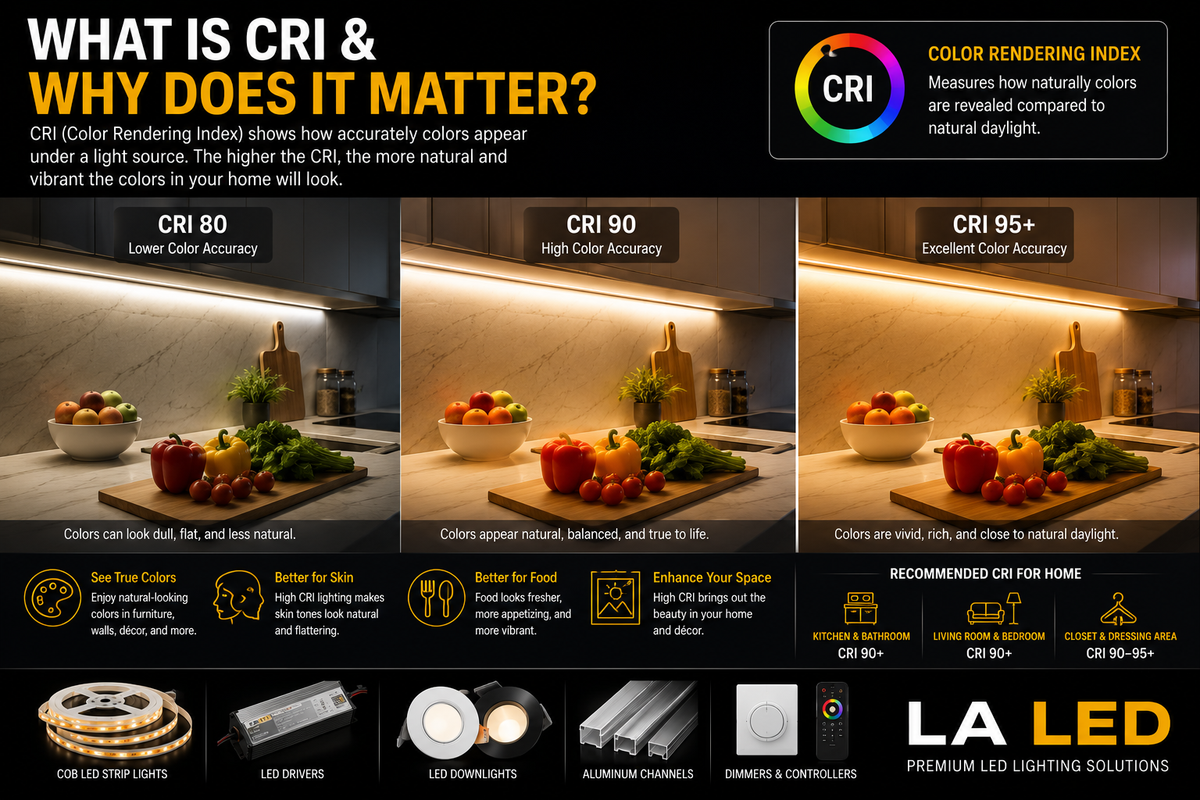
When shopping for LED lighting, most people look at three specifications first:
Brightness. Wattage. Color temperature.
But there's another number that can dramatically affect how your home looks:
CRI.
You may have seen LED products labeled:
CRI 80
CRI 90+
CRI 95+
But what does CRI actually mean?
And can two LED lights with the same brightness and color temperature make the same room look completely different?
Absolutely.
CRI affects how accurately colors appear under artificial lighting. It can influence the appearance of your furniture, kitchen countertops, artwork, clothing, food—and even your skin.
Let's take a closer look.
What Does CRI Mean?
CRI stands for:
Color Rendering Index
It's a measure used to describe how accurately a light source reveals colors compared with a reference light source.
CRI is generally expressed on a scale up to 100.
The closer the CRI is to 100, the more naturally and accurately colors generally appear under that light.
As a simple guide:
- CRI below 80 — Lower color accuracy
- CRI 80+ — Acceptable for many general applications
- CRI 90+ — Very good color rendering
- CRI 95+ — Excellent color rendering
However, CRI isn't the only metric that can describe light quality, and two products with the same stated CRI can still perform differently.
For everyday residential lighting, though, CRI remains a very useful specification to understand.
What Does High CRI Lighting Actually Look Like?
Imagine two identical kitchens.
Both use 3000K LED lighting.
Both provide approximately the same brightness.
But one uses lower-CRI lighting while the other uses high-CRI lighting.
Under the lower-CRI light:
- Tomatoes may look less vibrant.
- Wood can appear dull.
- Skin tones may look less natural.
- Countertops can lose some richness.
- Decorative colors may look flatter.
Under high-CRI lighting, those same colors can appear richer and more natural.
The difference isn't necessarily that the room becomes brighter.
Instead, the colors can look better.
CRI Is Not the Same as Color Temperature
This is one of the most important distinctions.
CRI and color temperature are two completely different specifications.
Color temperature tells you whether white light looks warm or cool.
For example:
2700K → Warm White
3000K → Warm / Soft White
4000K → Neutral White
5000K → Cooler / Daylight Appearance
CRI tells you how accurately colors appear under that light.
So you could have:
3000K / CRI 80
and
3000K / CRI 95
Both lights can have approximately the same warm-white appearance, but colors in the room may look noticeably different.
Does Higher CRI Mean Brighter Light?
No.
A higher CRI doesn't automatically mean the LED produces more light.
Brightness is generally described using lumens.
CRI describes color rendering.
For example, two LED strips might both produce similar lumen output while having different CRI ratings.
One isn't necessarily brighter—but one may make the colors in your kitchen, furniture, artwork, or clothing appear more natural.
Is CRI 80 Good Enough?
CRI 80 lighting can be perfectly suitable for many general-purpose applications.
For example:
- Hallways
- Garages
- Utility areas
- Storage rooms
- Some outdoor applications
- General circulation areas
If accurate color appearance isn't particularly important, CRI 80 may be sufficient.
But inside areas where appearance and design matter, upgrading to CRI 90+ can often provide a more attractive result. That applies outdoors too when the space is used for entertaining rather than circulation — the Outdoor Dotless COB LED Strip (10mm, 24V) is IP65 rated and rated at approximately CRI 90, so covered patios and outdoor kitchens do not have to drop to utility-grade color quality.
Is CRI 90 Good for Home Lighting?
For many residential applications, CRI 90+ is an excellent choice.
It provides strong color rendering while being widely suitable for:
- Kitchens
- Living rooms
- Bedrooms
- Bathrooms
- Dining rooms
- Closets
- Under-cabinet lighting
- Architectural lighting
If you're designing a modern home and want the interior finishes to look natural, CRI 90+ is a very useful target to consider.
The Indoor Dotless COB LED Strip (10mm, 24V) sits in this range at approximately CRI 90, and is available in 2700K, 3000K, 4000K, and 5000K so the color temperature can be matched to the room independently of the color rendering.
What About CRI 95+?
CRI 95+ provides even higher overall color-rendering performance and can be particularly valuable where accurate color appearance is important.
Applications may include:
- Makeup vanities
- Dressing rooms
- Artwork lighting
- Photography areas
- High-end kitchens
- Retail displays
- Luxury residential interiors
- Color-sensitive workspaces
However, a higher CRI number isn't automatically necessary for every single light in the house.
The key is understanding where accurate color rendering will make a meaningful difference.
Where Does High CRI Matter Most?
Kitchen Lighting
The kitchen is one of the best places to consider high-CRI LED lighting.
Think about everything you look at in a kitchen:
- Food
- Fruits and vegetables
- Meat
- Wood cabinets
- Stone countertops
- Backsplashes
- Decorative finishes
Poor color rendering can make food and surfaces appear less attractive.
For under-cabinet COB LED lighting, CRI 90+ can be particularly beneficial because the light directly illuminates your countertops and food-preparation areas.
Bathroom & Vanity Lighting
CRI is extremely important around mirrors.
Low-quality lighting can make:
- Skin tones appear unnatural
- Makeup colors look different
- Clothing colors appear inaccurate
This can become especially noticeable when you leave the bathroom and see the same colors under daylight.
For vanity and makeup lighting, CRI 90+ or higher is often worth considering.
Living Room Lighting
Your living room contains many materials and colors:
- Furniture
- Wood
- Rugs
- Artwork
- Plants
- Decorative objects
- Wall colors
High-CRI lighting can help these materials appear richer and more natural.
This becomes particularly valuable in carefully designed interiors where lighting is part of the overall aesthetic.
Bedroom Lighting
CRI may not seem as important in a bedroom, but it can still affect:
- Bedding colors
- Clothing
- Furniture finishes
- Skin tones
- Artwork
For bedrooms, combining warm 2700K–3000K lighting with good color rendering can create a comfortable environment while maintaining natural-looking colors.
Closets & Dressing Rooms
Have you ever selected an outfit indoors and then noticed that the color looked different outside?
Lighting may be responsible.
High-CRI lighting can help clothing colors appear more natural.
For:
- Walk-in closets
- Dressing rooms
- Wardrobes
good color rendering can be especially useful.
Dining Rooms
Food presentation is strongly affected by lighting.
Good color rendering can make:
- Vegetables look fresher
- Meat look more natural
- Table settings look richer
- Wood furniture appear warmer
- Decorative colors look more vibrant
This is one reason lighting quality is so important in restaurants—and the same principle applies at home.
Artwork & Display Lighting
If you're illuminating paintings, photographs, sculptures, or decorative collections, color accuracy becomes especially important.
Poor color rendering may change the way the artwork appears.
High-CRI lighting helps preserve the visual relationship between the colors intended by the artist and what you see in your home.
CRI and COB LED Strip Lights
COB LED strip lights are often chosen because they provide a smooth, continuous line of light with minimal visible spotting.
But the smooth appearance of the strip doesn't automatically tell you anything about its CRI.
Two COB strips can look physically similar while producing different color-rendering performance.
When choosing COB LED strips for:
- Kitchens
- Cabinets
- Shelves
- Closets
- Living rooms
- Architectural lighting
consider both:
Color Temperature + CRI
For example:
3000K + CRI 90+
can provide warm, comfortable illumination while maintaining good color accuracy.
Every strip in our COB LED strip light range publishes both figures on the product page, so the comparison above can be made before ordering rather than after installation.
CRI and Under-Cabinet Lighting
Under-cabinet lighting is one application where CRI deserves extra attention.
Why?
Because the LED strip is positioned very close to the objects you're viewing.
It directly illuminates:
- Food
- Countertops
- Cutting boards
- Backsplashes
- Cabinets
This makes differences in color rendering easier to notice.
If you're investing in a quality kitchen installation, don't choose under-cabinet lighting based only on wattage and Kelvin.
Check the CRI too.
Under-cabinet runs also need a driver small enough to hide inside the cabinet or millwork. The 60W Compact Dimmable LED Transformer (24V) is 3.3 inches long and dims with TRIAC, ELV, or MLV controls, which suits most single-run kitchen installations.
CRI and Interior Materials
Different interior materials can react noticeably to lighting quality.
Wood
High-quality color rendering can help preserve the warmth and natural variation of wood grain.
Stone
Marble, granite, quartz, and other surfaces may contain subtle colors that can appear different under poor lighting.
Paint
Wall colors can change dramatically depending on the light source.
Fabrics
Sofas, curtains, rugs, and bedding may appear more vibrant and accurate under better color-rendering light.
This is why lighting should ideally be considered as part of the interior design—not simply as a way to make the room bright.
Why Can Two CRI 90 Lights Still Look Different?
CRI is useful, but it's not a complete description of spectral quality.
Traditional general CRI is based on a set of test colors, and it doesn't tell you everything about how every individual color will appear.
Two LEDs labeled CRI 90 can therefore still render certain colors differently.
Other measurements can provide additional information.
One particularly useful value is R9.
What Is R9?
R9 describes how well a light source renders a strong red test color.
Red rendering is important because red tones appear in:
- Skin
- Food
- Wood
- Fabrics
- Artwork
- Interior finishes
A light can have a good general CRI while performing less impressively with saturated red tones.
That's why designers and lighting professionals may look beyond the headline CRI number when color quality is particularly important.
For ordinary consumers, you don't necessarily need to analyze every technical metric—but it's useful to understand that CRI alone doesn't tell the entire story.
Is the Highest CRI Always the Best Choice?
Not necessarily.
Lighting selection involves balancing several factors:
- CRI
- Color temperature
- Brightness
- Efficiency
- Wattage
- Dimming
- Cost
- Application
- Product quality
A CRI 95+ product may be valuable in a makeup area or artwork display, while CRI 80 may be perfectly adequate for a garage.
The goal isn't simply:
“Buy the highest CRI possible.”
The better approach is:
Choose the appropriate lighting quality for the application.
What CRI Should You Choose for Each Room?
| Area | Suggested CRI |
|---|---|
| Kitchen | 90+ |
| Under Cabinets | 90+ |
| Bathroom | 90+ |
| Makeup Vanity | 90–95+ |
| Living Room | 90+ |
| Bedroom | 90+ |
| Dining Room | 90+ |
| Closet / Dressing Room | 90+ |
| Artwork / Display | 90–95+ |
| Hallway | 80+ |
| Garage / Utility Area | 80+ |
These are general recommendations rather than strict requirements.
How to Choose Better LED Lighting
When comparing LED products, don't look at only one specification.
Consider:
1. Color Temperature
Do you want warm 2700K, versatile 3000K, neutral 4000K, or cooler white?
2. CRI
How important is accurate color appearance in the space?
3. Brightness
Does the product provide enough lumens for the application?
4. Dimming
Will you need adjustable brightness? For projects using architectural or commercial controls, see the 0-10V dimmable LED driver range.
5. LED Driver
Is the driver compatible with the strip and dimming system? A multi-protocol unit such as the 100W 5-in-1 Dimmable LED Driver works with 12V or 24V strips and TRIAC, ELV, MLV, 0-10V, or PWM controls.
6. Installation
Will you use an aluminum channel and diffuser?
7. Product Quality
Is the lighting designed for stable, long-term performance?
Looking at the complete system produces better results than simply choosing the LED with the highest wattage.
Final Thoughts
So, what is CRI and why does it matter?
CRI—or Color Rendering Index—helps describe how naturally colors appear under a light source.
A high-CRI LED doesn't necessarily make your room brighter.
Instead, it can make the things inside the room look better.
Your food can appear more appetizing.
Your wood and stone can show more natural detail.
Your clothing can look more accurate.
Your skin tones can appear more natural.
And your carefully selected interior colors can look closer to the way they're supposed to.
For many residential applications, CRI 90+ is an excellent choice, particularly for kitchens, under-cabinet lighting, bathrooms, living rooms, closets, and other areas where color appearance matters.
When choosing your next LED strip or fixture, don't stop at wattage and color temperature.
Check the CRI.
It may be one of the specifications you notice most after the lighting is installed.
FAQ
What does CRI mean in LED lighting?
CRI stands for Color Rendering Index. It indicates how accurately a light source renders colors compared with a reference source.
Is CRI 80 good enough for home lighting?
CRI 80 can be suitable for general-purpose areas, but CRI 90+ is often preferable in residential spaces where natural-looking colors and interior appearance are important.
Is CRI 90 better than CRI 80?
In terms of general color rendering, CRI 90 typically provides more accurate color appearance than CRI 80. Whether the difference matters depends on the application.
Is CRI 95 worth it?
It can be especially useful for makeup lighting, artwork, high-end interiors, photography, displays, and other color-sensitive applications.
Does higher CRI mean brighter LED lights?
No. CRI describes color rendering, while brightness is typically measured in lumens.
What's more important: CRI or color temperature?
They describe different things, so both matter. Color temperature determines whether the light appears warm or cool, while CRI describes how naturally colors appear under that light.
What CRI is best for kitchen lighting?
CRI 90+ is a strong choice for kitchens, especially for under-cabinet lighting where food, countertops, cabinetry, and finishes are directly illuminated.
Do COB LED strips have high CRI?
Some do, but COB technology itself doesn't guarantee a particular CRI. Always check the specifications of the specific COB LED strip.