
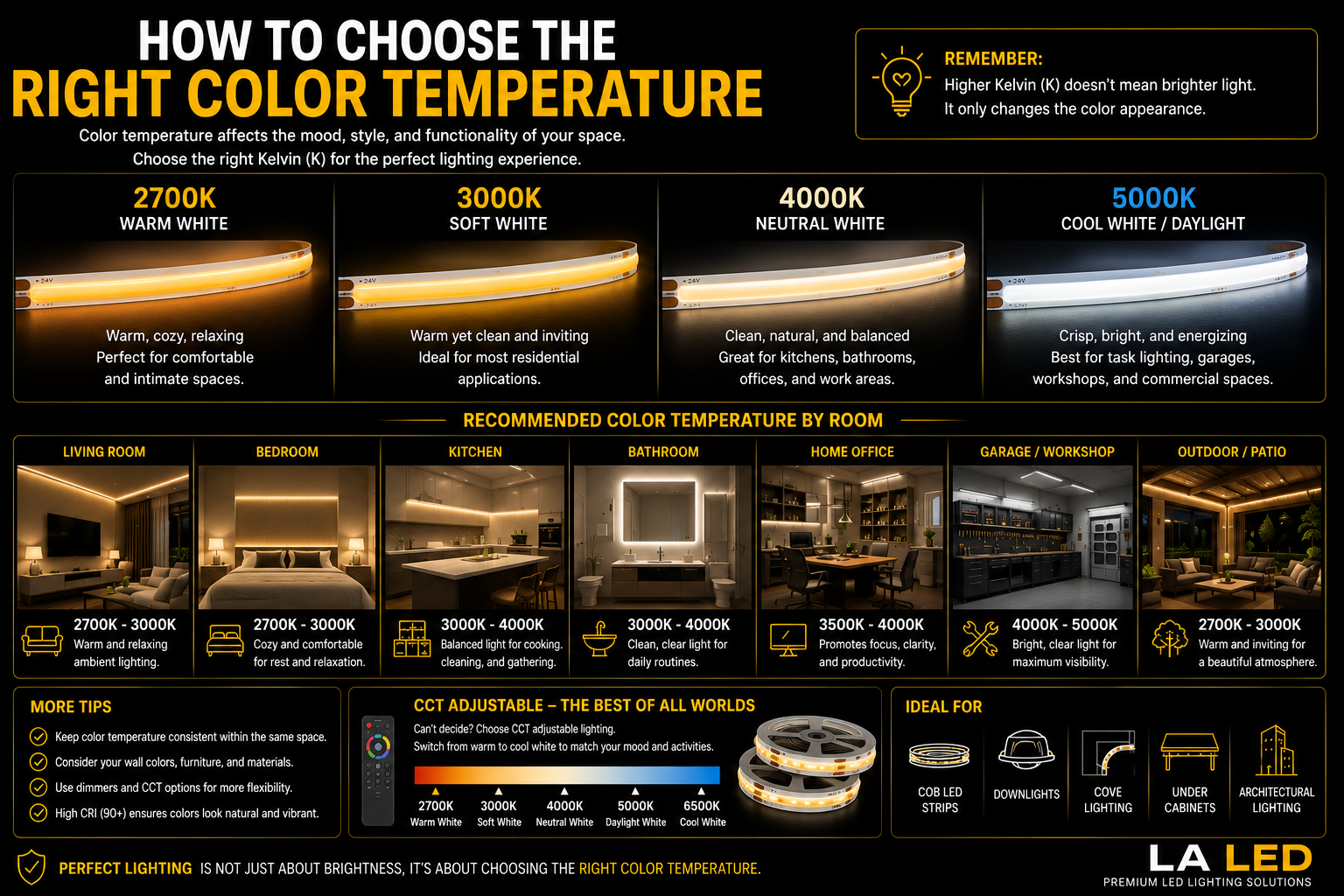
When choosing LED lighting, brightness isn't the only thing that affects how a room looks.
One of the most important specifications is color temperature.
You may have seen numbers such as 2700K, 3000K, 4000K, 5000K, or 6000K on LED strip lights, downlights, and other lighting products.
But what do these numbers actually mean?
And more importantly:
Which color temperature should you choose for your space?
The right answer depends on the room, its purpose, the materials and colors in the space, and the atmosphere you want to create.
What Is LED Color Temperature?
Color temperature describes whether white light appears warmer or cooler.
It's measured in Kelvin (K).
A lower Kelvin number produces warmer-looking light, while a higher Kelvin number produces cooler-looking light.
As a simple guide:
- 2700K – Warm White
- 3000K – Soft/Warm White
- 4000K – Neutral White
- 5000K – Cool/Daylight White
- 6000K – Very Cool White
One common misconception is that a higher Kelvin number means a light is brighter.
It doesn't.
Color temperature describes the appearance of the light, not its brightness.
Brightness is typically measured in lumens.
2700K – Warm and Cozy
2700K produces warm white light similar to the appearance many people associate with traditional incandescent lighting.
It creates a comfortable, relaxing atmosphere and works particularly well in spaces designed for rest.
Good applications include:
- Bedrooms
- Living rooms
- Dining rooms
- Lounges
- Hospitality-style interiors
- Decorative lighting
If you want your home to feel warm and inviting, 2700K is an excellent choice.
It also works beautifully with wood, warm stone, beige, cream, and other natural finishes.
3000K – Warm but More Modern
3000K is one of the most versatile color temperatures for residential lighting.
It still looks warm, but it's slightly cleaner and less yellow than 2700K.
This makes it particularly popular in modern homes.
3000K works well for:
- Kitchens
- Living rooms
- Bedrooms
- Bathrooms
- Hallways
- Under-cabinet lighting
- Cove lighting
- Architectural lighting
If you're unsure which color temperature to choose for your home, 3000K is often a very safe starting point.
It provides warmth without making the space feel overly yellow.
4000K – Clean and Neutral
4000K provides a more neutral white appearance.
It has less warmth than 3000K but doesn't usually appear as blue or cool as daylight-style lighting.
It's commonly used where visibility and a clean appearance are important.
Popular applications include:
- Kitchens
- Bathrooms
- Home offices
- Closets
- Garages
- Workspaces
- Commercial interiors
4000K can work particularly well with white, gray, black, concrete, stainless steel, and other contemporary finishes.
For highly modern interiors, it can create a crisp and sophisticated appearance.
5000K – Bright Daylight Appearance
5000K produces a noticeably cooler white light that's often associated with daylight.
It's commonly used in spaces where visual clarity and concentration are more important than creating a warm atmosphere.
Good applications may include:
- Workshops
- Garages
- Utility rooms
- Task areas
- Some offices
- Commercial workspaces
For living rooms and bedrooms, 5000K may feel too cool for many people, particularly during the evening.
However, personal preference always matters.
What About 6000K and Higher?
At around 6000K and above, white light can begin to appear noticeably cool or slightly bluish.
This can be useful for certain commercial, display, task, or specialty applications.
For typical residential ambient lighting, however, most homeowners prefer warmer temperatures.
What Color Temperature Is Best for the Living Room?
For most living rooms, 2700K to 3000K works beautifully.
2700K creates a softer, more traditional atmosphere.
3000K provides a cleaner and slightly more contemporary look.
For modern living rooms with hidden COB LED strip lighting, ceiling coves, TV walls, and floating shelves, 3000K can create an excellent balance between warmth and modern design.
What Color Temperature Is Best for the Bedroom?
Bedrooms should generally feel relaxing rather than stimulating.
For this reason, 2700K or 3000K is usually the best choice.
Warm lighting works especially well for:
- Headboard lighting
- Ceiling coves
- Bedside lighting
- Floating shelves
- Under-bed LED lighting
Avoid making bedroom lighting unnecessarily cool or harsh if your goal is a comfortable nighttime atmosphere.
What Color Temperature Is Best for the Kitchen?
Kitchens are more complicated because they need to be both comfortable and functional.
For many residential kitchens:
3000K–4000K works well.
3000K creates a warmer and more luxurious appearance, while 4000K provides a cleaner and more task-oriented look.
Your cabinet and countertop colors also matter.
Warm wood cabinetry may look beautiful under 3000K, while a highly contemporary white-and-gray kitchen may work well with 3500K or 4000K.
What Color Temperature Is Best for Under-Cabinet Lighting?
For residential under-cabinet lighting, 3000K is one of the most popular choices.
It provides good countertop visibility while maintaining a comfortable atmosphere.
4000K can be useful when a cleaner task-lighting appearance is preferred.
Most importantly, try to coordinate the under-cabinet lighting with the other lighting in the kitchen.
Using very different color temperatures in the same visual area can make the lighting appear inconsistent.
What Color Temperature Is Best for the Bathroom?
Bathrooms often benefit from slightly cleaner white light.
3000K to 4000K can work well depending on the design.
3000K creates a warmer, spa-like atmosphere.
4000K provides a cleaner appearance that may be useful around mirrors and vanities.
For grooming and makeup areas, color quality is also important, so don't look at color temperature alone. CRI (Color Rendering Index) should also be considered.
What Color Temperature Is Best for a Home Office?
For home offices, many people prefer 3500K to 4000K.
This creates a clean working environment without necessarily feeling as cool as 5000K daylight lighting.
If your office is also used as a relaxing living space, 3000K may be more comfortable.
What Color Temperature Is Best for Closets?
For closets and dressing areas, 3000K to 4000K is generally a good range.
However, CRI becomes especially important because you want clothing colors to appear natural.
High-quality lighting with good color rendering can make a significant difference when choosing clothing.
What Color Temperature Is Best for Outdoor Lighting?
For patios, architectural features, gardens, and outdoor living areas, 2700K to 3000K often creates the most attractive atmosphere.
Warm light complements:
- Wood
- Stone
- Landscaping
- Exterior walls
- Pergolas
- Outdoor kitchens
Very cool lighting can sometimes make residential outdoor spaces feel harsh.
Warm lighting generally creates a more inviting, high-end appearance.
Match the Color Temperature to Your Interior
Don't choose color temperature based only on the room name.
Look at the materials inside the room.
Warm lighting generally complements:
- Natural wood
- Beige
- Cream
- Brass
- Gold
- Warm stone
- Earth tones
Neutral or cooler lighting can complement:
- White
- Gray
- Black
- Concrete
- Chrome
- Stainless steel
- Cooler stone finishes
The same room can look completely different depending on the color temperature you choose.
Don't Mix Too Many Color Temperatures
One of the most common lighting mistakes is mixing several noticeably different white temperatures in the same space.
For example, imagine a kitchen with:
- 2700K pendant lights
- 4000K under-cabinet lights
- 5000K ceiling lights
Each fixture may look fine individually, but together the room can appear visually inconsistent.
For a more professional lighting design, keep nearby light sources within the same color temperature—or intentionally coordinate them as part of a layered lighting plan.
Color Temperature Is Not the Same as CRI
Color temperature and CRI describe different characteristics.
Color temperature tells you whether the light appears warm or cool.
CRI describes how accurately colors appear under that light compared with a reference source.
You can therefore have two 3000K LED products that make colors look noticeably different.
For kitchens, bathrooms, retail displays, closets, artwork, and high-end interiors, choosing LEDs with good color rendering can be just as important as selecting the right Kelvin temperature.
What If You Can't Decide? Choose CCT Adjustable Lighting
If you aren't sure which color temperature you'll prefer, CCT adjustable or tunable-white LED lighting can be an excellent solution.
Depending on the system, CCT lighting allows you to switch or adjust between different white temperatures.
For example:
2700K → 3000K → 4000K → 5000K → 6500K
This can be particularly useful in:
- Kitchens
- Living rooms
- Offices
- Retail spaces
- Multi-purpose rooms
You can use warmer light for relaxation and cooler light when greater visual clarity is desired.
COB LED Strips and Color Temperature
COB LED strip lights are an excellent option for architectural and residential lighting because they produce a smooth, continuous line of light with minimal visible spotting.
They're particularly effective for:
- Under-cabinet lighting
- Ceiling coves
- Floating shelves
- TV walls
- Closets
- Furniture
- Architectural details
Choosing the right color temperature allows the same COB installation to create completely different moods.
A 2700K COB strip can create a soft luxury atmosphere, while a 4000K COB strip can create a much cleaner contemporary appearance.
Quick Color Temperature Guide
| Area | Suggested Color Temperature |
|---|---|
| Living Room | 2700K–3000K |
| Bedroom | 2700K–3000K |
| Dining Room | 2700K–3000K |
| Kitchen | 3000K–4000K |
| Under Cabinets | 3000K–4000K |
| Bathroom | 3000K–4000K |
| Home Office | 3500K–4000K |
| Closet | 3000K–4000K |
| Garage / Workshop | 4000K–5000K |
| Patio / Outdoor Living | 2700K–3000K |
These ranges are general guidelines rather than strict rules. Interior finishes, natural daylight, personal preference, and the intended use of the space should also influence your decision.
Final Thoughts
Choosing the right LED color temperature isn't simply about deciding whether you like warm or cool white light.
Think about how the room is used, its interior colors and materials, the other light sources in the space, and the atmosphere you want to create.
For most residential spaces, 2700K–3000K creates a comfortable and inviting environment.
For kitchens, bathrooms, and work areas, 3000K–4000K can provide a cleaner appearance while remaining comfortable.
For garages, workshops, and task-oriented environments, 4000K–5000K may provide the crisp appearance you prefer.
And if you want maximum flexibility, a CCT-adjustable lighting system allows you to change the appearance of your lighting instead of committing to one color temperature.
FAQ
Is 3000K warm or cool white?
3000K is generally considered warm white. It has a clean appearance while still maintaining noticeable warmth.
Which is better, 3000K or 4000K?
Neither is universally better. 3000K is warmer and often preferred for residential spaces, while 4000K provides a cleaner, more neutral appearance suitable for kitchens, bathrooms, offices, and task areas.
What color temperature makes a home look luxurious?
Warm white lighting around 2700K–3000K is commonly used to create comfortable, upscale residential environments, especially when combined with indirect and architectural lighting.
Is 5000K too bright for a living room?
5000K isn't necessarily brighter—it appears cooler. Many people find its daylight-like appearance less relaxing in living rooms than 2700K or 3000K.
Can I mix 3000K and 4000K lighting?
You can, but noticeable differences between nearby fixtures may make a room look inconsistent. Coordinating color temperatures generally creates a more polished appearance.
What is CCT adjustable LED lighting?
CCT adjustable lighting allows the white color temperature to be changed between warmer and cooler settings using a compatible LED strip, controller, or fixture.