
When shopping for LED strip lights, most people focus on brightness, color temperature, voltage, and wattage.
But there's another specification that's easy to overlook:
LED strip width.
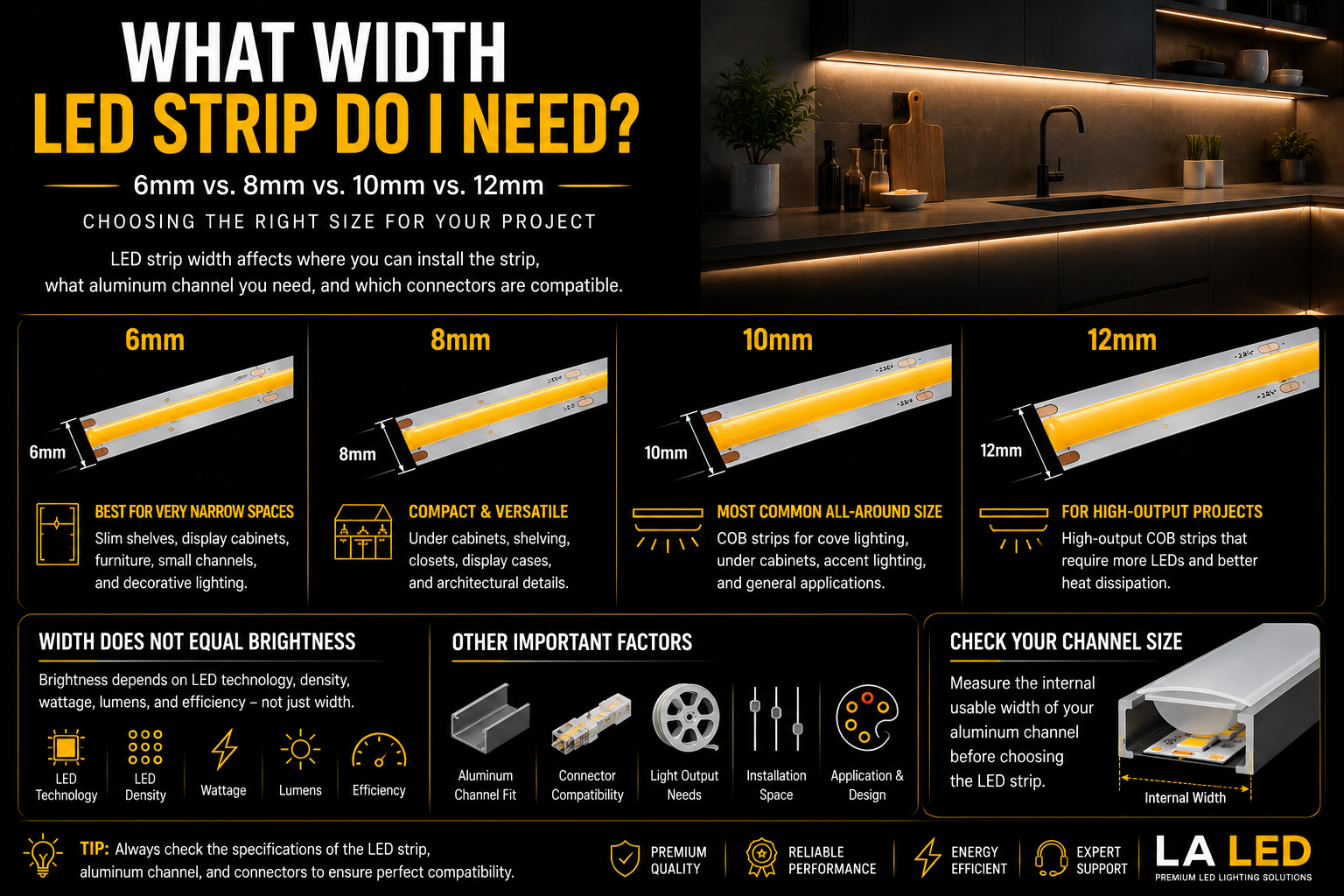
LED strips are available in different widths, and choosing the wrong size can create problems when you try to install the strip inside an aluminum channel, use a connector, fit it beneath a cabinet, or install it in a narrow architectural space.
So, what width LED strip do you actually need?
There's no single width that's best for every project. The right choice depends on the type of LED strip, available installation space, aluminum channel, connectors, light output, and application.
Here's what you should know before buying.
What Does LED Strip Width Mean?
LED strip width refers to the physical width of the flexible circuit board.
For example, an 8mm LED strip has a circuit board approximately 8 millimeters wide.
Common LED strip widths include:
- 6mm
- 8mm
- 10mm
- 12mm
Some specialty RGB, RGBW, high-output, or addressable LED strips may be wider.
The width doesn't tell you how bright the strip is. Two strips with the same width can have very different wattage, LED density, and light output.
6mm LED Strips – Best for Very Narrow Spaces
A 6mm LED strip is an excellent option when installation space is limited.
Its narrow profile makes it useful for:
- Slim shelves
- Display cabinets
- Furniture
- Narrow architectural details
- Small aluminum channels
- Decorative installations
Narrow COB LED strips are particularly useful when you want a continuous line of light in an area where a standard-width strip won't fit.
However, always check whether compatible connectors and aluminum channels are available for the exact strip you're using.
8mm LED Strips – Compact and Versatile
8mm is another popular width, particularly for single-color and COB LED strip lighting.
It provides a good balance between compact dimensions and installation flexibility.
Common applications include:
- Under-cabinet lighting
- Shelving
- Closets
- Display cases
- Ceiling details
- Furniture lighting
An 8mm strip can fit into many compact aluminum profiles while still providing excellent lighting performance, depending on the product.
10mm LED Strips – A Popular All-Around Size
10mm is one of the most commonly encountered LED strip widths.
It's frequently used for:
- COB LED strips
- CCT strips
- Single-color strips
- Architectural lighting
- Cove lighting
- Under-cabinet lighting
- Residential accent lighting
Because 10mm is common, finding compatible aluminum channels and installation accessories is often easier.
For many standard residential projects, a 10mm LED strip is a practical choice when installation space isn't extremely limited.
12mm LED Strips – Often Used for Multi-Channel Lighting
Wider LED strips are often needed when the circuit contains multiple lighting channels.
For example, some:
- RGB strips
- RGBW strips
- Tunable-white strips
- High-output strips
may require a wider circuit board to accommodate additional electrical pathways and components.
A 12mm strip can be an excellent option, but you'll need to make sure your aluminum channel and connectors are wide enough.
This is particularly important when replacing an existing LED strip inside a channel.
Does a Wider LED Strip Mean It's Brighter?
Not necessarily.
This is one of the most important things to understand.
Physical width and brightness are different specifications.
Brightness depends on factors such as:
- LED technology
- LED density
- Wattage
- Lumens per foot or meter
- Drive current
- Efficiency
A narrow COB strip can potentially produce more light than a wider strip designed primarily for decorative lighting.
Don't choose a strip based on width alone if brightness is your primary concern.
Width Matters When Choosing an Aluminum Channel
This is where LED strip width becomes especially important.
Before purchasing an aluminum channel, check its internal usable width.
For example, a channel may look wide enough from the outside but have a narrower internal space where the LED strip actually sits.
Your strip must fit comfortably inside the channel without:
- Folding
- Pinching
- Overlapping the edges
- Being forced into position
The safest approach is to check the specifications of both products before ordering.
Don't Forget the Connector Width
If you're planning a solderless installation, connector compatibility matters too.
An 8mm connector normally isn't designed for a 10mm or 12mm strip.
You also need to match the connector to the type of strip.
Depending on the lighting system, connectors may be designed for:
- Single-color
- CCT
- RGB
- RGBW
- Addressable LED strips
Matching the width alone isn't enough. The number and position of the electrical contacts must also match.
Which Width Is Best for Under-Cabinet Lighting?
For under-cabinet lighting, 8mm and 10mm LED strips are common choices.
A narrow strip can be especially useful when you want the aluminum channel to remain discreet.
However, don't choose solely based on appearance.
Consider:
- Required brightness
- Available mounting space
- Aluminum channel size
- Heat dissipation
- Color temperature
- Voltage
- Dimming requirements
For modern kitchens, COB LED strips can provide a smooth, continuous line of illumination without the visible dots associated with some traditional LED strips.
Which Width Is Best for Cove Lighting?
Cove lighting generally offers more installation space, so strip width is usually less restrictive.
Instead, prioritize:
- Light output
- Beam distribution
- Voltage drop
- Maximum run length
- Color temperature
- Dimming compatibility
An 8mm, 10mm, or wider strip may all work depending on the lighting design.
For long cove installations, electrical design can be more important than physical strip width.
Which Width Is Best for Shelves and Furniture?
For furniture, floating shelves, display cabinets, and other compact applications, narrower strips can be very useful.
6mm or 8mm COB strips can fit into small profiles and hidden spaces where wider strips may be difficult to conceal.
The result can be an extremely clean installation where you see the illumination rather than the lighting hardware.
What If I Already Have an Aluminum Channel?
If the aluminum channel is already installed, measure its inside width before purchasing your LED strip.
Don't measure only the outside of the channel.
You need to know the actual space available for the strip.
For example, if the usable internal width is approximately 10mm, don't assume every strip marketed as 10mm will automatically fit perfectly. Manufacturing tolerances and the profile design can affect compatibility.
Checking the specifications is always safer than relying on nominal measurements.
What If I'm Replacing an Existing LED Strip?
Before ordering a replacement:
- Measure the width of the existing strip.
- Check its voltage.
- Identify whether it's single-color, CCT, RGB, or RGBW.
- Check the wattage and light output.
- Measure the aluminum channel.
- Check connector compatibility.
Replacing a strip with another product simply because it has the same width doesn't guarantee compatibility.
Does LED Strip Width Affect Heat Dissipation?
Width can influence the physical design of the strip, but it shouldn't be used as the primary indicator of thermal performance.
Higher-output LED strips can generate more heat regardless of their width.
For higher-power installations, aluminum channels can help transfer heat away from the strip while also protecting the LEDs and creating a cleaner finished appearance.
Always follow the manufacturer's installation and thermal-management recommendations.
How to Choose the Right LED Strip Width
Before buying, ask yourself:
- How much installation space do I have?
- Will the strip be installed inside an aluminum channel?
- What is the channel's internal width?
- Do I need solderless connectors?
- Is the strip single-color, CCT, RGB, or RGBW?
- How much brightness do I need?
- Will the strip be visible or concealed?
- Do I need a very narrow profile?
Once you answer these questions, choosing the correct width becomes much easier.
Final Thoughts
There's no universal LED strip width that's best for every installation.
6mm and 8mm strips are excellent for narrow spaces, shelves, furniture, and discreet installations.
10mm strips are highly versatile and work well for many residential and architectural lighting projects.
12mm and wider strips are commonly found in more complex multi-channel lighting systems such as certain RGB and RGBW products.
Most importantly, don't choose your LED strip based on width alone.
Brightness, voltage, wattage, color temperature, LED technology, driver compatibility, connectors, and aluminum channel dimensions should all be considered together.
Choosing compatible components from the beginning will make installation easier and help create a cleaner, more professional lighting result.
FAQ
What is the most common LED strip width?
8mm and 10mm are common widths for many single-color and COB LED strips, while RGB, RGBW, and other multi-channel strips may be wider.
Is an 8mm LED strip better than a 10mm strip?
Not necessarily. The best width depends on your installation space and the specific product. Width alone doesn't determine brightness or quality.
Can I put a 10mm LED strip in an aluminum channel?
Yes, provided the channel has sufficient internal usable width. Always check the channel specifications before purchasing.
Does a wider LED strip produce more light?
Not automatically. Brightness depends primarily on the LEDs, wattage, density, efficiency, and electrical design rather than circuit-board width alone.
What width LED strip is best for under-cabinet lighting?
8mm and 10mm strips are common choices. Narrow COB strips can be especially useful when a discreet installation is desired.
What width LED strip should I use for RGBW lighting?
Many RGBW strips use wider circuit boards because they require additional electrical channels, but the exact width varies by product. Always check the manufacturer's specifications.