
You touch your LED driver or power supply and notice that it feels warm—or even hot.
The first question that usually comes to mind is:
Is this normal?
LED drivers convert incoming electrical power into the voltage and current required by LED lighting. During this conversion, some energy is naturally lost as heat.
So, a certain amount of warmth during operation is normal.
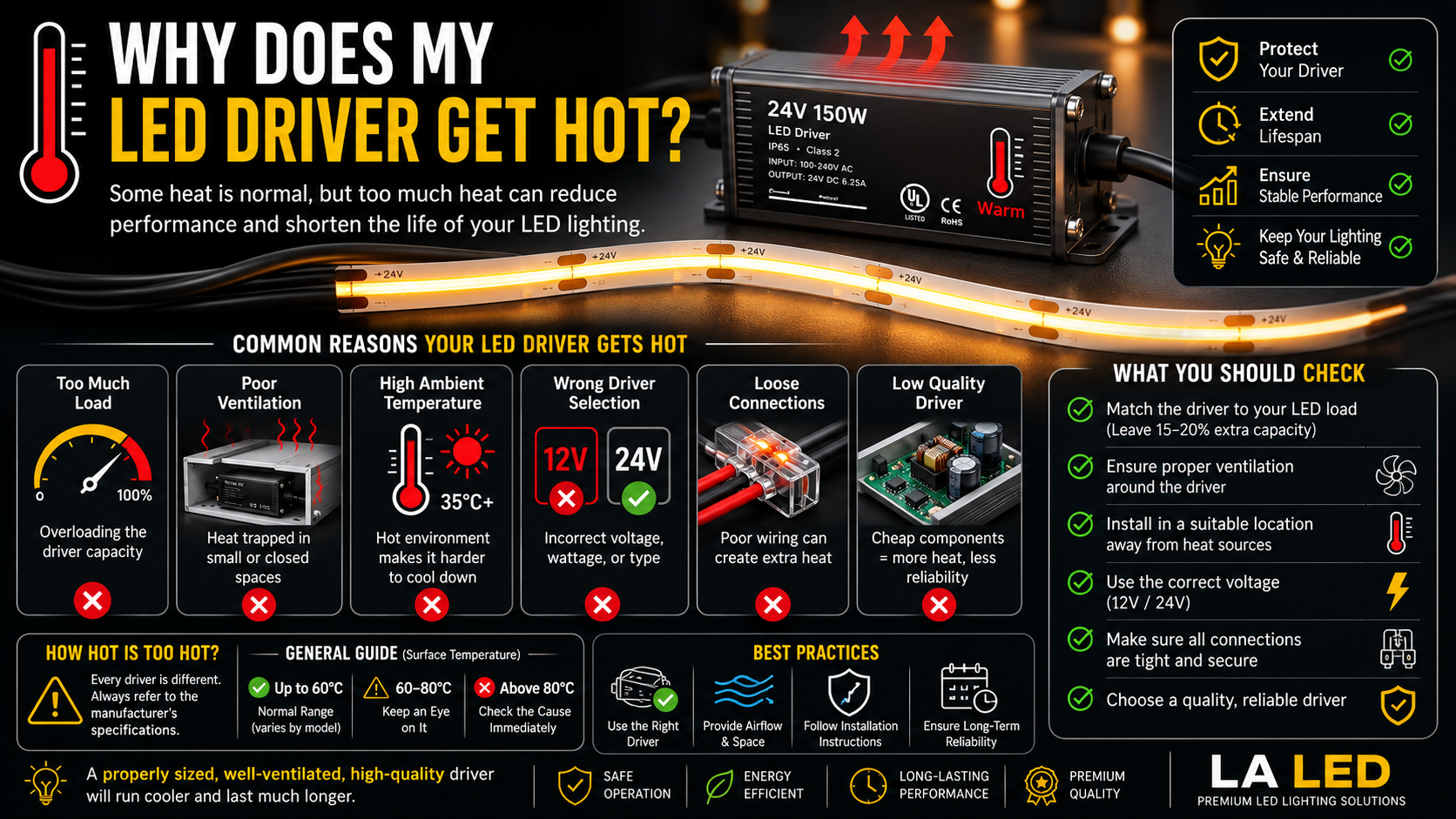
However, excessive heat can reduce the life of the driver and may indicate that the system is overloaded, poorly ventilated, incorrectly installed, or operating outside its intended conditions.
Understanding why an LED driver gets hot can help you determine whether you're seeing normal operation or a problem that needs attention.
Is It Normal for an LED Driver to Get Warm?
Yes.
LED drivers are electronic devices, and electronic components generate heat while operating.
How warm a driver becomes depends on factors such as:
- Driver wattage
- Connected LED load
- Driver efficiency
- Ambient temperature
- Ventilation
- Installation location
- Enclosure design
- Hours of continuous operation
A driver feeling warm doesn't automatically mean something is wrong.
The important question is whether it's operating within the manufacturer's specified temperature limits.
1. The LED Driver May Be Overloaded
One of the first things to check is the connected load.
Every LED driver has a maximum rated output.
For example, connecting close to or beyond 100 watts of LED load to a 100W driver can place significant stress on the power supply.
As a practical design approach, installers often leave additional capacity instead of continuously operating a driver at its absolute maximum.
A commonly used guideline is:
LED Load ≤ Approximately 80% of Driver Capacity
For example:
80W LED Load → 100W Driver
This additional capacity can help accommodate real-world operating conditions.
Always follow the manufacturer's specifications when sizing the driver.
2. Poor Ventilation Can Trap Heat
Where you install the LED driver matters.
A driver installed in a well-ventilated location can dissipate heat more effectively than one trapped inside a small sealed space.
Potential problem locations include:
- Small enclosed cabinets
- Insulated cavities
- Tight ceiling spaces
- Enclosures with little airflow
- Areas surrounded by heat-producing equipment
If the driver cannot release heat efficiently, its operating temperature may increase.
Never cover a driver with insulation unless the product is specifically rated for that installation method.
3. High Ambient Temperature
Even a correctly sized driver can become hotter when installed in a hot environment.
For example, drivers installed:
- Near ovens
- Above kitchen appliances
- Inside hot ceiling cavities
- In direct sunlight
- In poorly ventilated outdoor enclosures
may operate at higher temperatures.
Every driver has specified environmental and temperature limits.
Always check the manufacturer's ratings before choosing an installation location.
4. Using the Wrong Driver for the LED Strip
The driver must be compatible with the LED lighting system.
For constant-voltage LED strip lighting, the output voltage must match the strip.
For example:
12V LED Strip → 12V Compatible Power Supply
24V LED Strip → 24V Compatible Power Supply
Using an incompatible driver can result in poor performance and may damage the lighting system.
Voltage isn't the only consideration. You also need to check wattage, dimming method, installation environment, and product type.
5. Loose Electrical Connections
Poor connections can create additional electrical resistance.
This may result in localized heating around:
- Terminals
- Connectors
- Wire joints
- Junction points
- Damaged wiring
If the driver itself seems normal but one terminal or connection is unusually hot, the wiring should be inspected.
Electrical connections should be secure and installed according to applicable electrical requirements.
6. The Driver May Be Too Small
An undersized driver has to work harder to support the connected LED load.
For example, if an installation requires 120 watts but the driver is rated for only 100 watts, the power supply may experience overload conditions.
Possible symptoms include:
- Excessive heat
- Flickering
- Lights turning off
- Driver cycling on and off
- Reduced brightness
- Premature driver failure
Calculate the total LED load before selecting the power supply.
For LED strip lighting:
Watts per Foot × Total Length = Approximate Total Load
Then select a compatible driver with adequate capacity.
7. Dimming Compatibility Can Matter
If you're using a dimmable LED driver, the driver and dimmer need to be compatible.
Different systems may use:
- TRIAC
- ELV
- MLV
- 0–10V
- Other control methods
An incompatible dimming system may cause undesirable behavior such as:
- Flickering
- Buzzing
- Poor dimming range
- Unstable operation
If heat appears alongside dimming problems, compatibility should be investigated as part of the overall system.
8. Poor-Quality Drivers May Run Hotter
Not all LED drivers are designed or manufactured to the same standard.
Component quality, circuit design, thermal management, efficiency, and protection features can all affect operating temperature and reliability.
A properly selected, quality driver may include protection against conditions such as:
- Overload
- Short circuit
- Over-temperature
- Over-voltage
Available protections vary by product, so always check the driver's specifications rather than assuming every power supply includes the same features.
9. Outdoor Installations Need Extra Attention
Outdoor LED drivers face additional environmental challenges.
Heat, sunlight, moisture, and restricted airflow inside weather-resistant enclosures can all affect operating temperature.
For outdoor applications, choose a driver with the appropriate environmental rating and install it according to the manufacturer's instructions.
An IP65-rated driver, for example, provides protection against dust and water jets as defined by the IP rating system, but the complete installation—including connections and enclosures—must also be suitable for the environment.
Water resistance does not eliminate the need for proper thermal management.
10. Continuous Operation Creates More Heat
LED lighting that's used for long periods gives the driver more time to reach its normal operating temperature.
This is common in:
- Retail stores
- Restaurants
- Display lighting
- Offices
- Hotels
- Commercial buildings
- Architectural lighting
Drivers intended for these applications should be correctly sized and installed with appropriate heat dissipation and ventilation.
How Hot Is Too Hot for an LED Driver?
There's no universal surface temperature that applies to every LED driver.
Different products have different thermal designs and temperature ratings.
The driver label or technical documentation may include specifications such as:
Ta – Ambient Temperature
and
Tc – Case Temperature
These ratings are much more useful than simply deciding whether the driver “feels hot.”
Remember that something can feel very hot to your hand while still operating within its designed temperature range.
Conversely, a driver installed outside its rated conditions can have problems even if it doesn't immediately appear extremely hot.
Always use the manufacturer's specifications as the reference.
Warning Signs You Shouldn't Ignore
Heat deserves further investigation if you also notice:
- Burning smell
- Discoloration
- Melted wiring or connectors
- Repeated shutdowns
- Flickering
- Buzzing that wasn't previously present
- Driver repeatedly cycling on and off
- Visible damage
- Unusually hot terminals
If you notice signs of overheating or electrical damage, turn the system off and have it inspected by a qualified professional.
How Can You Keep an LED Driver Cooler?
Good system design can significantly improve thermal performance.
Consider these practices:
- Select the correct driver wattage.
- Avoid overloading the driver.
- Provide adequate ventilation.
- Follow the manufacturer's mounting requirements.
- Keep drivers away from unnecessary heat sources.
- Use appropriate wire sizes.
- Make sure electrical connections are secure.
- Use a driver rated for the installation environment.
- Verify dimmer compatibility.
- Use quality LED drivers and lighting components.
The goal isn't necessarily to make the driver completely cool.
The goal is to keep it operating safely within its intended thermal limits.
Should You Buy a Larger LED Driver?
Sometimes.
If your existing driver is operating too close to its maximum capacity, moving to a higher-wattage compatible model may provide additional capacity.
For example:
Instead of using a 100W driver for a 95W load, a properly selected larger driver may be a better choice.
However, simply installing the largest driver available isn't always necessary.
You still need to match:
- Output voltage
- Dimming type
- Environmental rating
- Electrical requirements
- Installation conditions
Driver sizing should be based on the actual lighting load and product specifications.
Does a Bigger LED Driver Make the LEDs Brighter?
No—not in a properly designed constant-voltage LED strip system.
Installing a 200W 24V driver instead of a 100W 24V driver doesn't automatically force twice as much power into the LED strip.
The larger wattage rating primarily indicates how much load the driver is capable of supporting.
The LED strip's electrical characteristics determine its normal power consumption when supplied with the correct voltage.
Can an Aluminum Enclosure Help?
Many LED drivers use metal housings because the enclosure can help transfer heat away from internal components.
However, even a metal-cased driver still needs to be installed according to its thermal and mounting requirements.
Don't assume that a metal housing means the driver can be placed anywhere without consideration for ventilation or ambient temperature.
Final Thoughts
If your LED driver feels warm during operation, don't immediately assume it's defective.
Some heat is a normal result of power conversion.
However, excessive heat can indicate problems such as:
- Too much connected load
- Poor ventilation
- High ambient temperature
- Incorrect driver selection
- Loose electrical connections
- Incompatible components
- Improper installation
The best approach is to check the driver's specifications, calculate the connected LED load, verify compatibility, and make sure the driver is installed in an appropriate location.
A correctly sized, properly installed LED driver is essential for stable brightness, reliable dimming, and long-lasting LED lighting.
FAQ
Is it normal for an LED driver to get hot?
Some warmth is normal because LED drivers generate heat while converting electrical power. Whether the temperature is acceptable depends on the driver's specified operating and case-temperature limits.
Can an overloaded LED driver overheat?
Yes. Operating a driver beyond its rated capacity can cause excessive heat, unstable operation, shutdowns, and potentially premature failure.
Should I leave extra wattage when choosing an LED driver?
Leaving additional capacity is a common design practice. An approximately 20% margin is often used as a general guideline, but manufacturer specifications should always take priority.
Can I use a higher-wattage LED driver?
Yes, provided the driver is otherwise compatible with the lighting system, including the correct output voltage and appropriate dimming and environmental specifications.
Does a larger LED driver make LED strips brighter?
No. In a correctly designed constant-voltage system, a higher driver wattage rating provides additional available capacity; it doesn't automatically increase the strip's brightness.
Can poor ventilation make an LED driver hotter?
Yes. Restricted airflow and high ambient temperatures can increase the driver's operating temperature.
Why does my LED driver turn off when it gets hot?
Some drivers include thermal or overload protection that can shut down or reduce output when unsafe operating conditions are detected. The exact behavior depends on the specific driver.