
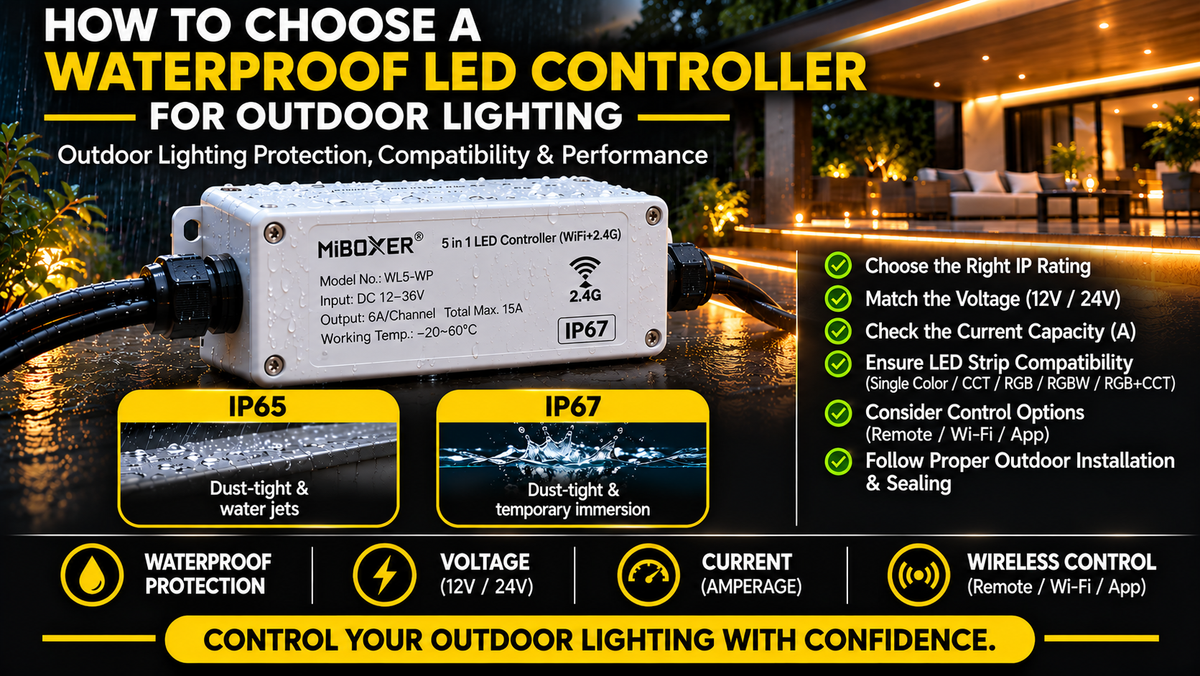
How to Choose a Waterproof LED Controller for Outdoor Lighting
Outdoor LED lighting can transform patios, decks, gardens, balconies, and architectural features into beautiful and functional spaces.
From warm white COB LED strips beneath outdoor steps to RGB+CCT lighting around a covered patio, modern LED systems offer flexibility in brightness, color, and atmosphere.
However, outdoor lighting requires more than selecting an attractive LED strip.
Every electrical component must be suitable for its environment, including the LED controller.
A controller designed for a dry indoor location may fail when exposed to rain, condensation, humidity, or other outdoor conditions.
This is why choosing a properly rated waterproof LED controller is important.
But what does waterproof actually mean?
Is an IP65 controller suitable for every outdoor installation?
Do you need IP67 protection?
Can one waterproof controller operate multiple outdoor LED strips?
And how do you calculate the correct electrical capacity?
In this guide, we'll explain how to select an outdoor LED controller based on environmental protection, electrical specifications, compatibility, control features, and installation requirements.
Our outdoor range covers all three parts of the system: IP65 outdoor strips, IP65 transformers, and the IP67-rated WL5-WP controller.
1. What Is a Waterproof LED Controller?
A waterproof LED controller is a lighting control device designed to resist specified levels of water exposure and environmental conditions.
Depending on the model, it may control:
Single-color LED strips
CCT tunable-white LED strips
RGB LED strips
RGBW LED strips
RGB+CCT LED strips
The controller regulates the output delivered to the connected LED lighting.
It may support functions such as:
On/off control
Brightness adjustment
Color selection
Color temperature adjustment
Dynamic lighting effects
Multi-zone operation
Wireless remote control
Wi-Fi or app-based control
What Makes It Suitable for Outdoor Use?
Outdoor-rated controllers may include:
Sealed housings
Gaskets
Protected cable entries
Moisture-resistant construction
Environmental protection ratings
Materials suitable for specified outdoor conditions
However, not all controllers marketed as waterproof provide the same level of protection.
The most important starting point is the manufacturer's actual environmental rating and installation instructions.
Worth being clear about our own range at the outset: the WL5-WP is the only outdoor-rated controller we carry. Every other unit in our controllers and remotes range, including the otherwise identical indoor WL5, is for dry indoor locations.
2. Why Outdoor LED Controllers Need Protection
Outdoor electrical equipment may experience conditions that are uncommon in indoor installations.
Rain and Water Exposure
Rainwater can enter inadequately protected housings and damage electronic components.
Condensation
Temperature changes can cause moisture to accumulate inside certain enclosures.
Humidity
Prolonged exposure to humid environments may contribute to corrosion and electrical problems.
Temperature Changes
Outdoor controllers may experience significant temperature variations between daytime and nighttime.
Direct Sunlight
Solar heating can increase enclosure temperature and affect electronic reliability.
Dust and Debris
Outdoor equipment may be exposed to dust, dirt, and airborne particles.
Snow and Ice
Cold-weather installations may encounter snow accumulation, freezing conditions, and moisture during thawing.
Important
A waterproof rating does not automatically guarantee protection against every outdoor environmental condition.
Temperature limits, UV resistance, corrosion resistance, and mounting requirements must also be considered.
That caution is worth taking literally. The WL5-WP is specified for −20°C to +45°C — a narrower band than the −40°C to +60°C of our IP65 transformers. In a cold-winter climate or a sun-exposed mounting position, the temperature limit may well be the binding constraint rather than the IP rating.
3. Understanding IP Ratings for LED Controllers
IP stands for Ingress Protection.
An IP rating describes the degree of protection an enclosure provides against solid objects and water under standardized test conditions.
An IP rating typically includes two digits.
For example:
IP65
The first digit describes protection against solid objects and dust.
The second digit describes protection against water.
Common IP Ratings
| IP Rating | Dust Protection | Water Protection |
|---|---|---|
| IP20 | Protection against fingers and similar solid objects | No rated water protection |
| IP44 | Protection against solid objects larger than 1 mm | Splashing water |
| IP65 | Dust-tight | Water jets |
| IP66 | Dust-tight | Powerful water jets |
| IP67 | Dust-tight | Temporary immersion under specified test conditions |
| IP68 | Dust-tight | Immersion conditions specified by manufacturer |
Important
IP67 is not a universal guarantee of suitability for continuous underwater use.
IP68 immersion conditions must be specified by the manufacturer.
Also, an immersion rating does not automatically establish resistance to every type of pressurized water jet.
Our outdoor products sit at two of those rows: the outdoor strips and IP65 transformers are IP65, and the WL5-WP controller is IP67.
4. IP65 vs IP66 vs IP67: Which Is Better for Outdoor Lighting?
The best rating depends on the installation environment.
IP65 LED Controllers
IP65 controllers are dust-tight and protected against water jets under specified test conditions.
They may be suitable for certain outdoor installations exposed to rain or splashing water, provided the manufacturer approves the intended mounting conditions.
Potential Applications
Covered patios
Protected outdoor cabinets
Certain exterior wall installations
Outdoor architectural lighting in suitable locations
Important
IP65 does not mean the controller can be submerged in water.
IP66 LED Controllers
IP66 provides dust-tight protection and resistance to powerful water jets under specified test conditions.
This may be useful for installations exposed to more demanding water spray conditions.
Potential Applications
More exposed exterior locations
Certain commercial outdoor installations
Areas where stronger water spray may occur
Important
IP66 does not automatically mean the controller is suitable for immersion.
IP67 LED Controllers
IP67 provides dust-tight protection and protection against temporary immersion under defined test conditions.
Potential Applications
Outdoor locations where temporary water accumulation is a realistic concern
Certain landscape lighting installations
Equipment installations with greater moisture exposure
Important
Even an IP67 controller should not be installed in a location where standing water, flooding, or continuous immersion is expected unless the manufacturer specifically approves that use.
This is the category our WL5-WP falls into. Note the asymmetry it creates in a typical system: the controller is IP67 while the strips and transformers around it are IP65, so the controller is not the weakest link — which is the right way round, since it is usually the hardest component to replace.
5. Is IP65 Enough for Outdoor LED Lighting?
For many outdoor lighting applications, an appropriately approved IP65 controller may provide sufficient ingress protection.
However, the answer depends on actual exposure.
Example 1: Covered Patio
A controller is mounted under a roof overhang, protected from direct rainfall.
An IP65 controller may be a suitable option if its other specifications and installation requirements are satisfied.
Example 2: Exposed Garden Wall
A controller is mounted on an exterior wall and may receive direct rain and wind-driven moisture.
An outdoor-rated IP65 or higher enclosure may be appropriate, depending on the manufacturer's approved use and the actual conditions.
Example 3: Ground-Level Landscape Lighting
A controller is installed near soil where water can collect.
This presents a greater moisture risk.
A better installation may involve relocating the controller above the expected water level and using a suitable enclosure rather than relying only on a higher IP rating.
Key Takeaway
Choose the controller based on the installation conditions, not simply the highest IP number available.
6. Waterproof vs Water-Resistant LED Controllers
The terms waterproof and water-resistant are often used in product descriptions.
However, they do not always provide enough technical information to determine installation suitability.
Water-Resistant
Generally indicates that a product is designed to resist some degree of water exposure.
Waterproof
Often suggests stronger protection, but the term alone does not establish a specific standardized performance level.
What Should You Check Instead?
Look for:
Verified IP rating
Manufacturer installation instructions
Approved indoor or outdoor use
Temperature range
Cable sealing requirements
Environmental limitations
Recommendation
Avoid selecting an LED controller based only on the word waterproof in its product title.
Use its documented environmental specifications.
All six items on that list are published on our WL5-WP product page, including the IP67 rating and the −20°C to +45°C operating range, so the check can be made against stated figures rather than a product title.
7. Choose the Correct LED Controller Voltage
Environmental protection is only one part of controller selection.
The controller must also support the electrical voltage of the LED lighting system.
Common low-voltage LED strip systems use:
12V DC
24V DC
Some controllers support wider input voltage ranges.
Example
Suppose you have a 24V outdoor COB LED strip.
You need:
A compatible 24V constant-voltage LED power supply
An LED controller that supports 24V operation
Compatible 24V LED strips
What Happens If the Voltage Is Wrong?
Incorrect voltage can cause:
Failure to operate
Unstable lighting
Excessive current
Damage to electrical components
Potential safety hazards
Important
The controller's supported voltage range does not change the LED strip's required operating voltage.
A 24V strip still requires a suitable 24V supply even if the controller supports multiple voltages.
That example is the standard case in our range. Our outdoor COB strips — the 8mm and 10mm — are 24V, the WL5-WP accepts DC 12–48V so it covers 24V comfortably, and the IP65 transformers supply 24V. There is also a 12V outdoor SMD strip if an existing installation runs at 12V.
8. How to Calculate the Required Controller Current
One of the most important specifications is the controller's maximum output current.
The controller must support the electrical load of the connected LED strips.
For a constant-voltage system:
Current (A) = Power (W) ÷ Voltage (V)
Example: 24V Outdoor COB LED Strip
Suppose an outdoor COB LED strip consumes 5W per foot.
The installation requires 20 feet.
Total power:
5W × 20 = 100W
Current:
100W ÷ 24V = 4.17A
The controller must support at least this load under the specified operating conditions.
Example: 12V System
For the same 100W load:
100W ÷ 12V = 8.33A
This is approximately twice the current required at 24V.
Comparison
| System | Total Power | Approximate Current |
|---|---|---|
| 12V | 60W | 5A |
| 12V | 120W | 10A |
| 24V | 60W | 2.5A |
| 24V | 120W | 5A |
| 24V | 240W | 10A |
Important
These are illustrative electrical calculations.
Actual LED strip wattage and controller ratings must be verified from product specifications.
Run against a real product: 20ft of our 10mm Outdoor COB at 4.27 W/ft is about 85W, or 3.56A at 24V. Every row of that table sits within the WL5-WP's 20A total rating, which is the highest of any controller we carry.
9. Per-Channel Current vs Total Current
Multi-channel LED controllers may have separate current ratings for individual output channels and for the entire device.
For example, a controller might specify:
6A per channel
15A total
These are hypothetical values.
Both limits must be respected.
Example
A five-channel controller operates RGB+CCT lighting.
The maximum simultaneous current may depend on the controller's operating mode and the connected LED strip.
Even if no individual channel exceeds 6A, the combined load could exceed the controller's 15A total limit.
Important
Always calculate the maximum current that can flow simultaneously through the controller.
A waterproof enclosure does not increase the controller's electrical capacity.
Our own figures show how widely the total varies between controllers with identical per-channel ratings. All three of these are 6A per channel:
| Controller | Per channel | Total |
|---|---|---|
| FUT039 (indoor) | 6A | 10A |
| WL5 (indoor) | 6A | 15A |
| WL5-WP (IP67) | 6A | 20A |
Five channels at 6A would multiply out to 30A on every one of them, yet the real totals are 10A, 15A and 20A. The per-channel figure alone tells you very little about capacity.
10. Which Controller Type Do You Need?
The correct controller depends on the type of outdoor LED strip.
Single-Color Outdoor COB LED Strips
These strips produce one fixed light color.
A compatible single-color dimming controller is typically sufficient.
Common Applications
Outdoor steps
Deck edges
Pathway accents
Patio lighting
Our options are the 8mm Outdoor COB and 10mm Outdoor COB, both IP65, CRI ~90 and available in 2700K, 3000K, 4000K and 5000K. For this application there is also a simpler route than any controller: an IP65 dimmable transformer operated from a wall dimmer handles brightness with no receiver in the system at all.
CCT Outdoor LED Strips
CCT strips allow adjustment between warm and cool white light.
They require a compatible tunable-white controller.
Common Applications
Outdoor seating areas
Covered patios
Architectural accent lighting
Our CCT COB Strip is IP20 indoor-rated, so a tunable-white outdoor installation would need a weatherproof channel or a protected location such as a covered soffit. The WL5-WP supports CCT mode on the control side.
RGB Outdoor LED Strips
RGB strips combine red, green, and blue channels to create different colors.
They require compatible RGB control.
Common Applications
Decorative garden lighting
Entertainment areas
Outdoor parties
Color-changing architectural features
RGBW Outdoor LED Strips
RGBW strips include a dedicated white channel.
A compatible four-channel controller is generally required for conventional analog RGBW strips.
Common Applications
Decorative outdoor lighting
Patios requiring both white and colored light
Commercial exterior accents
This is the colour option we stock for outdoor use: the RGBW Outdoor COB Strip (12mm, IP65, 3000K and 5000K white channels), driven by the WL5-WP in RGBW mode.
RGB+CCT Outdoor LED Strips
RGB+CCT strips combine RGB color control with adjustable warm and cool white channels.
They typically require a compatible five-channel controller.
Common Applications
Premium outdoor entertainment spaces
Multi-purpose patio lighting
Architectural color-changing systems
Commercial decorative installations
Important
Some addressable LED strips use different control methods and are not compatible with ordinary analog RGB or RGB+CCT controllers.
Always verify the strip's control protocol.
Note that a five-channel RGB+CCT strip is a separate product type from the RGBW strip above. The WL5-WP supports RGB+CCT mode, but if your project is built around full RGB+CCT outdoors, confirm your strip source before specifying the system around it.
11. What Is a 5-in-1 Waterproof LED Controller?
A 5-in-1 LED controller is designed to support multiple types of compatible LED strip configurations.
Depending on the model, selectable modes may include:
Single-color
CCT
RGB
RGBW
RGB+CCT
Why Is This Useful?
A 5-in-1 controller can provide flexibility when designing different lighting systems.
For example, the same controller family may support a single-color patio installation or a more advanced RGB+CCT architectural lighting system.
Important
The controller must be configured for the correct LED strip type.
Its supported voltage, current rating, control method, and environmental protection must also match the installation.
For outdoor work the 5-in-1 approach has a particular practical advantage: it is the only outdoor-rated controller in our range, so choosing it does not commit you to a lighting type at the point of purchase. The same unit covers a single-colour deck installation now and an RGBW patio later.
12. MiBoxer WL5-WP: A Waterproof 5-in-1 Controller Option
For customers looking for a multi-function LED controller, the MiBoxer WL5-WP is an option worth evaluating.
The WL5-WP is designed for compatible LED lighting control applications.
Its 5-in-1 functionality can support different LED strip configurations when properly selected and configured.
Published Specifications
| Specification | WL5-WP |
|---|---|
| IP rating | IP67 |
| Input voltage | DC 12–48V |
| Output | 6A per channel |
| Maximum total output | 20A |
| LED types | Single colour, CCT, RGB, RGBW, RGB+CCT |
| Communication | Wi-Fi + 2.4GHz RF |
| RF range | Up to 30m |
| Operating temperature | −20°C to +45°C |
| Voice control | Alexa and Google Assistant |
Potential Advantages
Multiple lighting control modes
Compatibility with supported LED strip configurations
Wireless control capabilities
Suitable applications where its documented environmental rating and installation conditions are met
Flexible use in different lighting projects
What Should You Verify?
Before purchasing or installing the WL5-WP, confirm:
Input voltage range
Maximum output current
Per-channel limits
Total output capacity
Exact IP rating
Supported lighting modes
Remote compatibility
Wi-Fi requirements
Operating temperature range
Manufacturer installation instructions
Important
Do not assume that every controller in the MiBoxer product family has the same environmental or electrical specifications.
Use the specifications for the exact WL5-WP model and product revision.
That warning is worth illustrating with the closest comparison. The indoor WL5 shares the same 5-in-1 modes, the same 12–48V input and the same 6A per channel — but it has no IP rating and a 15A rather than 20A total. The two are not interchangeable outdoors despite the near-identical name.
Explore the Product
MiBoxer WL5-WP Waterproof 5-in-1 LED Controller
13. Wireless Remote vs Wi-Fi Control for Outdoor Lighting
Outdoor LED controllers may support different control methods.
The best choice depends on how you want to operate the lighting.
RF Handheld Remote
A compatible RF remote can provide convenient local control.
Advantages
Dedicated physical controls
Often does not require internet access
Convenient brightness and color adjustment
Useful for outdoor seating areas
Limitations
Operating range varies
Remote may be misplaced
Battery replacement may be required
The WL5-WP's listed companion remote is the FUT092, a 4-zone RGB+CCT handheld. Our remotes are indoor devices, so one kept inside and used through a window or door is the realistic arrangement.
Wi-Fi or Smartphone Control
Some controllers support control through a compatible smartphone application.
Potential Advantages
Convenient phone-based operation
Access to supported scenes and settings
Possible scheduling features
Potential integration with other smart devices
Limitations
Wi-Fi coverage may be weak outdoors
Setup requirements vary
Some features may depend on network or internet availability
Important
Wi-Fi compatibility does not automatically mean every controller supports remote access, voice control, or automation.
Check the manufacturer's supported features.
The WL5-WP does support app control, Alexa and Google Assistant. Scheduling is particularly useful outdoors, where lighting often follows sunset rather than occupancy — and it means nobody has to go outside to switch the lights off.
14. Why Wireless Range Matters Outdoors
Wireless control performance depends on more than the advertised communication distance.
Potential obstacles include:
Exterior walls
Metal structures
Electrical enclosures
Dense building materials
Nearby electronic equipment
Distance from the transmitter
Wi-Fi interference
Example
A controller is installed inside a metal electrical cabinet on an exterior wall.
Although the controller may be within the remote's advertised range, the metal enclosure can significantly reduce wireless signal strength.
Better Installation Practices
Test wireless control before final mounting.
Avoid unnecessary signal-blocking obstacles.
Follow antenna placement instructions.
Verify Wi-Fi coverage if applicable.
Select a suitable installation location.
Important
Do not compromise electrical enclosure sealing or environmental protection to improve wireless reception.
The WL5-WP's 30m RF figure is measured under favourable conditions, and an exterior wall between the remote and the controller will reduce it substantially. This is the practical argument for using the Wi-Fi side rather than RF outdoors: the signal travels through the existing network rather than through the wall.
15. Can One Waterproof Controller Operate Multiple Outdoor LED Strips?
Yes, provided the controller is compatible and the combined electrical load remains within its ratings.
Example
Suppose three outdoor COB LED strips each consume 40W.
Combined power:
40W × 3 = 120W
At 24V:
120W ÷ 24V = 5A
A controller must support the combined 5A load, along with any applicable channel limits.
What About Long Installations?
Long LED strip runs may require:
Multiple power injection points
Suitable wire sizing
Additional controllers
Compatible LED amplifiers
Separate power distribution circuits
Important
Adding multiple LED strips to a controller does not eliminate voltage drop.
The electrical layout must be designed appropriately.
That 120W example is close to a 16.5ft run of our 10mm Outdoor COB (about 70W) plus a shorter second run, and it sits well inside the WL5-WP's 20A capacity. For the power-injection point, our IP65 multi-output units give separate terminated feeds from one enclosure: the 192W Dual-Channel, the 288W Triple-Output, or the 120W Dual-Channel in 12V. Where a single run is genuinely long, the 100ft 110V Outdoor COB Strip is a line-voltage product that sidesteps the low-voltage run-length limit, though it is not controller-compatible.
16. Do Outdoor LED Controllers Need Waterproof Power Supplies?
Every electrical component must be suitable for its own installation environment.
An outdoor-rated controller does not make an indoor-only power supply suitable for outdoor exposure.
A Complete Outdoor System May Include
Outdoor-rated LED strips
Suitable LED controller
Appropriate LED power supply
Approved electrical enclosure
Suitable wiring and connectors
Proper cable sealing
Required electrical protection
Example
An IP65 controller is installed outdoors.
However, its power supply is an indoor-only model exposed to rain.
The system is not appropriately protected simply because the controller has an outdoor rating.
Recommendation
Evaluate the environmental requirements of the complete system.
A complete outdoor system from our range would be: an IP65 outdoor strip, the IP67 WL5-WP, and an IP65 transformer such as the 96W, 288W or 384W units, all of which are rated for wet locations. Our compact transformers are dry and damp only, so they do not belong in this system despite being otherwise suitable drivers.
17. Waterproof Connectors and Cable Entries Matter
One of the most common weaknesses in outdoor electrical installations is the connection point.
Even when the controller enclosure is appropriately rated, improperly sealed cable entries can allow moisture inside.
Potential Problems
Water entering through cable glands
Damaged cable insulation
Loose connectors
Improperly sealed splices
Corrosion at terminals
Water collecting around connections
Better Practices
Use:
Manufacturer-approved cable glands
Connectors rated for the installation environment
Appropriate cable strain relief
Suitable electrical enclosures
Approved wiring methods
Important
The environmental rating of an enclosure may depend on the correct installation of cable glands, covers, gaskets, and other accessories.
Improper modifications can compromise the rating.
We do not currently stock cable glands, sealing kits or outdoor-rated strip connectors, so these will need to be sourced from an electrical supplier. One way to reduce the number of exposed connections in the first place is to terminate the AC side inside the driver's own enclosure — our IP65 transformers with integrated junction box are built for that.
18. Where Should You Install an Outdoor LED Controller?
Choosing the installation location is just as important as selecting the controller.
Recommended Considerations
Minimize direct water exposure where practical.
Avoid locations where water accumulates.
Maintain required service access.
Follow mounting orientation instructions.
Avoid unnecessary direct sunlight.
Consider wireless signal strength.
Keep the controller within its operating temperature range.
Protect electrical connections appropriately.
Example: Outdoor Deck Lighting
A controller for deck-edge COB LED strips might be mounted in an accessible, protected location near the lighting installation.
This can reduce unnecessary exposure while keeping cable runs manageable.
Avoid
Unapproved burial
Standing water
Locations subject to flooding
Excessive heat
Inaccessible enclosed spaces
Mounting arrangements prohibited by the manufacturer
The fifth and seventh points in the first list interact on this product. With a +45°C ceiling, a south-facing wall in summer sun is a genuinely marginal location for the WL5-WP even though its IP67 rating is more than adequate there. A shaded position under a soffit or deck is the better choice on both counts.
19. Can You Install a Waterproof LED Controller Inside an Electrical Enclosure?
Yes, when the controller and enclosure are suitable for the arrangement.
An additional enclosure may provide mechanical or environmental protection.
However, it introduces other design considerations.
Potential Benefits
Protection from accidental contact
Reduced direct weather exposure
Organized wiring
Additional physical protection
Potential Concerns
Heat accumulation
Limited wireless reception
Condensation
Insufficient mounting space
Difficult maintenance access
Important
A sealed electrical enclosure can trap heat.
The controller must remain within its specified operating temperature limits.
Two of those concerns are especially relevant here. The WL5-WP's +45°C ceiling leaves little margin inside a sealed box in summer, and putting a Wi-Fi and RF device inside a metal enclosure undermines both of its control methods. Since the unit is already IP67, an additional enclosure usually adds the drawbacks without adding meaningful protection.
20. Does a Waterproof LED Controller Overheat?
It can.
Waterproof or sealed construction does not eliminate heat generation.
LED controllers contain electronic switching components that may dissipate heat during operation.
Factors Affecting Temperature
Connected LED load
Current through the controller
Ambient temperature
Enclosure design
Mounting location
Direct sunlight
Ventilation
Controller efficiency
Example
A controller operates close to its maximum rated current inside a sealed box exposed to afternoon sunlight.
The internal temperature may become significantly higher than the surrounding air temperature.
Recommendation
Follow the manufacturer's current limits, temperature specifications, and installation requirements.
Do not assume an outdoor-rated controller can operate continuously at full load under every temperature condition.
This is the single most important caveat on the WL5-WP. Its +45°C limit is lower than the +60°C of our transformers, so in a hot installation the controller rather than the power supply is likely to be the limiting component. Designing well below the 20A rating is the practical response.
21. Outdoor LED Controller Problems and Their Causes
| Problem | Possible Cause | What to Check |
|---|---|---|
| Controller stops responding | Power, pairing, or controller fault | Supply voltage and control connection |
| LED strips flicker | Overload, voltage drop, or wiring fault | Current, driver, and wiring |
| Controller overheats | Excess load or high ambient temperature | Current rating and mounting conditions |
| Remote works intermittently | Signal obstruction or interference | Range and receiver location |
| Wi-Fi disconnects | Weak outdoor coverage | Network signal and configuration |
| One color does not work | Channel wiring or output fault | Connections and channel configuration |
| Moisture appears inside enclosure | Failed seal or incorrect installation | Gaskets, glands, and enclosure condition |
| Lights turn off after a while | Thermal protection or overload | Driver and controller ratings |
| Corrosion appears at terminals | Moisture exposure | Connection sealing and materials |
| Controller fails after rain | Water ingress or electrical fault | Environmental protection and installation |
Important
These symptoms can have several causes.
Do not assume every malfunction is caused by water exposure.
That last line is worth emphasising on an outdoor installation, where water is the obvious suspect. Rows two, three and eight are all electrical rather than environmental — check the driver capacity and the controller current ratings before concluding that a seal has failed.
22. Common Mistakes When Choosing Waterproof LED Controllers
Mistake 1: Assuming Every Waterproof Controller Is Suitable for Any Outdoor Location
Different products have different environmental limitations.
Mistake 2: Choosing IP65 for Continuous Submersion
IP65 is not an immersion rating.
Mistake 3: Ignoring the Controller's Voltage Range
The controller must support the lighting system's voltage.
Mistake 4: Exceeding the Current Rating
An outdoor-rated enclosure does not increase electrical capacity.
Mistake 5: Using the Wrong Channel Configuration
RGB, RGBW, and RGB+CCT systems have different wiring and control requirements.
Mistake 6: Ignoring the Power Supply's Environmental Rating
Every component must be suitable for its installation conditions — our IP65 transformers are the outdoor options.
Mistake 7: Using Unprotected Connections
Poorly sealed connectors can allow water ingress.
Mistake 8: Installing the Controller in Standing Water
Avoid locations where flooding or water accumulation may occur.
Mistake 9: Ignoring Wireless Signal Strength
Outdoor walls and metal enclosures can affect communication.
Mistake 10: Installing the Controller in Direct Sunlight Without Considering Heat
Solar heating can increase operating temperature. With a +45°C ceiling, this matters more on the controller than on the driver.
Mistake 11: Assuming IP67 Means Unlimited Underwater Use
IP67 addresses temporary immersion under specified conditions.
Mistake 12: Forgetting About Maintenance Access
Outdoor controllers and electrical connections may require future inspection or service.
23. Quick Decision Summary
| Your Installation | Recommended Starting Point |
|---|---|
| Covered patio lighting | Appropriately approved outdoor controller, often IP65 |
| Exposed exterior wall | Outdoor-rated controller suitable for direct weather exposure |
| Area exposed to strong water spray | Evaluate IP66 and installation requirements |
| Location with temporary water accumulation risk | Consider relocation and appropriate immersion protection |
| Garden lighting | Suitable outdoor controller with protected connections |
| RGB outdoor strips | Compatible RGB controller |
| RGBW outdoor strips | Compatible RGBW controller |
| RGB+CCT outdoor strips | Compatible five-channel controller |
| Multiple lighting zones | Compatible multi-zone control system |
| Smartphone control | Controller with supported Wi-Fi or smart features |
| Large LED strip installation | Calculate current and consider multiple output circuits |
| Controller inside sealed enclosure | Evaluate temperature and wireless reception |
| Outdoor COB LED strips | Match voltage, current, channels, and environmental rating |
The Bottom Line: Choose an outdoor LED controller based on its documented environmental protection, electrical capacity, LED strip compatibility, and installation conditions—not simply the word waterproof.
Translated into our range, every controller row resolves to the same product, because the WL5-WP is our only outdoor-rated controller and its 5-in-1 modes cover the RGB, RGBW and RGB+CCT rows. What varies is the rest of the system: an 8mm or 10mm Outdoor COB for single-colour work, the RGBW Outdoor COB for colour, and an IP65 transformer sized to the load.
24. Professional Outdoor LED Controller Buying Checklist
Before purchasing an outdoor LED controller, confirm:
Manufacturer approves the intended outdoor installation.
IP rating is suitable for expected water exposure.
Dust protection is adequate.
Operating temperature range is suitable.
Controller voltage matches the system.
LED strip type is supported.
Per-channel current rating is sufficient.
Total controller current rating is sufficient.
Driver voltage and wattage are correct.
Required dimming functions are supported.
RGB or CCT functionality is compatible.
Wireless remote compatibility is verified.
Wi-Fi coverage is adequate if needed.
Multi-zone functionality meets the project requirements.
Cable entries can be properly sealed.
Wiring and connectors are rated for the environment.
Mounting location minimizes unnecessary exposure.
Heat management is considered.
Electrical connections remain accessible where required.
Applicable electrical codes and installation instructions are followed.
IP rating, input voltage, per-channel and total current, RF range and operating temperature are all published on the WL5-WP product page, and wattage, location rating and certifications on every page in our drivers and transformers range.
Frequently Asked Questions
1. What is a waterproof LED controller?
A waterproof LED controller is a lighting control device designed to resist specified levels of water exposure while controlling compatible LED lighting.
2. What IP rating should an outdoor LED controller have?
The appropriate rating depends on water exposure and installation conditions. IP65 is suitable for some outdoor applications, while other environments may require different protection. Our WL5-WP is IP67.
3. Is IP65 waterproof?
IP65 provides dust-tight protection and resistance to water jets under specified test conditions, but it is not rated for immersion.
4. Is IP67 better than IP65?
IP67 provides temporary immersion protection, while IP65 addresses water jets. The better choice depends on the expected exposure.
5. Can I use an indoor LED controller outdoors?
Only if it is installed within a suitable approved arrangement that protects it and complies with its manufacturer's instructions. The indoor WL5 is not outdoor-rated despite sharing the WL5-WP's control features.
6. Can a waterproof LED controller control COB LED strips?
Yes, when the voltage, current, channel configuration, and control method are compatible — our outdoor COB strips are 24V.
7. Can I use one controller for multiple outdoor LED strips?
Yes, if the combined electrical load remains within the controller's specified limits. The WL5-WP is rated at 20A total.
8. Do outdoor LED controllers support RGB lighting?
Many do, but the exact lighting modes depend on the model. The WL5-WP supports five modes.
9. What is an outdoor RGB+CCT controller?
It is a controller designed to manage compatible red, green, blue, warm white, and cool white lighting channels in an outdoor-suitable installation.
10. Do waterproof LED controllers support Wi-Fi?
Some models do. Features and network requirements vary. The WL5-WP supports Wi-Fi, 2.4GHz RF, Alexa and Google Assistant.
11. Can I use a handheld remote outdoors?
Yes, when it is compatible with the controller and used within its own environmental limitations. Our remotes are indoor devices.
12. Can a waterproof LED controller be submerged?
Only when the manufacturer specifically approves the intended immersion conditions.
13. Does a waterproof controller need a waterproof driver?
The driver must be suitable for its own installation environment. Outdoor exposure may require an appropriately rated driver — see our IP65 range.
14. Can rain damage an IP65 LED controller?
An appropriately installed IP65 controller is designed to resist specified water-jet exposure, but damaged seals, incorrect cable entries, or conditions beyond its rating can still cause water ingress.
15. Why does my outdoor LED controller keep disconnecting?
Possible causes include weak wireless signals, interference, power problems, pairing issues, or controller faults.
16. Can outdoor LED controllers overheat?
Yes. Excess current, high ambient temperature, direct sunlight, and enclosure heat buildup can contribute to overheating. Check the operating temperature range, which is −20°C to +45°C on the WL5-WP.
17. What voltage is best for outdoor LED strips?
Both 12V and 24V systems are used. Our outdoor COB range is 24V, with a 12V SMD option available.
18. Do waterproof LED controllers need maintenance?
Periodic inspection may be appropriate, particularly for seals, connections, mounting hardware, and signs of moisture or corrosion.
19. Is a five-in-one controller suitable for outdoor lighting?
It can be, if the exact model supports the required lighting configuration and is approved for the intended outdoor environment — see the WL5-WP.
20. What is the most important factor when choosing an outdoor LED controller?
The controller must be suitable for the environment and electrically compatible with the complete LED lighting system.