
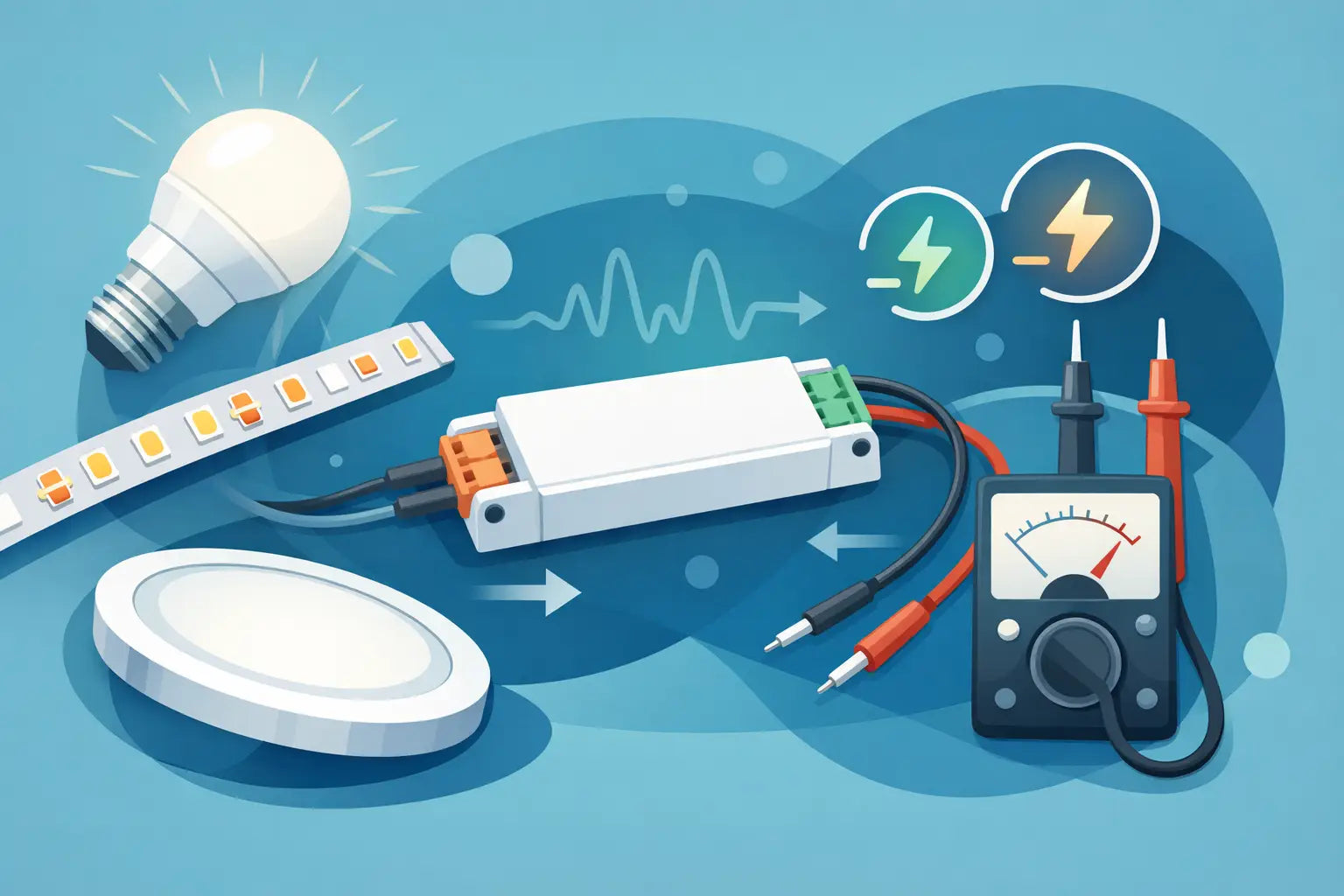
A surprising number of LED failures start with one basic mistake: getting the driver voltage wrong. If you are figuring out how to match LED driver voltage, the goal is simple - the driver and the LED load must speak the same electrical language. Get that part right, and you avoid flicker, overheating, dimming problems, and premature failure.
This is where many projects go off track. A strip light says 24V DC, the installer grabs a driver that fits the wattage, and the system still performs poorly because the output type or voltage does not actually match the fixture. On a premium residential job or a commercial install, that kind of mismatch costs time and credibility.
How to Match LED Driver Voltage Without Guessing
The first thing to understand is that LED drivers are not interchangeable just because the connectors fit or the wattage looks close. Voltage matching comes before wattage sizing, dimming compatibility, or form factor.
There are two common driver output types: constant voltage and constant current. Constant voltage drivers supply a fixed output voltage, usually 12V DC or 24V DC. These are commonly used for LED strip lights, tape lights, some under-cabinet systems, and many low-voltage architectural products. Constant current drivers supply a fixed current, such as 350mA, 700mA, or 1050mA, and allow the voltage to vary within a specified range. These are often used for downlights, pucks, linear fixtures, and integrated LED modules.
If your LED product is rated for 24V DC, you need a 24V constant voltage driver. If your fixture is rated for 700mA constant current, you need a 700mA driver with a voltage range that includes the fixture's required forward voltage. That is the core rule. You do not swap one type for the other.
Start With the Fixture or Strip Light Spec
Before you look at any driver, look at the LED load. The product label or spec sheet should tell you whether it needs constant voltage or constant current. It should also give you the exact input requirement.
For strip lighting, the label is usually straightforward. You may see 12V DC or 24V DC. In that case, the voltage match is direct. A 24V strip gets a 24V driver. A 12V strip gets a 12V driver.
For LED fixtures using constant current, the information may be shown differently. You might see something like 700mA, 30-42V DC. That means the fixture needs a constant current driver rated at 700mA, and the driver must be able to operate within that voltage window.
If the load spec is missing or unclear, stop there. Guessing at driver voltage is one of the fastest ways to damage LEDs or create an unstable system.
Constant Voltage Applications
Constant voltage is the standard choice for most LED strip and tape light systems. It is also common in color-changing products such as RGB, RGBW, and tunable white systems where controllers are built around 12V or 24V DC architecture.
In these setups, the driver voltage must exactly match the strip voltage. A 24V COB strip light needs a 24V driver, not 12V and not a current-regulated driver. The wattage still matters, but it comes second.
A higher-voltage driver is not a performance upgrade. Feeding 24V into a 12V strip can destroy it. Feeding 12V into a 24V strip will usually give you weak output or no operation at all.
Constant Current Applications
Constant current is less forgiving because you need to match current first and confirm voltage range second. If the fixture calls for 500mA, the driver must output 500mA. Then you verify that the driver's voltage range covers the fixture's forward voltage.
For example, if a downlight requires 500mA at 18-24V, a driver rated 500mA with an output range of 12-36V may work. A driver rated 500mA with a 9-15V range will not. The current matches, but the voltage range does not.
This is why fixture replacement and retrofit jobs deserve extra attention. A driver can appear close on paper and still be the wrong fit.
Wattage Matters, But Only After Voltage
Once voltage type and output are matched, then size the driver for load wattage. This is where many buyers start, but it should be step two, not step one.
For constant voltage systems, add up the total wattage of the connected LED products. If you have 24V strip light running at 5 watts per foot over 20 feet, the total load is 100 watts. Your driver should exceed that load with headroom, typically around 20 percent.
That means a 120W or 150W 24V driver would be a safer choice than a 100W unit operating at full capacity all the time. Extra headroom helps thermal performance, longevity, and real-world reliability.
For constant current systems, wattage is still relevant, but the current and voltage range are the controlling specs. You do not choose a constant current driver by wattage alone.
Dimming Can Change the Driver You Need
Voltage matching alone does not guarantee a successful install. If the system needs dimming, the driver must also be compatible with the control method.
This is especially important in residential remodels and higher-end custom homes where dimming quality matters. TRIAC, ELV, MLV, and 0-10V systems each have different driver requirements. A perfectly matched 24V driver can still perform poorly if it is paired with the wrong dimmer type.
For example, a 24V constant voltage strip light may need a dimmable 24V driver rated for TRIAC wall-dimmer control, or it may need a non-dimming driver feeding a separate low-voltage controller. Both setups can be valid, but they are not interchangeable.
If you are matching driver voltage for tunable white, RGB, or RGBW systems, remember that the controller also becomes part of the electrical chain. The driver output voltage has to match the controller input voltage, and the controller output has to match the lighting load.
What Happens When the Voltage Is Wrong
The symptoms of a mismatch are not always dramatic at first. Sometimes the lights turn on, but the system still fails in the field.
A voltage mismatch can cause flickering, low brightness, inconsistent color, driver overheating, reduced dimming range, audible buzzing, or complete LED failure. In wet-location and outdoor systems, poor driver selection can become an even bigger problem because replacement is harder and environmental stress is higher.
This is one reason professional buyers tend to stick with UL-certified components designed for US electrical standards. Reliability is not just about whether the light turns on. It is about whether it keeps performing under normal load, dimming demand, and installation conditions.
A Simple Way to Check How to Match LED Driver Voltage
If you want a clean process, use this order every time. First, identify whether the LED load is constant voltage or constant current. Second, match the exact voltage for constant voltage products, or match the current and voltage range for constant current fixtures. Third, calculate total load wattage and add headroom. Fourth, confirm dimming compatibility. Fifth, check location rating, especially for damp or wet environments.
That sequence prevents most ordering mistakes.
It also helps avoid a common problem in mixed-product projects. Installers sometimes focus on the strip light and forget the controller spec, or they replace a driver based on housing size instead of electrical output. The safer approach is to treat the entire system as one chain: power source, control method, and LED load all need to be aligned.
Where Buyers Usually Get Tripped Up
The most common issue is assuming all low-voltage LED products are 12V. Many premium strip and tape light systems now run on 24V because it supports longer runs and better consistency. If you default to 12V without checking, the system will not perform as designed.
Another issue is replacing a failed driver with whatever matches the wattage and connector style. That can work by accident, but it is not a professional standard. The correct replacement needs the same output type, correct voltage or current spec, compatible dimming behavior, and enough capacity for the load.
Buyers also run into trouble when they mix indoor-only drivers into outdoor or architectural applications. Even if the voltage is correct, the enclosure, junction box, and location rating matter. Compact drivers for wet and damp locations are often the better fit when the installation conditions are demanding.
For contractors and homeowners buying online, the best move is to read the load spec first and build the system around that. If the product says 24V DC, stay with a 24V driver and then choose the wattage, dimming protocol, and enclosure that fit the project. If the fixture is constant current, do not substitute a strip-light driver just because it is available.
At LA LED Lighting, that practical approach is what keeps projects clean, especially when the job includes dimmable strip lights, downlights, color-changing systems, or compact power components in tight spaces.
The right driver should never be a guess. Match the voltage to the load, account for the full control system, and give the install enough headroom to perform well long after the first power-up.