
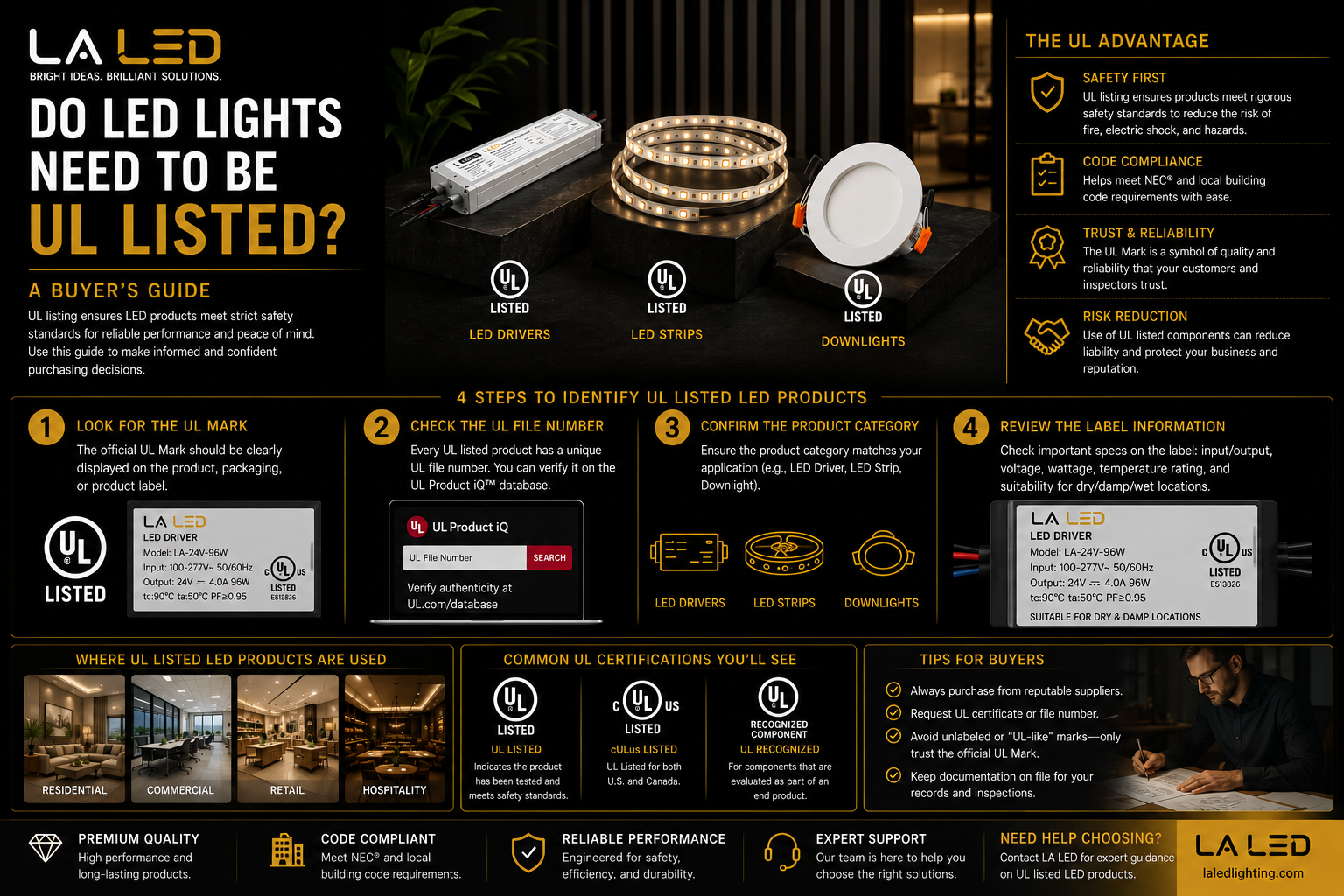
If you are sourcing fixtures, strip lights, drivers, or transformers for a real project, the question is not just do LED lights need to be UL listed. The better question is where they are being installed, what part of the system is exposed to inspection, and how much risk you want to carry if something fails.
For contractors and homeowners alike, UL listing is less about marketing and more about proof. It tells you a product was evaluated to a recognized safety standard. That matters when you are wiring a kitchen remodel, upgrading office lighting, installing tape light in millwork, or building a landscape system that has to perform in damp or wet conditions without creating callbacks.
Do LED lights need to be UL listed for every project?
Not every LED product is legally required to carry a UL mark in every situation, but many installed lighting products effectively do need recognized safety certification to satisfy code officials, inspectors, project specifications, insurance requirements, and common-sense risk management.
That distinction matters. There is no universal rule that says every LED lamp, strip, driver, or accessory sold in the US must always be UL listed. But once you move from loose components to permanent installation, the bar gets higher. In residential and commercial work, inspectors often expect listed products, especially for anything tied into building power.
If you are installing recessed downlights, hardwired drivers, LED transformers, under-cabinet systems, or low-voltage tape light with concealed power components, listing becomes a practical requirement even when someone tries to argue technical loopholes. A cheap non-listed component may save money upfront, but it can create delays, failed inspections, premature failure, or liability if a problem shows up later.
What UL listing actually means
UL stands for Underwriters Laboratories, one of the best-known safety testing organizations in the US. When a product is UL listed, it means samples were tested against specific safety standards for the intended use.
That does not mean every UL mark means the same thing. Some products are UL Listed. Some are UL Recognized Components. Some may be certified by another Nationally Recognized Testing Laboratory, or NRTL, rather than UL specifically. From a code and inspection standpoint, what matters is usually whether the product is certified by an accepted testing lab for the way it will be used.
This is where buyers get tripped up. A strip light, driver, or connector may look professional online, but the actual certification status may only apply to one part of the assembly. A UL recognized internal component is not the same as a fully listed end product ready for field installation.
Where UL listing matters most in LED systems
The need for listing depends on the application. Plug-in decorative products have a different compliance profile than architectural lighting built into a home or commercial space.
For hardwired lighting, listing is usually the safer path and often the expected one. Electricians, remodelers, and inspectors want products that have been tested for electrical safety, heat management, enclosure integrity, and intended environmental conditions.
Hardwired fixtures and recessed lighting
If the product is going into a ceiling, wall, soffit, or built-in structure, use listed products. Recessed downlights, retrofit kits, and integrated LED fixtures should match the application, including IC rating, damp rating, or wet rating where needed.
LED strip lights and tape lights
Strip lighting is where mistakes happen fast. People focus on brightness, color temperature, and dotless COB appearance, then overlook the full system. The strip itself matters, but so do the driver, transformer, connectors, wire, controls, and the location.
A premium strip light installation in cabinetry, coves, toe kicks, stair treads, or outdoor detailing should use certified components suited to the environment. If the run is in a kitchen, bathroom, exterior, or other moisture-prone area, the wet or damp location rating matters as much as the listing itself.
Drivers and transformers
Power components carry real risk. A quality dimmable LED driver or transformer with the proper listing and junction box can make the difference between a clean, reliable install and a service call waiting to happen.
This is especially true when you need compatibility with TRIAC, ELV, MLV, or 0-10V dimming. A poorly built, non-certified driver might power the load initially, but flicker, overheating, nuisance failures, and dimming instability are common when the component quality is weak.
Outdoor and landscape lighting
Outdoor installs raise the stakes. If a product is exposed to rain, irrigation, condensation, or temperature swings, the certification and location rating need to line up with reality. Wet-location components, sealed connections, and properly listed power supplies are not optional if you want long-term performance.
Code, inspection, and insurance considerations
Electrical code enforcement happens locally, and interpretation can vary. One inspector may be strict about every visible marking, while another focuses more on the overall assembly and whether the products are certified by an approved lab.
Still, if your goal is a smooth install, listed products are the safest bet. They reduce friction during inspection and strengthen your position if questions come up later. On commercial jobs, listed lighting products are often required outright by spec.
Insurance is another factor that gets ignored until there is a problem. If a fire, electrical failure, or property damage event involves a non-listed lighting component, that choice can become part of the claim review. Nobody wants to defend a low-cost shortcut after the fact.
UL listed vs UL recognized
This point deserves extra attention because it is one of the most misunderstood parts of LED compliance.
A UL Listed product is typically intended for standalone installation as a finished product. A UL Recognized component is usually meant to be built into another product or system, with the final assembly evaluated separately.
For example, a driver or LED board may be recognized as a component, but that does not automatically mean the field-installed system is fully listed as assembled. If you are buying parts to create a custom solution, you need to know which pieces are certified for field use and which are only approved as subcomponents.
That is one reason serious buyers prefer suppliers that clearly identify certification status and application suitability instead of burying it in a spec sheet.
Can you legally use non-UL-listed LED lights?
Sometimes yes, but that does not make it a smart choice.
A portable decorative product used temporarily may fall into a different category than a hardwired architectural system. Some low-voltage components may also be sold for specialty or OEM use without full listing as a finished field-installed product. But for typical residential and commercial installations, especially anything permanent, non-listed products create unnecessary risk.
If you are a homeowner working on a simple DIY project, you might be tempted by lower prices from generic imports. The problem is consistency. LED lighting is a system, not just a light source. If one weak component fails, the whole installation suffers.
For contractors, the answer is even clearer. The labor cost of replacing failed parts, losing inspection time, or dealing with client dissatisfaction will usually outweigh any small savings on uncertified products.
How to choose the right certified LED product
Start with the application, not the price tag. Ask whether the product is plug-in or hardwired, indoor or outdoor, dry, damp, or wet location, line voltage or low voltage, dimmable or non-dimmable, and part of a finished listed assembly or a custom build.
Then verify the power side. Drivers and transformers should be matched to the load, the control type, and the installation environment. If the job calls for premium strip lighting, tunable white, RGB, or RGBW controls, the certification and compatibility details should be just as clear as the lumen output.
For trade buyers and design-conscious homeowners, the best approach is simple: buy lighting components that are built for US standards, clearly rated for the installation conditions, and backed by real technical support. That is especially important in high-end residential work where dimming performance, clean light output, and long-term reliability all matter.
At LA LED Lighting, that is exactly why certified drivers, transformers, strip lights, and architectural lighting components matter. Superior performance and reliability start with products that are designed to meet the installation, not just make it into a shopping cart.
The bottom line on whether LED lights need UL listing
If the LED product is part of a permanent installed lighting system, the practical answer is usually yes. Even when the code language leaves room for interpretation, certified products protect the installer, the property, and the end user.
The cheapest lighting option often becomes the most expensive one after flicker, heat issues, failed inspection, or early replacement. When you choose listed LED products built for the job, you are not paying for a label. You are paying for fewer unknowns, better performance, and a system you can stand behind.
If you are planning a project now, treat listing as part of the specification, not an afterthought. That is how you keep a lighting job clean, compliant, and built to last.