
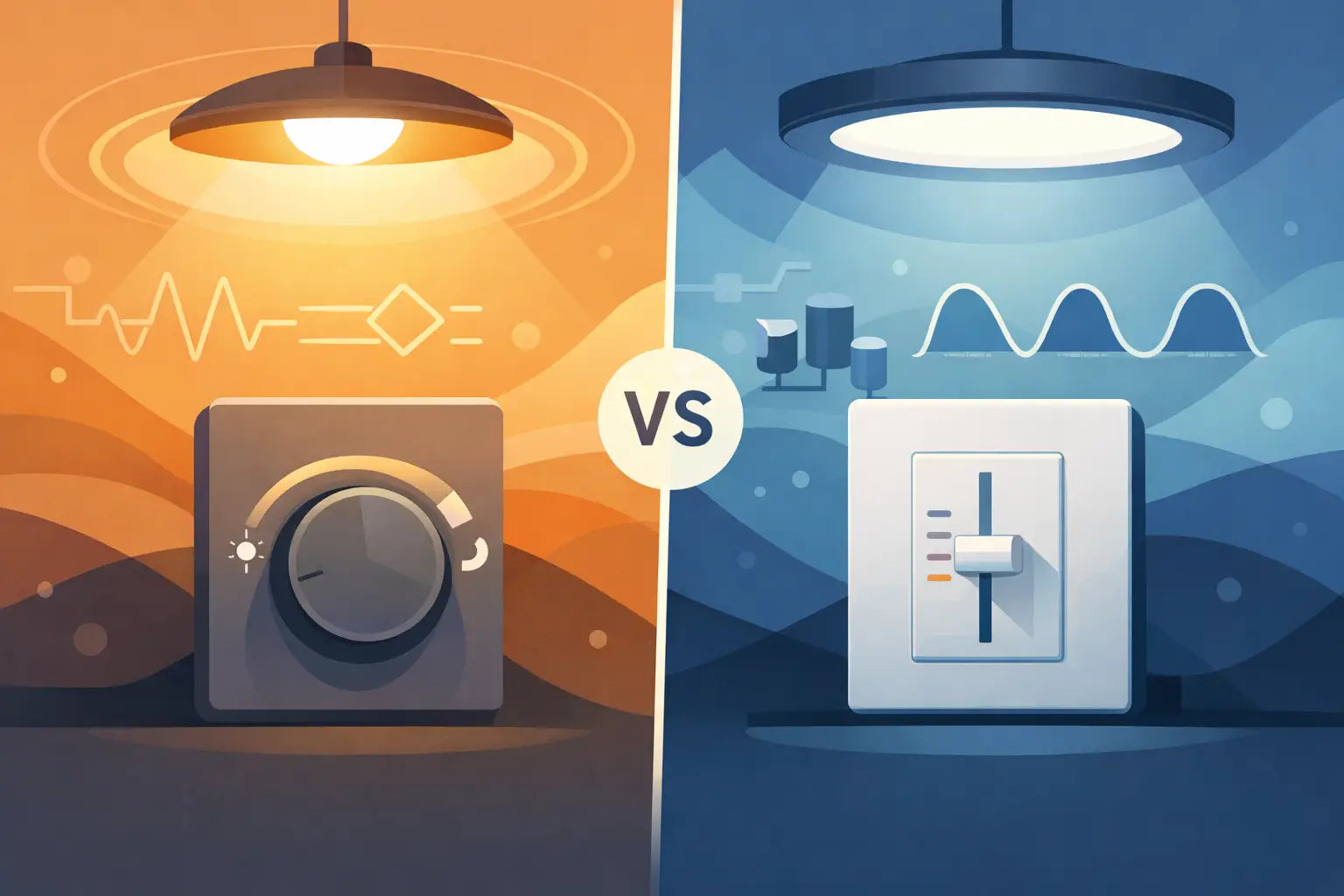
A dimmer that buzzes, flickers, or drops out at low light is usually not a bad LED. More often, it is a mismatch in control method. When people compare triac vs elv dimming, they are really trying to answer a practical jobsite question: which system will give stable, smooth LED performance with the driver and fixture they are installing?
That answer depends on the load, the driver design, the wiring already in the wall, and how refined the dimming needs to feel. In residential remodels, tenant improvements, custom homes, and landscape lighting, the wrong dimming choice can waste time fast. The right one gives you clean low-end control, better compatibility, and fewer callbacks.
What triac vs elv dimming actually means
TRIAC dimming is a forward-phase dimming method. It was developed around older incandescent and halogen loads, and it remains common because many homes and commercial spaces already use wall dimmers based on this approach. It is familiar, widely available, and often the first thing people ask for when they want a dimmable LED driver or transformer that works with standard wall-box controls.
ELV dimming is reverse-phase dimming. It is generally better suited to electronic low voltage loads, including many modern LED drivers. In practice, ELV dimmers usually deliver smoother performance at lower light levels, with less audible noise and less instability when paired correctly with compatible LED power components.
The key point is simple: these are not interchangeable labels. A fixture or driver may be dimmable, but not with every dimmer type. Dimmable only means something if the control method and power supply match.
TRIAC vs ELV dimming for LED systems
For many LED projects, TRIAC still works well - especially when the driver is specifically engineered for forward-phase dimming and the installation uses existing line-voltage wall dimmers. This can make TRIAC the practical choice in retrofit work where opening walls or changing control schemes is not ideal.
But TRIAC has limits. Some LED loads do not dim smoothly across the full range. You may see pop-on at the low end, shimmer, dead travel on the dimmer slider, or cutoff before reaching a very warm low-light level. On smaller loads, these issues become more noticeable because the dimmer was not originally designed around the electrical behavior of LEDs.
ELV usually has the edge when the goal is premium dimming performance. In higher-end residential applications, under-cabinet lighting, architectural strip lighting, recessed systems, and spaces where ambiance matters, reverse-phase dimming often provides better control. Low-end dimming tends to feel more gradual and refined, especially with quality LED drivers built for ELV.
That does not mean ELV is always the winner. It often requires a compatible dimmer, a compatible driver, and in some cases a higher product cost. If the project has budget constraints or needs to work with existing forward-phase controls, TRIAC may still be the better fit.
Where TRIAC makes sense
TRIAC is often the practical answer in remodels and straightforward residential retrofits. If the wallbox already has compatible forward-phase controls and the selected LED driver is rated for TRIAC dimming, the install can stay simple. That matters to electricians and contractors trying to keep labor predictable.
It also makes sense for many standard LED downlight and strip light applications where deep dimming is not the top priority. If the client wants reliable dimming for general illumination in kitchens, hallways, bedrooms, and living areas, a well-matched TRIAC system can perform very well.
The catch is product quality. Cheap dimmers and poorly designed drivers create most of the complaints people blame on TRIAC itself.
Where ELV makes sense
ELV is a strong choice when the dimming experience matters as much as the light output. Design-conscious homeowners, lighting designers, and installers working in premium interiors often prefer it because it can reduce flicker, improve low-end stability, and create a more polished feel.
It is also well suited to many modern LED drivers and compact electronic power supplies, including applications where strip lighting is used for coves, millwork, toe-kicks, vanities, and architectural accents. In these setups, dimming quality is immediately visible. A rough dimming curve or low-end dropout stands out fast.
If the project is being built from scratch, ELV is easier to specify from the beginning because the dimmer, driver, and load can all be planned together.
The compatibility question matters more than the dimmer label
This is where many projects go sideways. A contractor sees dimmable on the spec sheet, grabs a wall dimmer, and assumes it will work. Then the lights flicker below 30 percent or refuse to turn off cleanly.
The more reliable approach is to start with the driver or transformer. Check whether it is rated for TRIAC, ELV, MLV, 0-10V, or another control type. Then match the dimmer to that rating. After that, confirm the load range. LED loads are low compared with legacy incandescent circuits, and some dimmers do not behave well when the total wattage is too small.
This matters even more with LED strip lighting. A premium COB strip paired with the wrong dimmable driver can still perform poorly. The strip is not the issue. The control stack is.
Driver quality changes the result
A well-built, UL-listed dimmable LED driver can make the difference between smooth performance and constant troubleshooting. Better drivers are designed to interpret the chopped waveform correctly, maintain output stability, and dim consistently across the usable range.
That is why professionals tend to focus less on dimmer marketing and more on system compatibility. Good dimming is never just about the wall control. It is about the dimmer, the driver, the fixture, and the load acting like one system.
Installation and retrofit considerations
If you are working in an existing home or office, TRIAC often wins on convenience. There may already be compatible line-voltage dimmers in place, and replacing a driver is simpler than redesigning the control method. For many retrofit jobs, that keeps the scope contained.
ELV can be the better technical choice, but not always the easier field choice. Depending on the dimmer and wallbox conditions, you may need to account for wiring requirements, device depth, and cost. On some jobs, that is completely justified. On others, it is unnecessary.
In new construction and high-end remodels, the decision is easier to make strategically. If the client expects premium dimming performance in key visual areas, specifying ELV-compatible drivers and controls from the start often avoids compromise later.
Performance differences users actually notice
Most end users do not care whether the waveform is forward-phase or reverse-phase. They care whether the lights dim smoothly, stay quiet, and turn on without flashing. That is the real-world test.
TRIAC systems can perform well, but they are more likely to show quirks when the dimmer and driver are only loosely compatible. ELV systems, when matched correctly, tend to feel cleaner at lower light levels. This is especially noticeable in bedrooms, dining rooms, hospitality spaces, and layered lighting scenes where subtle dimming matters.
Another difference is audible noise. Buzzing can come from the dimmer, the driver, or the fixture components reacting to the waveform. ELV often reduces that risk, though quality still matters. A low-grade ELV setup is not automatically better than a well-engineered TRIAC system.
Which one should you choose?
Choose TRIAC if the project is a retrofit, the selected driver is designed for forward-phase dimming, and the goal is dependable performance with common wall controls. It is often the right answer for practical residential upgrades and cost-conscious jobs.
Choose ELV if you want better low-end dimming, smoother control for modern LED loads, and a more refined result in premium spaces. It is especially attractive for architectural strip lighting, custom interiors, and projects where dimming quality is part of the finish level.
If you are unsure, the safest move is to select the driver first and build the dimming method around it. That is how professionals avoid compatibility surprises.
For contractors, electricians, and homeowners buying LED power components online, this is where a specialized supplier matters. A focused product catalog with dimmable drivers, compact transformers, and LED systems built around known compatibility takes a lot of risk out of the decision.
The best dimming setup is not the one with the most familiar name. It is the one that matches the driver, suits the installation, and performs cleanly when the lights are actually on the wall. Shop with that standard, and the project usually goes right the first time.