
If you're replacing old lights, renovating your home, or planning a new lighting system, you may find yourself comparing two familiar options:
LED and halogen lighting.
Halogen lighting was once extremely common in homes, especially for recessed lights, spotlights, track lighting, and accent lighting.
LED technology has since become the dominant choice for many residential applications.
But does that automatically mean LED is better?
What about the warm appearance of halogen?
Can LED provide the same quality of light?
And does switching to LED actually save enough electricity to matter?
Let's compare LED vs. halogen lighting and look at which one makes more sense for today's home.
What Is Halogen Lighting?
A halogen lamp is a type of incandescent light.
Electric current heats a tungsten filament until it becomes hot enough to produce visible light.
Halogen lamps use a halogen gas that helps improve performance compared with traditional incandescent bulbs.
They became popular because they offered:
- Bright, crisp light
- Excellent color rendering
- Compact lamp sizes
- Easy dimming
- Attractive accent lighting
- Relatively inexpensive initial cost
For many years, halogen was widely used in kitchens, living rooms, recessed fixtures, and display lighting.
But there's a major disadvantage:
A large portion of the electrical energy becomes heat rather than visible light.
What Is LED Lighting?
LED stands for:
Light-Emitting Diode
Unlike halogen lamps, LEDs don't create light by heating a filament.
Instead, they produce light through semiconductor technology.
This allows LEDs to convert electrical energy into visible light much more efficiently.
Modern LED technology is available in many forms, including:
- LED bulbs
- Downlights
- COB LED strips
- Under-cabinet lighting
- Architectural lighting
- Outdoor lighting
- RGB and RGBW lighting
- CCT-adjustable lighting
- Smart lighting
This flexibility is one of the biggest reasons LED lighting has changed residential lighting design.
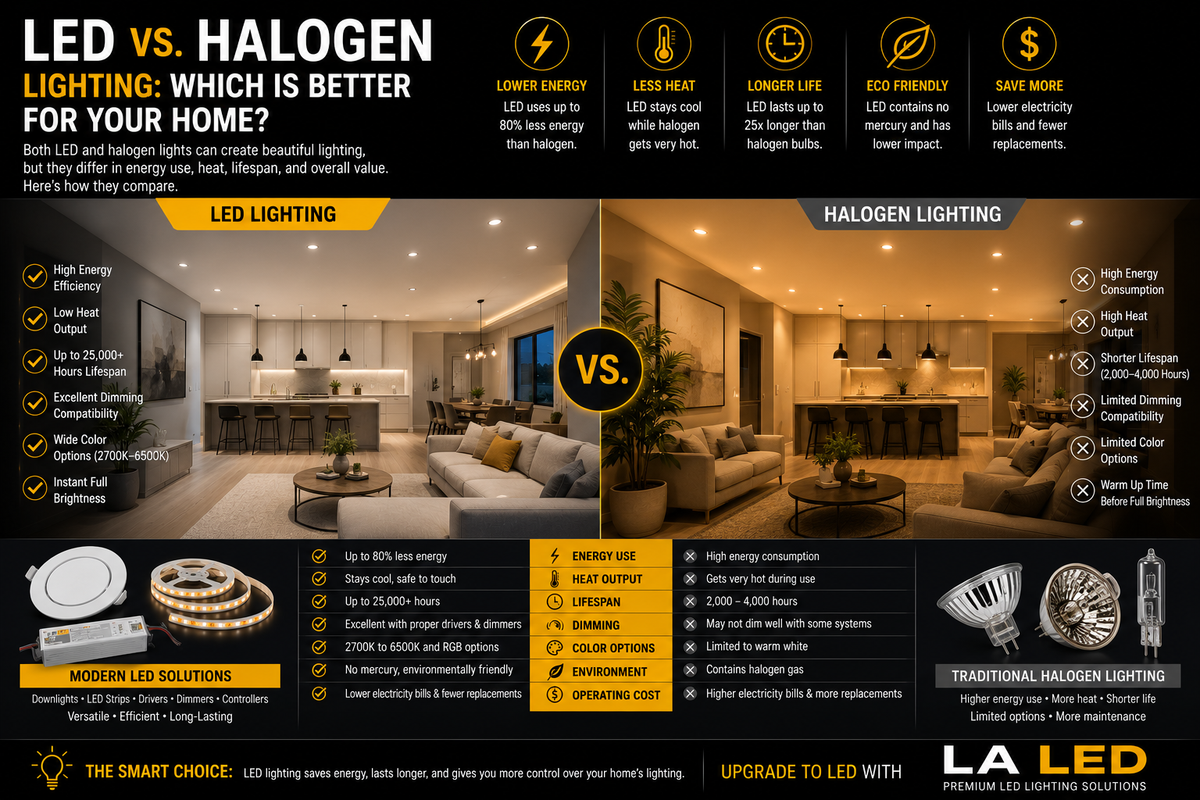
LED vs. Halogen: Quick Comparison
| Feature | LED | Halogen |
|---|---|---|
| Energy Efficiency | Excellent | Low |
| Heat Output | Lower | Very High |
| Typical Lifespan | Much Longer | Shorter |
| Maintenance | Low | Higher |
| Dimming | Excellent with compatible equipment | Naturally easy |
| Color Options | Very Wide | Primarily warm white |
| Design Flexibility | Excellent | Limited |
| Smart Controls | Widely Available | Limited |
| Initial Cost | Often Higher | Often Lower |
| Long-Term Operating Cost | Lower | Higher |
Let's look at these differences more closely.
1. Which Uses Less Electricity?
LED wins by a significant margin.
Halogen lamps produce light by heating a filament to an extremely high temperature.
That process requires considerably more energy than producing comparable illumination with an efficient LED source.
An LED can often produce similar usable light while consuming substantially less electricity than a halogen lamp.
The exact savings depend on the specific products being compared, so you should compare lumens rather than watts.
For example, don't assume:
50W Halogen = 50W LED
A 50W LED would typically produce far more light than a 50W halogen lamp.
Instead, compare the lumen output.
2. Which Produces More Heat?
This is another major difference.
Halogen lamps become extremely hot.
Heat is an inherent part of how they produce light.
LED lighting also generates heat, but generally much less radiant heat than halogen lighting for comparable illumination.
LED products still require proper thermal management.
For example, quality LED fixtures may use:
- Heat sinks
- Aluminum housings
- Aluminum channels
- Thermal management systems
But in a residential environment, replacing halogen lighting with efficient LEDs can significantly reduce the amount of heat produced by the lighting system.
3. Which Lasts Longer?
LED lighting generally has a major advantage in operating life.
Halogen lamps typically require much more frequent replacement.
Quality LED products can operate for many thousands of hours before reaching their specified end-of-life performance.
The actual lifespan of an LED depends on:
- Product quality
- Operating temperature
- Driver quality
- Installation
- Dimming system
- Electrical conditions
- Hours of use
So, not every LED will last equally long.
But properly designed LED systems generally require significantly less lamp replacement than traditional halogen lighting.
4. Which Costs Less?
This depends on whether you're looking at initial cost or long-term cost.
Halogen lamps have historically been inexpensive to purchase.
LED products can have a higher initial price.
But purchase price tells only part of the story.
Long-term lighting cost includes:
Purchase Price + Electricity + Replacement + Maintenance
Because LEDs typically consume much less electricity and last longer, they can provide lower operating costs over time.
This becomes especially important in homes with many recessed lights.
Example: A Room with 10 Downlights
Imagine a room with:
10 × 50W halogen lights
Total power consumption:
500 watts
Now imagine replacing them with LED downlights that provide suitable comparable illumination while consuming, for example:
10 × 9W
Total:
90 watts
That's a difference of:
410 watts whenever the lights are operating.
The exact LED wattage required will depend on lumen output, beam angle, fixture design, and the room, but the example demonstrates why LED upgrades can substantially reduce lighting energy consumption.
5. Which Has Better Light Quality?
This question is more interesting.
Halogen lighting naturally provides excellent color rendering and has a continuous spectrum that many people find visually attractive.
This is one reason halogen lighting remained popular for so long.
Older LED products sometimes produced:
- Harsh white light
- Poor color rendering
- Unnatural colors
- Inconsistent color temperature
But modern LED technology has improved significantly.
Today, quality LED products can offer:
- CRI 90+
- CRI 95+
- Warm 2700K
- 3000K
- 4000K
- Tunable white
- High-quality dimming
A carefully selected LED can create warm, comfortable illumination while providing the efficiency benefits of LED technology.
6. What About CRI?
CRI stands for:
Color Rendering Index
It describes how naturally colors appear under a light source compared with a reference.
Halogen lighting generally has excellent color rendering.
With LED lighting, CRI varies depending on the product.
For many residential applications, CRI 90+ is an excellent target.
High-CRI LEDs are particularly valuable for:
- Kitchens
- Bathrooms
- Closets
- Artwork
- Living rooms
- Dining rooms
- Under-cabinet lighting
So when replacing halogen with LED, don't choose based only on wattage.
Check the CRI too.
7. Which Has Better Color Temperature Options?
This is an area where LED offers far more flexibility.
Halogen lighting naturally produces warm light.
LEDs are available across a much wider range.
For example:
2700K – Warm and relaxing
3000K – Warm but slightly cleaner
4000K – Neutral and crisp
5000K – Cooler daylight appearance
Some LED products also offer CCT-selectable or tunable-white lighting, allowing you to choose or adjust the color temperature.
That level of flexibility isn't normally available with traditional halogen lamps.
8. Does LED Look as Warm as Halogen?
It can.
One reason some homeowners hesitate to replace halogen is that they like its warm appearance.
If that's your priority, look for quality LEDs around:
2700K
This can provide a warm residential appearance closer to traditional incandescent and halogen lighting.
For a slightly cleaner modern look:
3000K
is also very popular.
But Kelvin alone isn't enough.
Look at CRI, dimming performance, beam quality, and overall product quality as well.
9. Which Is Better for Dimming?
Halogen lamps have traditionally been excellent for dimming.
Their simple electrical characteristics allow them to dim smoothly with compatible traditional controls.
LED dimming is more complex.
For a good LED dimming experience, you need compatible components.
Depending on the system, this may involve:
- Dimmable LED fixture
- Dimmable LED driver
- TRIAC dimmer
- ELV dimmer
- MLV dimmer
- 0–10V control
- LED controller
When correctly matched, modern LED systems can provide excellent dimming.
But compatibility matters.
For low-voltage strip systems, a driver that accepts every common protocol, such as the 100W 5-in-1 Dimmable LED Driver, removes most of this guesswork because it works with TRIAC, ELV, MLV, 0-10V, and PWM controls.
10. Why Can LED Lights Flicker When Replacing Halogen?
Sometimes homeowners replace halogen lamps with LEDs but keep the existing dimmer.
Then they experience:
- Flickering
- Buzzing
- Limited dimming range
- Lights that won't turn completely off
- Lights that suddenly switch off at low levels
The LED itself may not be defective.
The problem can be dimmer compatibility.
Older dimmers designed primarily for incandescent or halogen loads may not work correctly with every LED product.
When upgrading to LED, check the complete system.
11. LED Gives You More Design Options
This is one of LED's biggest advantages.
With halogen, residential lighting was largely based around:
Bulbs + Fixtures
LED technology allows lighting itself to become part of the architecture.
For example:
COB LED Strip Lighting
Can create continuous lines of light inside:
- Ceiling coves
- Cabinets
- Shelves
- TV walls
- Stairs
- Furniture
The Indoor Dotless Dimmable COB LED Strip (10mm, 24V) is the workhorse for this, with a continuous dot-free line and approximately CRI 90.
Slim Downlights
Can provide clean ceiling illumination with minimal visual impact, such as the 4 Inch Flat Panel LED Downlight (9W, 5CCT) — which is the same 9W figure used in the 10-downlight example above.
Adjustable Downlights
Can highlight:
- Artwork
- Walls
- Cabinets
- Architectural features
The 4 Inch Multi-Direction LED Recessed Light (9W, 5CCT) tilts up to 90 degrees for exactly this purpose.
RGBW Lighting
Can provide both white and colored illumination.
CCT Lighting
Can allow adjustable white color temperature.
This gives homeowners and designers much more creative flexibility.
12. LED Is Better for Indirect Lighting
Halogen lighting is primarily fixture-based.
LED strips make indirect lighting much easier to integrate into a home.
For example:
COB LED strips + aluminum channels
can create smooth illumination in:
- Ceiling coves
- Under cabinets
- Floating shelves
- Staircases
- Wall details
- Closets
Instead of seeing the fixture, you see the effect of the light.
This has become a major feature of modern interior lighting.
13. Which Is Better for Recessed Lighting?
For most modern residential installations, LED downlights are usually the more practical choice.
Benefits include:
- Lower energy consumption
- Longer operating life
- Lower heat output
- Slim fixture options
- Multiple color temperatures
- Dimming options
- Adjustable designs
- CCT-selectable models
If you're renovating a home filled with older halogen recessed lighting, upgrading to LED can significantly modernize the lighting system.
Where the existing cans are staying in place, a retrofit unit such as the 6 Inch 5CCT LED Retrofit Recessed Downlight (14W) replaces the halogen fixture without opening up the ceiling.
14. Which Is Better for Kitchens?
LED is particularly useful in kitchens because you can combine several lighting layers:
- LED downlights for general illumination
- COB LED strips for under-cabinet task lighting
- Accent lighting for cabinets or shelves
This creates a more flexible kitchen lighting design than relying entirely on ceiling-mounted halogen fixtures.
For kitchens, consider:
3000K–4000K
and preferably:
CRI 90+
depending on the desired appearance. The COB LED strip light range lists both figures for every option, so the under-cabinet layer can be matched to the downlights.
15. Which Is Better for Living Rooms?
Living rooms benefit from flexible lighting.
Instead of relying only on ceiling lights, LED allows you to combine:
- Dimmable downlights
- Cove lighting
- TV backlighting
- Shelf lighting
- Accent lighting
- Floor and table lamps
For comfortable residential environments, 2700K–3000K is often a good starting point.
Dimming makes the system even more versatile.
16. Which Is Better for Bedrooms?
LED offers more flexibility for creating soft, layered bedroom lighting.
You might use:
- Warm LED downlights
- COB headboard lighting
- Under-bed lighting
- Closet lighting
This can create a much more relaxing environment than relying on a few bright ceiling fixtures.
For bedrooms, warm:
2700K–3000K
lighting is often preferred.
17. Which Is Better for Bathrooms?
LED is also well suited to bathrooms, provided fixtures and components have appropriate ratings for their installation locations.
You can combine:
- Downlights
- Vanity lighting
- Mirror lighting
- Indirect LED strips
- Shower-area lighting where appropriately rated
High CRI is especially useful around mirrors because it helps skin tones and colors appear more natural.
18. Which Is Better for Outdoor Lighting?
LED is widely used for modern outdoor lighting because of its efficiency and flexibility.
Applications include:
- Path lighting
- Landscape lighting
- Architectural lighting
- Pergolas
- Outdoor kitchens
- Steps
- Decks
Products must be appropriately rated for the outdoor environment, such as the Outdoor Dotless Dimmable COB LED Strip (10mm, 24V), which is IP65 rated for damp and covered outdoor locations.
For residential landscapes, 2700K–3000K often creates a more natural and inviting atmosphere.
19. LED Can Work with Smart Lighting
LED technology also integrates well with modern controls.
Depending on the system, you may be able to control:
- Brightness
- Color temperature
- RGB/RGBW color
- Lighting zones
- Timers
- Scenes
- Schedules
using:
- Wall controls
- Remotes
- Apps
- Compatible smart-home systems
A controller such as the MiBoxer WL5 WiFi 5-in-1 LED Controller (12-48V) covers single color, CCT, RGB, RGBW, and RGB+CCT strips from one unit and works with app and remote control.
Traditional halogen lighting offers far less flexibility in this area.
20. Is Halogen Still Better at Anything?
Halogen does have some advantages.
It provides:
- Excellent natural color rendering
- Smooth traditional dimming
- Warm familiar light
- Low initial lamp cost in some situations
Some people simply like the visual character of halogen.
But for most new residential lighting projects, these benefits usually don't outweigh LED's advantages in:
- Efficiency
- Lifespan
- Heat reduction
- Design flexibility
- Controls
- Maintenance
And modern high-quality LED products have closed much of the gap in light quality.
21. Should You Replace Working Halogen Lights?
If your existing halogen system works, you don't necessarily need to replace everything immediately.
But upgrading may make sense when:
- Lamps require frequent replacement
- Electricity use is high
- Fixtures generate excessive heat
- You're renovating
- You want smart controls
- You want better dimming flexibility
- You want architectural LED lighting
- You want fewer ceiling fixtures
- Existing fixtures are aging
A renovation is often an ideal opportunity to rethink the entire lighting design instead of simply replacing one lamp technology with another.
22. Don't Just Replace Bulbs—Improve the Lighting Design
This is probably the biggest opportunity when moving from halogen to LED.
Instead of:
Old Halogen Bulb → New LED Bulb
consider:
Old Lighting Design → New Lighting Design
For example, instead of 12 ceiling spotlights, you might use:
- 6–8 carefully positioned downlights
- COB under-cabinet lighting
- Indirect cove lighting
- Accent lighting
The result can be more comfortable and visually interesting while potentially using less energy.
LED vs. Halogen: Which Wins?
For most modern homes:
Energy Efficiency
Winner: LED
Lifespan
Winner: LED
Heat Output
Winner: LED
Design Flexibility
Winner: LED
Smart Controls
Winner: LED
Color Temperature Options
Winner: LED
Traditional Dimming Simplicity
Winner: Halogen
Natural Color Rendering Without Checking Specifications
Winner: Halogen
Overall Choice for a New Residential Lighting System
Winner: LED
Final Thoughts
So, LED vs. halogen—which is better for your home?
For most homeowners today, LED is the better overall choice.
It uses significantly less electricity, produces less heat for comparable illumination, lasts longer, requires less maintenance, and offers far more flexibility in terms of:
- Color temperature
- Dimming
- Fixture design
- Architectural lighting
- Smart controls
- COB strip lighting
- Adjustable lighting
- Outdoor applications
Halogen still has excellent color rendering and familiar dimming characteristics, but modern high-quality LEDs can deliver beautiful warm light while providing the efficiency and flexibility expected from a contemporary lighting system.
Most importantly, if you're upgrading from halogen, don't think only about replacing bulbs.
Use the opportunity to rethink how your home is illuminated.
Layer downlights with indirect COB lighting, task lighting, and accent lighting.
That's where the real advantage of modern LED technology becomes visible.
FAQ
Is LED better than halogen?
For most residential applications, LED offers major advantages in energy efficiency, lifespan, heat output, maintenance, and design flexibility.
Does LED use less electricity than halogen?
Yes. LEDs can generally provide comparable illumination while consuming substantially less electrical power than halogen lamps.
Does LED produce less heat than halogen?
Yes. Halogen lamps become extremely hot because they produce light by heating a filament. LEDs still generate heat and require thermal management, but generally produce much less heat for comparable useful illumination.
Can LED look as warm as halogen?
Yes. Quality 2700K LEDs can create a warm residential appearance, while high-CRI products can provide excellent color rendering.
Why do my LEDs flicker after replacing halogen bulbs?
An incompatible existing dimmer is one possible cause. LED lamps, drivers, and dimmers need to be compatible for stable dimming performance.
Should I replace my halogen downlights with LED?
In many homes, upgrading can reduce energy consumption and maintenance while providing more options for color temperature, dimming, and fixture design.
Is halogen better for color rendering?
Halogen naturally provides excellent color rendering. LED color quality varies, so look for quality products with CRI 90+ when accurate color appearance is important.
Which is cheaper: LED or halogen?
Halogen may have a lower initial lamp cost in some cases, but LED typically offers lower long-term operating costs because of reduced electricity use and longer service life.