
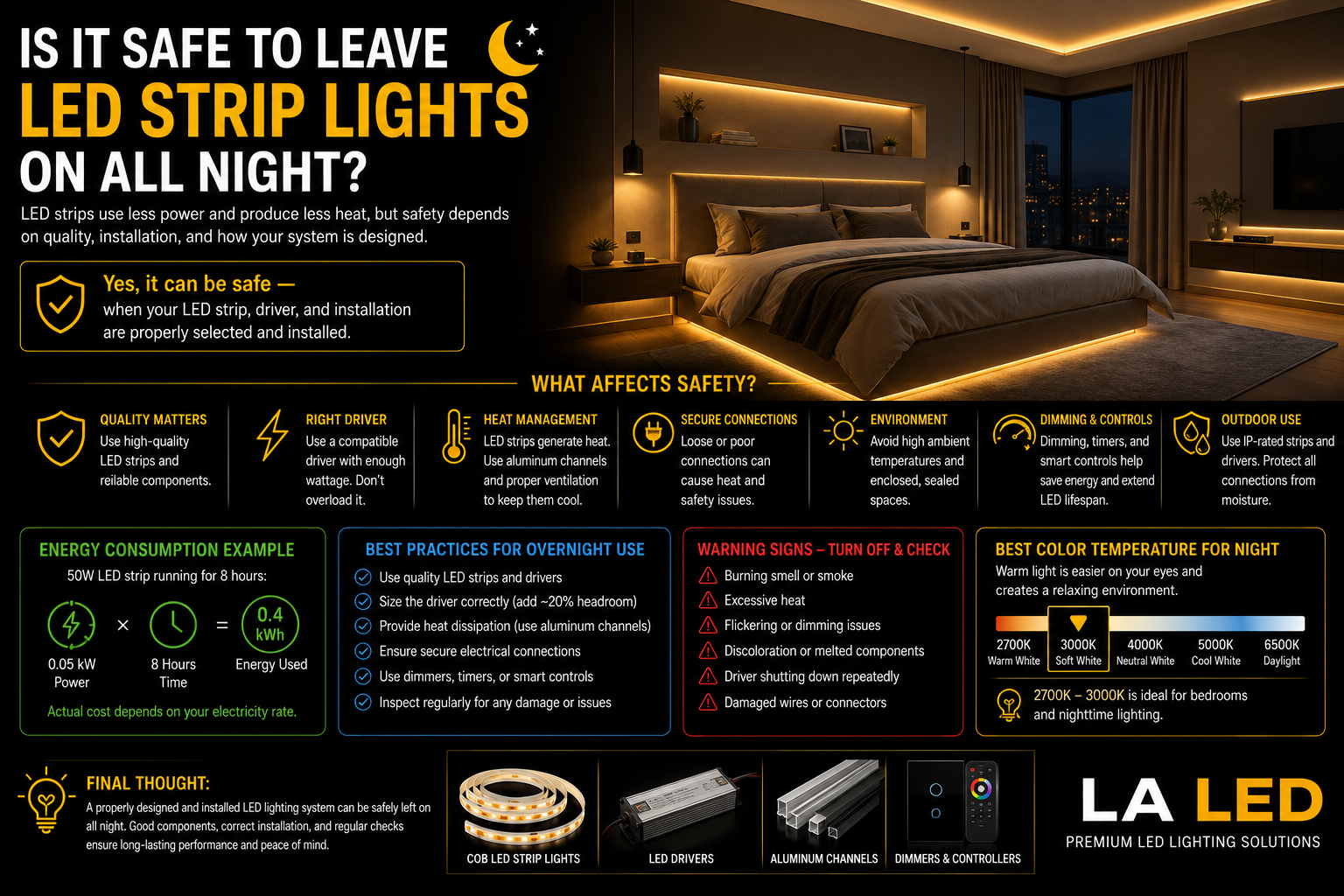
LED strip lights are commonly used for bedroom lighting, ceiling coves, under-cabinet lighting, hallways, staircases, accent lighting, and even nighttime illumination.
Because LEDs use relatively little electricity and produce less heat than many traditional light sources, you may wonder:
Is it safe to leave LED strip lights on all night?
In many cases, yes—properly selected and installed LED strip lights can operate for extended periods, including overnight.
However, that doesn't mean every LED strip installation should automatically be left running continuously.
The safety and reliability of the system depend on the quality of the LED strip, the driver or power supply, electrical connections, heat management, installation environment, and whether all components are being operated within their ratings.
Here's what you should know.
Do LED Strip Lights Get Hot?
Yes.
LEDs are much more energy-efficient than incandescent lighting, but they still generate heat while operating.
The amount of heat depends on factors such as:
- LED strip wattage
- LED density
- Operating voltage
- Installation surface
- Ambient temperature
- Airflow
- Length of continuous operation
- Quality of the LED strip
A low-power decorative strip may produce relatively little heat, while a high-output LED strip can become considerably warmer.
This is why heat management should be considered when designing an installation intended to operate for many hours.
Are COB LED Strips Safe to Leave On Overnight?
COB LED strips can be suitable for long-duration operation when they're correctly specified and installed.
COB technology creates a smooth, continuous line of illumination, making it especially popular for:
- Bedrooms
- Ceiling coves
- Hallways
- Under-cabinet lighting
- Shelves
- Architectural lighting
But being COB doesn't automatically make a strip safe for every installation.
The wattage, driver, wiring, mounting method, environment, and manufacturer's specifications still matter.
1. Use a Quality LED Strip
The quality of the LED strip itself is important.
A well-designed strip should use suitable circuit materials and components for its rated electrical load.
Poor-quality products may suffer from:
- Excessive heat
- Uneven brightness
- Premature LED failure
- Damaged circuit traces
- Inconsistent performance
For lighting that will operate for extended periods, product quality becomes even more important. Our UL-certified indoor COB LED strip light is built for continuous architectural use.
2. The LED Driver Is Just as Important
The LED strip is only one part of the system.
Low-voltage LED strips typically require a compatible LED driver or power supply.
The driver must match the strip's voltage.
For example:
12V LED Strip → 12V Driver
24V LED Strip → 24V Driver
It must also provide sufficient wattage for the connected load.
An overloaded or poorly installed driver can generate excessive heat and may shorten the life of the lighting system.
3. Don't Overload the Driver
Calculate the total wattage before selecting your LED driver.
For example, if an LED strip consumes:
5 watts per foot
and you're installing:
16 feet
the approximate load is:
5W × 16 ft = 80W
A common design practice is to provide some additional driver capacity rather than continuously operating at the maximum rating.
Using an approximately 20% margin is a frequently used general guideline, although the manufacturer's specifications should always take priority.
In this example, a properly compatible 100W driver could provide that additional capacity — such as our 24V 100W flicker-free LED driver.
4. Heat Management Matters
If LED strips will operate all night, managing heat can help support long-term reliability.
One option is an aluminum LED channel.
Aluminum channels can:
- Help transfer heat away from the LED strip
- Provide a clean mounting surface
- Protect the strip
- Hold a diffuser
- Create a more professional finished appearance
They are particularly useful for higher-output strips and permanent architectural installations.
Always follow the strip manufacturer's mounting and thermal-management requirements.
5. Don't Install LED Strips Where Heat Cannot Escape
Installation location matters.
Avoid placing higher-output LED strips in extremely tight, enclosed areas without considering heat dissipation.
For example, problems may occur when strips are:
- Tightly enclosed
- Surrounded by insulating material
- Installed near another heat source
- Mounted in areas with very high ambient temperatures
The same principle applies to the LED driver.
Drivers also generate heat and should be installed according to their ventilation and temperature requirements.

6. Check Your Electrical Connections
Connections should be secure and suitable for the LED strip being used.
Poor connections can increase electrical resistance and may create localized heating.
Pay particular attention to:
- Wire connections
- Driver terminals
- Strip connectors
- Solder joints
- Extension wiring
If a connector or terminal becomes unusually hot, the system should be turned off and inspected.
7. Don't Ignore Damaged LED Strips
Before leaving an LED strip running overnight, inspect it for visible damage.
Don't continue using a system if you notice:
- Damaged wiring
- Burn marks
- Discoloration
- Melted connectors
- Exposed conductors
- Strong electrical or burning odors
- Intermittent operation
- Unusual flickering
These symptoms deserve investigation rather than simply leaving the lights running.
8. Is It Safe to Leave Bedroom LED Strips On All Night?
It can be, provided the lighting system is properly installed and designed for extended operation.
But there is another consideration:
Do you actually need full brightness all night?
For nighttime bedroom lighting, you may prefer to:
- Dim the strip
- Use warm white lighting
- Create a low-level night-light setting
- Use a timer
- Use a smart controller
This can reduce unnecessary energy use and create a more comfortable nighttime environment.
9. What Color Temperature Is Best at Night?
If you're using white LED strip lighting in a bedroom or relaxation area at night, warmer color temperatures are generally more comfortable than very cool white light.
For example:
2700K–3000K creates a warm, relaxing appearance.
Cooler lighting such as 5000K may feel harsher in a bedroom environment.
CCT-adjustable LED strips can provide even more flexibility, allowing you to use cooler light when needed and switch to warmer illumination later in the evening.
10. Does Dimming Help?
Dimming can be useful when LED strips remain on for extended periods.
Reducing the light level can lower power consumption and may reduce the amount of heat generated by the lighting system, depending on how the dimming system operates.
For overnight ambient lighting, you often don't need the LEDs at 100% brightness.
Make sure the:
- LED strip
- LED driver
- Dimmer
- Controller
are compatible with each other. A 384W 4-channel TRIAC dimmable driver pairs the driver and dimming together for larger multi-zone runs.
Do LED Strip Lights Use a Lot of Electricity Overnight?
LED strips are energy-efficient, but leaving any electrical device operating for additional hours increases energy consumption.
You can estimate the energy used with a simple calculation:
Power (kW) × Hours = Energy (kWh)
For example, a 50W LED installation running for 8 hours uses approximately:
0.05 kW × 8 hours = 0.4 kWh
The actual cost depends on your local electricity rate.
So while LED strips may use much less energy than many traditional lighting technologies, turning them off when they're unnecessary still saves electricity.
Does Leaving LED Strips On All Night Shorten Their Life?
Potentially, yes.
LEDs have finite operating lives, so additional operating hours contribute to total usage.
Heat also plays an important role in LED longevity.
Operating an LED strip for eight extra hours every night adds approximately:
2,920 operating hours per year.
That doesn't mean the strip will quickly fail, but unnecessary operation does consume part of its useful operating life.
Good thermal management and quality components can help support long-term performance.
Can LED Strip Lights Be Left On 24/7?
Some properly designed LED systems are used for very long operating schedules in commercial and architectural applications.
However, “LED” doesn't automatically mean every strip should run continuously 24/7.
Continuous operation should consider:
- Product ratings
- Driver capacity
- Operating temperature
- Ventilation
- Wiring
- Installation environment
- Manufacturer recommendations
For a residential application, if the lighting isn't needed, turning it off is usually the more energy-efficient choice.
What About Outdoor LED Strips?
Outdoor installations require additional consideration.
The LED strip, driver, connections, and other components need to be suitable for the environment.
Depending on the location, you may need appropriate protection against:
- Water
- Moisture
- Dust
- Temperature changes
- Direct weather exposure
An IP-rated strip alone doesn't automatically make the entire lighting system weather-resistant. Our IP65-rated outdoor COB LED strip light is built for damp and exterior locations.
Connections and power supplies must also be appropriately protected.
When Should You Turn the LED Strip Off Immediately?
Turn the system off if you notice:
- Burning smell
- Smoke
- Melted components
- Unusually high heat
- Damaged wiring
- Repeated driver shutdowns
- Sparking
- Major flickering
- Discolored connectors
A properly functioning LED installation shouldn't show signs of electrical damage.
If the cause isn't obvious, have the installation inspected by a qualified professional.
How to Make Overnight LED Lighting Safer and More Reliable
If you plan to operate LED strips overnight:
- Use quality LED strips.
- Use a correctly matched LED driver.
- Don't overload the power supply.
- Provide appropriate heat dissipation.
- Use aluminum channels when appropriate.
- Keep drivers properly ventilated.
- Make secure electrical connections.
- Inspect the system for damage.
- Follow product installation instructions.
- Use suitable products for wet or outdoor environments.
- Consider dimming, timers, or smart controls when full brightness isn't needed.
A reliable installation depends on the entire lighting system, not just the LED strip.
Final Thoughts
So, is it safe to leave LED strip lights on all night?
For a properly designed and installed LED lighting system using quality components, extended overnight operation can be completely practical.
But the LED strip should be paired with the correct driver, wiring, connectors, and thermal management, and every component should operate within its rated conditions.
For bedrooms and ambient nighttime lighting, running the strip at a lower brightness or using a timer or controller can often provide all the illumination you need while reducing unnecessary energy consumption.
And if an LED strip, connector, or driver shows signs of excessive heat or electrical damage, don't leave it running unattended.
FAQ
Can I sleep with LED strip lights on all night?
A properly installed LED strip system can be used overnight. For bedroom lighting, dimmed warm-white illumination is often more comfortable than running bright lighting throughout the night.
Can LED strip lights overheat if left on overnight?
They can become warm during operation. Excessive temperature may result from high-output strips, poor heat dissipation, an overloaded driver, improper installation, or high ambient temperature.
Are COB LED strips safe for long periods of use?
Quality COB LED strips can be suitable for extended operation when properly powered, installed, and thermally managed.
Should LED strips be installed in aluminum channels?
Not every strip necessarily requires one, but aluminum channels can help with heat transfer, physical protection, diffusion, and creating a professional installation.
Does leaving LED strips on all night waste electricity?
It uses additional electricity compared with turning them off. Using a dimmer, timer, or smart controller can reduce unnecessary energy consumption.
Can I leave LED strips on 24/7?
Some LED systems are designed for long operating schedules, but suitability depends on the specific strip, driver, installation, thermal conditions, and manufacturer specifications.
Should I turn off an LED strip if the driver is very hot?
If the driver is unusually hot or shows symptoms such as repeated shutdowns, burning odor, discoloration, or damaged wiring, turn the system off and investigate the cause.
