
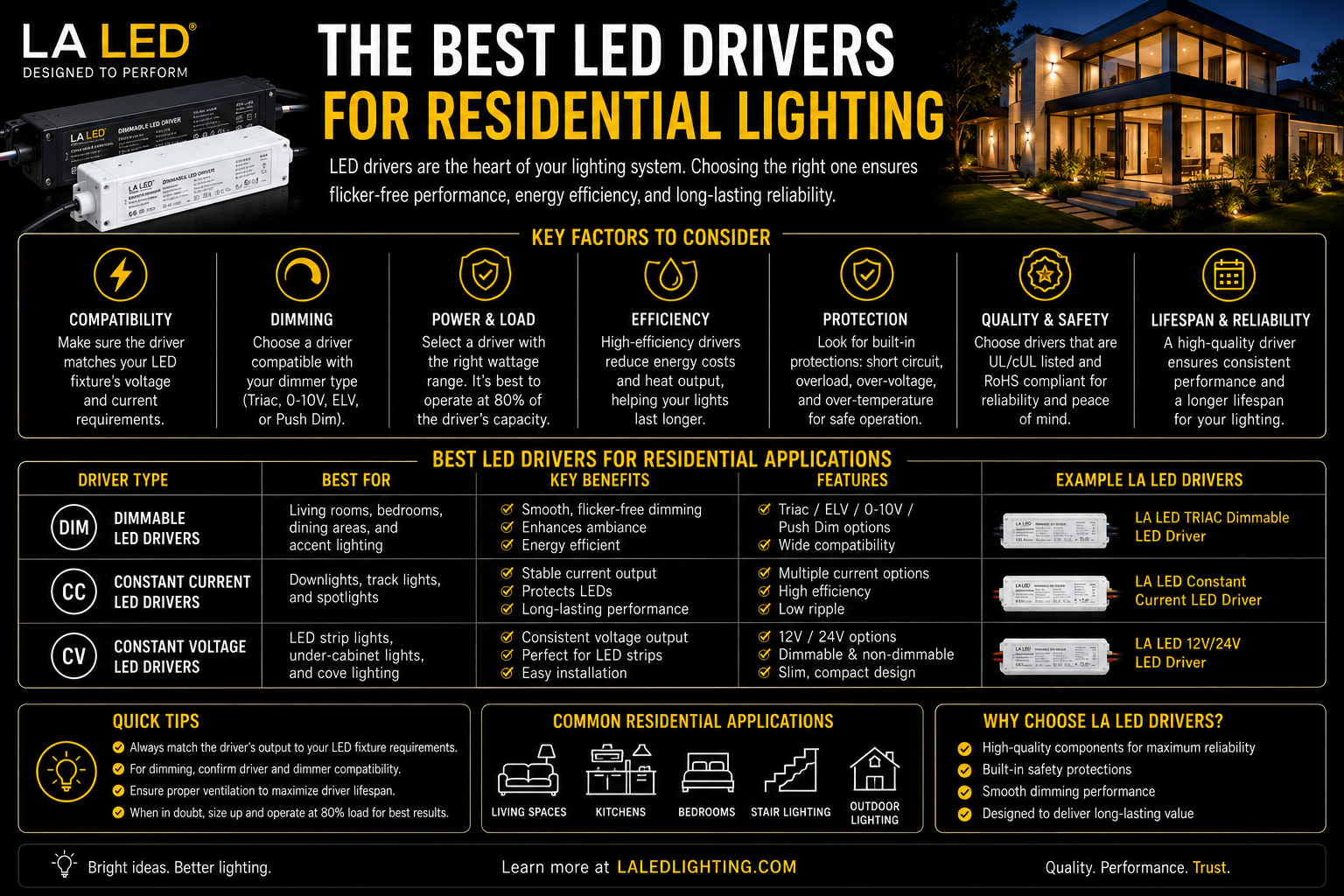
A buzzing strip light in a custom kitchen or a downlight that flickers every time the dimmer drops below 30% usually points to the same weak link - the driver. When buyers search for the best led drivers residential projects need, they are really looking for stable dimming, clean power delivery, code-compliant safety, and fewer callbacks after installation.
In residential work, the right driver matters just as much as the fixture or strip light itself. A premium LED load paired with a cheap or mismatched driver can produce poor dimming, shortened lifespan, radio interference, or outright failure. For electricians, remodelers, and homeowners investing in better lighting, driver selection is where performance gets decided.
What makes the best LED drivers residential grade
The best residential LED drivers are not simply the ones with the highest wattage or the lowest price. They are the ones that match the load correctly, support the intended dimming method, and hold up over time in real installation conditions.
For most homes, reliability starts with certification and electrical compatibility. UL-listed or UL-recognized components, USA-standard input requirements, and predictable output specs are the baseline. After that, the real differentiators are dimming behavior, enclosure quality, thermal management, and fit for location - especially when a project includes wet or damp areas, hidden millwork, or compact recesses.
A driver for under-cabinet COB strip lighting has a different job than one feeding recessed architectural lighting or a color-changing outdoor run. That is why there is no single best unit for every house. The best choice depends on the fixture type, control method, mounting space, and whether the client expects warm, low-end dimming without shimmer or dropout.
Start with constant voltage vs constant current
This is where many residential mistakes begin. Constant voltage drivers are typically used with LED strip lights, tape lights, and many low-voltage architectural products. The most common outputs are 12VDC and 24VDC. If the strip is rated for 24V, the driver must supply 24V - not 12V, not a range that sounds close enough.
Constant current drivers are used for fixtures or modules designed to operate at a specific current, such as 350mA, 700mA, or 1050mA. These are common in some downlights, specialty fixtures, and integrated lighting assemblies. Here, the driver adjusts voltage within a stated range while holding current steady.
For residential buyers, the practical rule is simple. Match the driver to the LED product specification exactly. If the load calls for constant voltage, do not substitute constant current. If a fixture requires a fixed current, do not try to power it from a transformer intended for strip lighting.
Dimming compatibility is where quality shows up fast
Most residential complaints about LED performance are not caused by the LEDs. They come from dimming incompatibility. A homeowner wants smooth, silent dimming. The installer wants a driver that works with the control on the wall and does not turn final trim into a troubleshooting session.
TRIAC and ELV remain common in homes, especially in remodels where existing wall dimmers are part of the plan. MLV still shows up in some applications, though it is less common with newer LED systems. In more advanced residential projects, 0-10V can make sense for large homes, custom spaces, and layered architectural lighting where better control is worth the extra planning.
The best LED drivers for residential dimming do three things well. They dim smoothly across a usable range, they stay stable at low levels, and they are tested to work with common dimmer types. If a driver says dimmable but does not specify protocol compatibility clearly, that is a red flag.
There is also a trade-off here. TRIAC dimming is familiar and convenient for many residential installs, but performance can vary by dimmer model and load size. ELV can offer better behavior with many electronic loads, but it requires the right control hardware. 0-10V gives more precision, yet it is not always the simplest fit in a standard single-family retrofit. The best answer depends on the project, not just the product sheet.
Sizing a driver correctly matters more than most buyers think
Undersizing a driver leads to overload and early failure. Oversizing too far is not ideal either, especially in dimming applications where the load may fall outside the driver's optimal operating range.
A good rule for residential LED strip projects is to calculate total wattage and add headroom, often around 20%. If a run draws 80 watts, a 96W or 100W driver may be appropriate depending on the product line and installation environment. That extra margin helps the driver run cooler and more reliably.
But sizing is not just about wattage. Voltage drop, run length, parallel connections, and driver placement all affect system performance. In larger homes, long tape light runs in coves, stair details, and millwork can create power distribution issues that no driver can fix by itself. Sometimes the better move is splitting the load across multiple drivers rather than forcing one oversized unit to do everything.
Best LED drivers residential projects use indoors and out
Residential work today extends well beyond dry indoor spaces. Drivers are now expected to support bathroom lighting, kitchen task lighting, exterior soffits, landscape accents, and covered outdoor living areas. That means enclosure type and location rating matter.
For dry locations inside a cabinet, closet, or accessible utility space, a compact driver may be ideal. In damp or wet locations, buyers should look for enclosed units and integrated junction box options where required by application and code. The best systems are designed for real installation conditions, not just bench testing.
This is especially relevant in luxury homes where lighting is built into narrow architectural details. A compact driver can make layout easier, but only if it still offers enough thermal performance and access for service. Small size helps, but not when it comes at the cost of long-term reliability.
The best drivers support the whole lighting system
A residential LED driver should never be selected in isolation. It has to work with the strip light, controller, dimmer, wire gauge, connectors, and mounting plan. This is even more important with tunable white, RGB, RGBW, and intelligent COB systems.
If the project includes color changing or CCT adjustment, the driver is only one part of the power and control chain. Buyers need to confirm compatibility with remotes, controllers, and signal type. A high-quality RGBW strip will not perform correctly if the power side is unstable or the control hardware is mismatched.
This is where specialized suppliers have a real advantage over general catalogs. A product range built around dimmable drivers, COB strip lighting, compact transformers, and matching accessories makes it easier to build a system that actually works together. For residential buyers who care about premium results, that matters.
What professionals look for before they buy
Contractors and installers usually judge drivers on a short list of real-world factors. First is callback risk. Does the driver run quietly, dim correctly, and hold output without flicker? Second is install practicality. Can it fit the planned space, wire cleanly, and meet project requirements without improvised workarounds?
Third is compliance and consistency. Certified components and clear specifications reduce guesswork and protect the job. Fourth is availability. Even the best driver is not useful if replacements or matching units are hard to source for phase two of a project.
Homeowners may focus first on brightness and dimming, but professionals know the hidden value is dependability. A driver that performs well behind the scenes protects the finish, the fixture investment, and the installer's reputation.
Red flags when choosing residential LED drivers
Some warning signs show up early. Vague dimming claims, missing certifications, unrealistic wattage ratings, and poor documentation usually point to lower-grade products. Another common issue is buying solely by price. Cheap drivers can look similar on paper, but differences in internal components, heat handling, and dimmer compatibility show up fast after installation.
It is also wise to avoid mixing unknown drivers with premium LED tape or architectural fixtures just to save a little upfront cost. In most residential projects, the labor to diagnose or replace a failed driver costs more than the original savings.
For buyers who want fewer surprises, the safer path is to choose drivers with clearly stated voltage or current output, confirmed dimming protocol support, location suitability, and a supplier that understands both product specs and field conditions. That is the standard serious residential lighting projects deserve.
When the goal is better lighting at home, the best driver is the one that disappears into the system by doing its job perfectly. Choose for compatibility first, reliability second, and price third, and the finished space will look cleaner, dim better, and stay that way long after install day.