
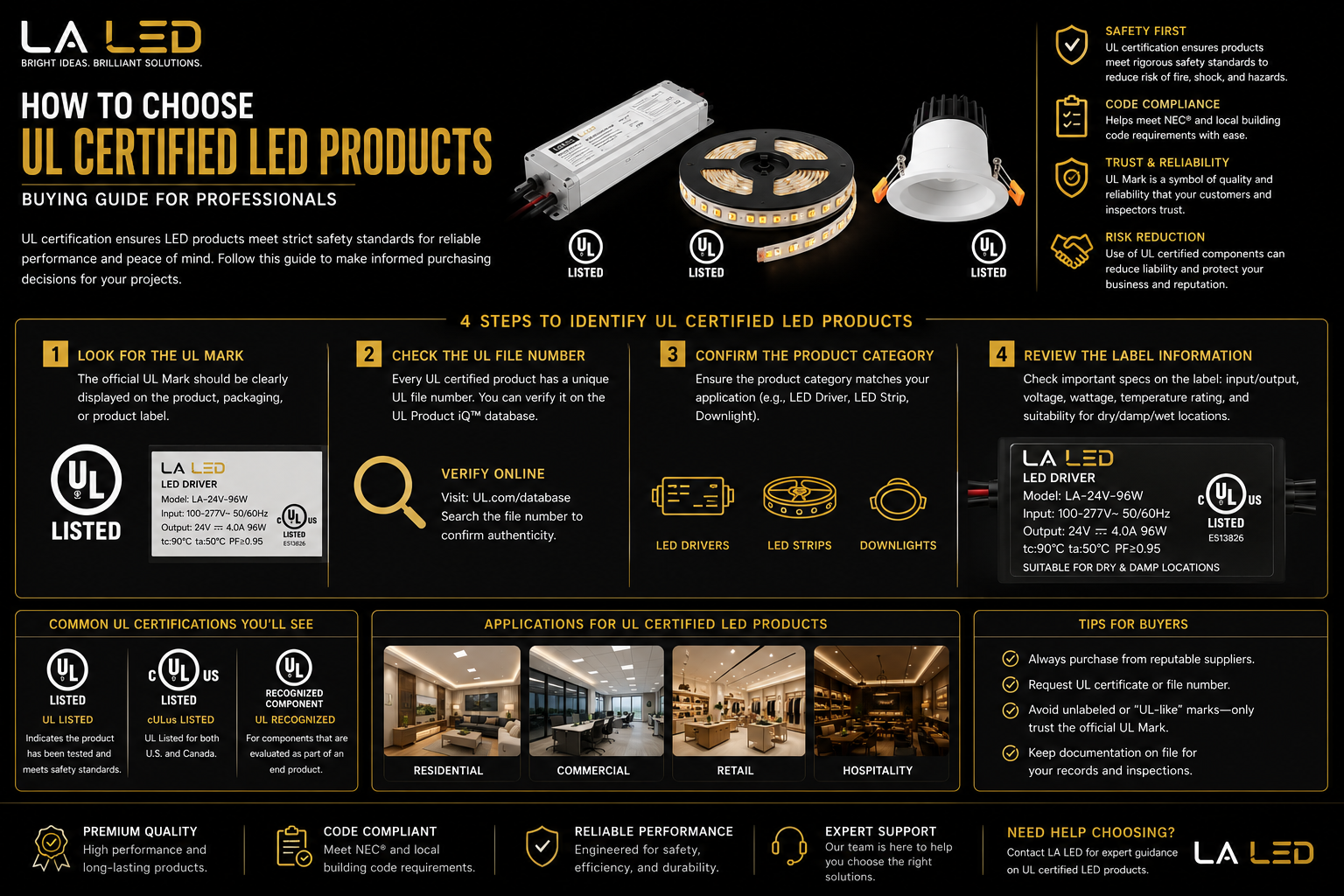
A lighting system usually fails at the weakest point, not the most visible one. The strip may look great, the downlight trim may match the ceiling perfectly, and the color temperature may be exactly right, but if the driver, transformer, connector, or wet-location component is not properly evaluated, the whole installation can become a callback waiting to happen. That is why buyers looking for ul certified led products are usually not shopping for a label alone. They are trying to reduce risk, protect the project, and get dependable performance once power is on.
For contractors, electricians, and serious homeowners, certification matters because LED systems are not single-piece products. They are assemblies. A strip light depends on the correct driver. A dimmable load depends on compatible controls. An outdoor run depends on the right enclosure, wiring method, and location rating. When those pieces are selected with compliance in mind, the result is a cleaner install and fewer surprises.
Why UL certified LED products matter
UL certification is one of the clearest signals that a lighting product has been evaluated for safety against recognized standards. In practical terms, that matters on the job site because inspectors, builders, and property owners want proof that electrical components are suitable for their intended use. It also matters after installation, when heat, load conditions, dimming behavior, and environmental exposure start testing the system in real life.
That does not mean every product with a certification mark is equal. Build quality, dimming performance, thermal management, and long-term consistency still vary. But starting with UL certified LED products puts the project on much stronger ground than relying on unknown imports or loosely documented components that may not meet US standards.
For a trade buyer, the value is straightforward. You want fewer failures, fewer compatibility issues, and fewer questions during inspection. For a homeowner or designer, the value is just as real. Certified products help support a safer installation and a more reliable finished result, especially in premium residential spaces where lighting quality is part of the design, not an afterthought.
What certification does and does not tell you
Certification is a baseline, not the whole story. It tells you the product has been evaluated to a relevant safety standard, but it does not automatically tell you whether it is the right fit for your dimmer, your low-voltage layout, your exterior environment, or your desired light output.
This is where many buyers get tripped up. They assume certification alone guarantees performance. It does not. A UL-listed LED driver can still flicker with the wrong dimmer. A certified strip can still underperform if voltage drop is ignored on a long run. A wet-location power supply still needs proper installation details. Good product selection means reading beyond the badge.
The stronger approach is to use certification as the starting filter, then evaluate application fit. That includes voltage, wattage, location rating, dimming protocol, enclosure style, and accessory compatibility.
Where UL certified LED products make the biggest difference
The biggest difference usually shows up in the parts buyers are most tempted to treat as interchangeable. Drivers, transformers, controllers, and connectors do not get the same visual attention as architectural fixtures, but they are often where safety and performance problems begin.
In low-voltage strip lighting, for example, the driver is doing far more than supplying power. It affects dimming behavior, load stability, heat management, and long-term reliability. If the driver is poorly matched, you may see inconsistent light output, buzzing, premature failure, or control issues. That is especially true in projects using TRIAC, ELV, MLV, or 0-10V dimming, where real compatibility matters more than broad marketing claims.
The same is true outdoors. Landscape and exterior installations add moisture, temperature swings, and exposure concerns. Using compact transformers and drivers with proper junction box configurations and location ratings for wet or damp environments helps protect both performance and safety. On these jobs, product quality is not a luxury. It is what keeps service calls down.
How to evaluate certified LED components the right way
Start with the full system, not the fixture alone
One of the most common mistakes is selecting the visible light source first and piecing together the rest later. That approach works until it does not. A better method is to define the complete system from the start: power supply, control method, light source, mounting condition, location rating, and total load.
If you are installing COB strip lighting in a custom kitchen, cove, or display application, think through cut points, run length, wattage draw, aluminum channel use, and dimming expectations before you buy. If you are specifying recessed downlights, confirm driver integration, insulation contact requirements if applicable, and control compatibility.
Certified products perform best when used as part of a properly planned system. That may sound obvious, but it is exactly where rushed projects get expensive.
Confirm dimming compatibility early
Dimming is one of the biggest reasons premium LED projects succeed or fail. A product can be certified and still give a poor dimming experience if it is paired with the wrong control. Smooth low-end dimming, stable output, and flicker control depend on the interaction between the driver and the dimmer protocol.
That is why professionals often prioritize tested compatibility across common control types such as TRIAC, ELV, MLV, and 0-10V. The more specialized the application, the less room there is for guesswork. In high-end homes, poor dimming is noticed immediately. In commercial projects, it becomes a performance complaint. Either way, it reflects on the installer.
Match the rating to the environment
Indoor dry locations, damp locations, and wet locations are not interchangeable. Neither are open indoor ceilings and sealed outdoor enclosures. Certified LED products still need the correct environmental rating for the actual installation.
This matters with drivers, transformers, tape lighting, and accessories. A compact unit may save space, but if it is being placed in a demanding environment, the enclosure and rating have to match. The trade-off is simple: smaller form factors improve installation flexibility, but they should never come at the cost of suitability for the location.
Why professionals prefer specification-ready products
Trade buyers are not just buying for appearance. They are buying for install speed, repeatability, and fewer callbacks. That is why specification-ready lighting products stand out. Clear wattage data, voltage information, dimming details, location ratings, and compatibility notes save time before the order and after the install.
This is especially useful in projects involving tunable white, RGB, RGBW, CCT, or addressable strip lighting. Once controls and color-changing components are involved, system clarity becomes even more important. A premium result depends on having the right driver, controller, wiring approach, and strip configuration from the beginning.
For design-conscious homeowners, this same principle applies even if they are not using trade terminology. They want clean light, dependable controls, and products that work together the first time. That is a practical reason to buy from a specialist rather than a generic marketplace.
Buying ul certified led products for residential and commercial use
Residential and commercial buyers often care about the same fundamentals, but the priorities shift a little. In a home, visual comfort, dimming smoothness, and finish quality usually lead the conversation. In an office, retail, or hospitality setting, reliability, scalability, and maintenance planning often carry more weight.
Still, the baseline remains the same. Buyers should look for ul certified led products that are built for US-standard-compliant installations, with clear documentation and realistic compatibility claims. Premium projects benefit from premium components, particularly in applications like dotless COB strip lighting, recessed downlights, compact remote drivers, and outdoor systems where poor-quality parts are hard to hide later.
At LA LED Lighting, that focus on certified, specification-driven components is what makes the catalog useful to both trade professionals and homeowners who want better than commodity-grade lighting.
The real cost question
Certified products are not always the cheapest option upfront. That is the honest trade-off. But the lower sticker price on off-brand components can disappear fast once you factor in replacement labor, troubleshooting time, dimming issues, and failed inspections.
Most experienced installers already know this. The question is not just what the part costs today. The question is what the system costs if it has to be revisited after drywall, cabinetry, or landscape work is finished. That is where dependable, certified lighting products usually prove their value.
When you are comparing options, think beyond the fixture face or the lumens on the box. Look at the entire power and control chain. Check the ratings. Confirm the dimming method. Match the environment. Good lighting decisions are rarely about buying more product. They are about buying the right product once.
If a project needs to look clean, pass inspection, dim properly, and keep working long after the install crew leaves, certification is not a detail to gloss over. It is one of the smartest filters you can use before you add anything to the cart.