
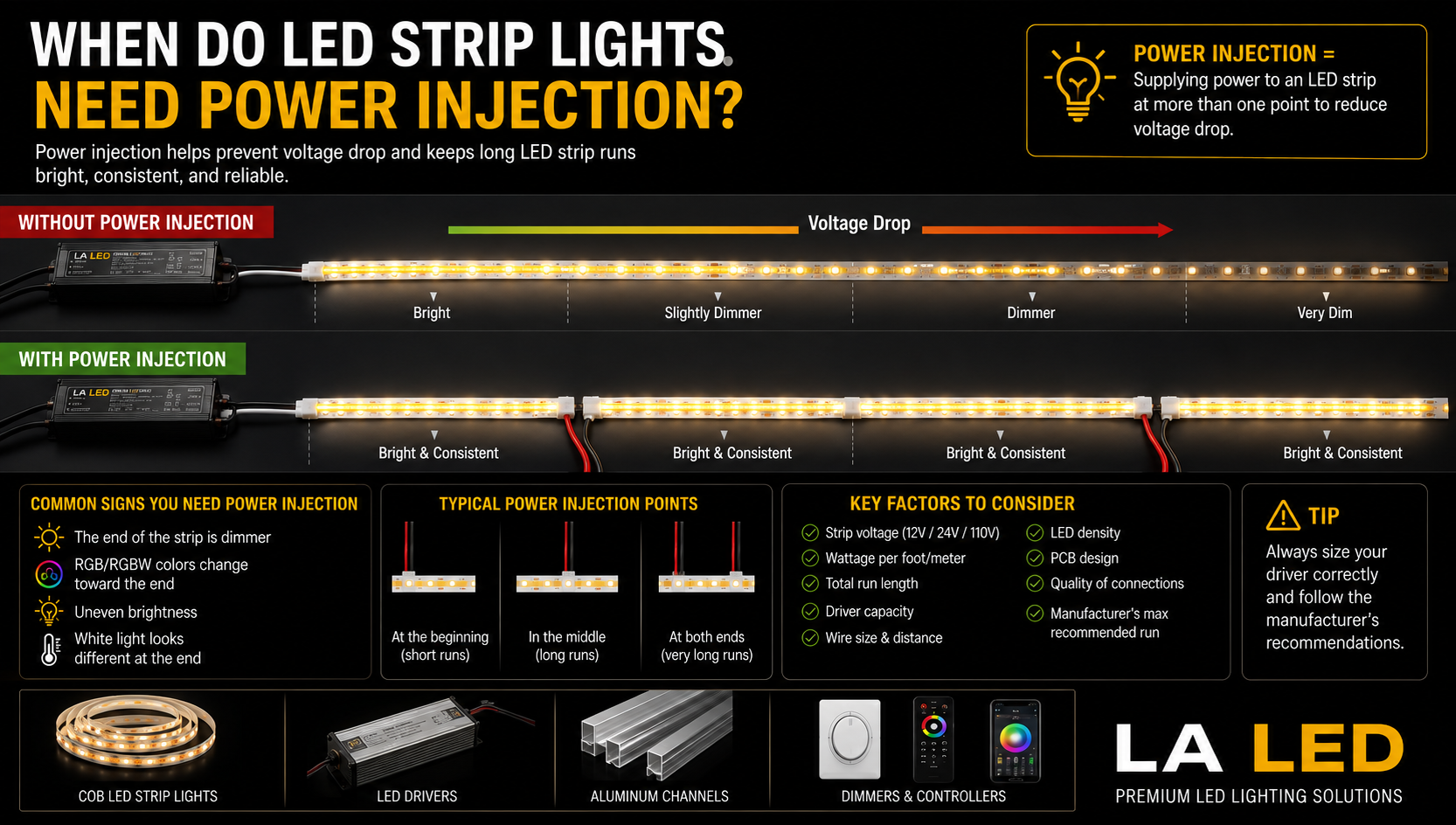
You install a long run of LED strip lights, turn them on, and everything looks great near the power source.
But farther down the strip, something changes.
The LEDs may become slightly dimmer. White light may no longer look consistent. RGB or RGBW strips may even begin showing incorrect colors near the end.
One possible cause is voltage drop.
And one common way to address voltage drop in longer LED strip installations is power injection.
But what exactly is power injection, and when do LED strip lights actually need it?
Let's break it down.
What Is Power Injection?
Power injection means supplying power to an LED strip at more than one point instead of powering the entire installation only from one end.
A basic LED strip installation might look like this:
LED Driver → LED Strip → LED Strip → LED Strip
Power enters at the beginning and travels through the conductive traces of the strip.
For a relatively short run, this may work perfectly.
But as the strip becomes longer, electrical resistance causes some voltage to be lost along the way.
With power injection, additional wiring delivers the correct supply voltage to another point farther along the strip.
Conceptually, it may look like:
Driver → Beginning of Strip
and
Driver → Additional Power Point Farther Along the Strip
The goal is to reduce excessive voltage drop and maintain more consistent performance across the installation.
Why Does Voltage Drop Happen?
Every conductor has electrical resistance.
LED strips use thin conductive traces to carry power along the flexible circuit board.
As current travels farther through those traces, some voltage is lost.
The longer the strip and the higher the electrical load, the more noticeable the effect can become.
Voltage drop may result in:
- Lower brightness toward the end
- Uneven illumination
- Color differences
- Poor RGB/RGBW color accuracy
- Inconsistent white tones
- Reduced performance
Power injection helps by providing electrical power closer to the areas that need it.
How Do You Know If Your LED Strip Needs Power Injection?
There isn't one universal distance that applies to every LED strip.
Whether power injection is necessary depends on several factors:
- Strip voltage
- Wattage per foot or meter
- Total strip length
- Current draw
- PCB design
- Copper thickness
- LED density
- Wire size
- Distance between driver and strip
- Manufacturer's maximum recommended run
However, there are several signs that power injection should be considered.
1. The End of the Strip Is Noticeably Dimmer
This is one of the most obvious symptoms.
If the beginning of your COB LED strip looks bright but the far end is noticeably dimmer, voltage drop may be occurring.
Before assuming the strip is defective, check:
- Total run length
- Input voltage
- Driver capacity
- Wiring size
- Connection quality
- Manufacturer's maximum run specification
If these are correct, additional power injection may help maintain more consistent brightness.
2. You're Installing a Long Continuous Run
Long LED strip installations are more likely to experience voltage drop.
Examples include:
- Ceiling coves
- Long hallways
- Large kitchens
- Commercial displays
- Retail shelving
- Architectural features
- Restaurants
- Hotels
- Large entertainment walls
Instead of simply connecting strip after strip and powering everything from one end, longer installations should be planned electrically from the beginning.
Power injection may be part of that design.
3. You're Using a High-Wattage LED Strip
Length isn't the only factor.
A higher-output strip consumes more power per foot or meter.
That means more current may need to travel through the strip's conductive traces.
For example, two LED strips may both be 20 feet long, but one may consume significantly more power than the other.
The higher-wattage strip may experience voltage drop sooner.
That's why you shouldn't decide whether power injection is needed based only on strip length.
4. RGB or RGBW Colors Change Toward the End
Voltage drop can become particularly noticeable with multi-channel LED strips, such as an RGBW COB LED strip.
Suppose an RGBW installation produces the correct white or mixed color near the beginning but looks different farther along the run.
The strip itself may not necessarily be defective.
Different channels draw different amounts of current, and voltage drop can affect the resulting color.
If colors become inconsistent over distance, the electrical design should be checked.
5. White Light Looks Different at the End
Even single-color or tunable-white LED strips can show visible changes when voltage becomes too low.
You may notice:
- Reduced brightness
- Slight color inconsistency
- Uneven illumination
With architectural lighting, even relatively small differences can become noticeable because you're looking at one continuous line of light.
This is especially important with COB LED strip lighting, where the goal is usually to create a smooth, uniform lighting effect.
Does Every Long LED Strip Need Power Injection?
No.
Some LED strips can support longer runs than others.
The maximum practical run depends heavily on the product's electrical design.
For example, a 24V strip may often support longer practical runs than a comparable 12V strip because the same power can generally be delivered with less current.
But that doesn't mean:
“24V strips never need power injection.”
They still can.
Always check the manufacturer's recommended maximum continuous run.
12V vs. 24V and Power Injection
Voltage makes a significant difference when designing longer LED strip installations.
12V LED Strips
12V strips can be excellent for shorter installations and certain applications, but voltage drop can become more significant as run length increases.
24V LED Strips
24V strips are commonly preferred for longer architectural installations because they can generally carry the same amount of power at lower current than a comparable 12V system.
This can help reduce voltage drop.
For:
- Long ceiling coves
- Large kitchens
- Commercial installations
- Long shelving systems
- Architectural lighting
24V COB LED strips are often worth considering.
However, maximum run length still depends on the specific strip.
What About 110V LED Strip Lights?
High-voltage LED strip systems operate differently from typical 12V and 24V low-voltage strips.
Certain 110V LED strip products are designed specifically for much longer continuous runs.
For example, some products may support installations such as 100-foot runs, depending on the product design and manufacturer specifications.
These systems have different installation and safety requirements and shouldn't be treated the same way as low-voltage LED strips.
Can You Simply Connect More LED Strips Together?
Physically connecting LED strips doesn't necessarily mean the electrical system can support the resulting length.
This is a common mistake.
Imagine that a connector allows you to attach another strip.
That only proves the strips can physically connect.
It does not guarantee that:
- The strip traces can safely carry the total current
- Voltage will remain consistent
- The driver has sufficient capacity
- Brightness will remain uniform
Always consider electrical load and maximum run length before extending an installation.
Where Should Power Be Injected?
The correct location depends on the strip and installation.
Power may be supplied:
- At the beginning
- At both ends
- At intermediate points
- At multiple branches in larger installations
For example, instead of powering a very long run only from one end, a system may supply power at the beginning and again farther down the installation.
For more complex installations, several power-feed points may be used.
The exact spacing should be determined from the strip specifications and voltage-drop calculations rather than using one fixed distance for every product.
Can You Power an LED Strip from Both Ends?
In some properly designed systems, supplying the strip from both ends can help reduce voltage drop.
However, the wiring configuration must be appropriate for the LED strip and power supply.
You should not randomly connect multiple drivers or power sources to the same strip.
If more than one power supply is involved, the system needs to be designed correctly to avoid unsafe or incompatible electrical connections.
For permanent installations, consult the manufacturer's documentation or a qualified installer.
Power Injection Doesn't Mean You Need Another Driver
This is an important distinction.
Power injection does not automatically mean adding another LED driver.
A single properly sized driver, such as a 300W 5-in-1 dimmable LED driver, may supply multiple power-feed wires to different points along the LED installation.
For example:
One Driver
→ Feed #1 to beginning of strip
→ Feed #2 to middle or another section
The driver must still have enough wattage capacity for the total connected LED load.
Calculate the Total Load First
Before designing power injection, calculate how much power the entire LED installation requires.
A simple calculation is:
Watts per Foot × Total Feet = Total LED Load
For example:
If a COB LED strip consumes:
4.5W per foot
and you're installing:
20 feet
then:
4.5W × 20 = 90W
Your driver must be compatible with the strip voltage and provide sufficient capacity for the total load.
A commonly used design guideline is to leave approximately 20% additional driver capacity, although manufacturer requirements should always take priority.
Wire Size Matters Too
Power injection can reduce voltage drop along the LED strip, but the wires carrying power from the driver can also experience voltage drop.
Longer wire runs and higher current may require larger conductors.
Important factors include:
- Current
- Wire length
- Supply voltage
- Acceptable voltage drop
- Installation environment
Using undersized wire can defeat the purpose of power injection.
Don't Forget the Distance from the Driver
Sometimes the LED strip itself isn't the main source of the voltage drop.
The driver may be located far away from the lighting installation.
For example:
Driver → 40 feet of wire → LED Strip
That wire run can introduce additional voltage drop before power even reaches the strip.
For remote-driver installations, both the wire run and the LED strip run should be considered.
Parallel Wiring Can Be Better for Multiple Runs
Suppose you're installing several separate LED strips.
Instead of:
Driver → Strip 1 → Strip 2 → Strip 3
it may be better to create separate appropriately designed feeds:
Driver → Strip 1
Driver → Strip 2
Driver → Strip 3
This type of parallel distribution can help each section receive more consistent voltage.
The driver must still be properly sized for the combined load, and for smaller individual sections a 96W compact 24V dimmable transformer can be a practical option.
Example: Long Ceiling Cove
Imagine a large room with a long COB LED strip installation around the ceiling.
If all of the strip is powered from one end, you may notice:
Beginning → Bright
Middle → Slightly Dimmer
End → Noticeably Dimmer
Depending on the product and electrical design, additional power feeds can help create:
Beginning → Consistent
Middle → Consistent
End → Consistent
This is one reason professional architectural LED installations are planned electrically rather than simply connecting as much strip as possible.
Example: Long Kitchen Installation
Imagine LED strips running under several kitchen cabinets.
Instead of connecting every cabinet into one extremely long strip run, the installation may be divided into multiple sections.
Each section can receive power through appropriately sized wiring from the driver.
This can provide more consistent illumination across the entire kitchen.
Does Power Injection Make LED Strips Brighter?
Power injection shouldn't be thought of as a way to make a correctly operating LED strip brighter than designed.
Its purpose is to help ensure that sections farther from the original power connection receive adequate voltage.
In other words, it helps the distant part of the strip perform more like the beginning of the strip.
Can Power Injection Fix Every Brightness Problem?
No.
If an LED strip is dim, power injection isn't automatically the solution.
Other possible causes include:
- Undersized driver
- Incorrect voltage
- Damaged LED strip
- Poor electrical connections
- Incorrect controller
- Undersized wiring
- Excessive dimming
- Defective components
Troubleshooting should consider the complete system.
How to Reduce the Need for Power Injection
Good planning can reduce voltage-drop problems before installation begins.
Consider:
- Using 24V strips for longer low-voltage installations when appropriate
- Following the manufacturer's maximum run recommendations
- Selecting appropriate wire size
- Locating drivers strategically
- Dividing large installations into multiple runs
- Wiring separate sections in parallel
- Using properly sized drivers
- Choosing quality COB LED strips
- Planning power-feed locations before installation
For large projects, electrical planning should happen before the LED strips are installed.
Final Thoughts
So, when do LED strip lights need power injection?
Power injection should be considered when voltage drop causes—or is expected to cause—noticeable performance differences along a longer LED strip installation.
Common signs include:
- The far end is dimmer
- Brightness isn't uniform
- RGB/RGBW colors change
- The strip run exceeds the manufacturer's recommended length
- High-wattage strips are being used over longer distances
There's no single rule such as “inject power every X feet” that works for every LED strip.
The correct design depends on the strip voltage, wattage, current, length, wiring, driver location, and manufacturer specifications.
For longer architectural installations, planning power distribution correctly from the beginning can make the difference between a strip that gradually loses brightness and a clean, uniform line of light from start to finish.
FAQ
What is power injection for LED strip lights?
Power injection means supplying electrical power to additional points along an LED strip installation to help reduce voltage drop and maintain consistent brightness.
How do I know if my LED strip needs power injection?
If the strip becomes noticeably dimmer or changes color farther from the power source, voltage drop may be occurring. Long and high-wattage runs are more likely to require additional power feeds.
Do 24V LED strips need power injection?
They can. 24V systems often perform better over longer distances than comparable 12V systems, but maximum run length still depends on the specific LED strip.
Can I inject power from the same LED driver?
Often, yes. A properly sized driver can potentially supply multiple power-feed wires, provided the driver has adequate capacity and the system is wired correctly.
Can I power an LED strip from both ends?
Some installations can be designed this way to reduce voltage drop, but the wiring and power supply configuration must be appropriate for the specific system.
Does power injection increase LED brightness?
It primarily helps restore voltage to distant sections so they can operate closer to their intended brightness. It shouldn't be used to overdrive the LEDs.
Is power injection necessary for short LED strip runs?
Usually not when the strip operates within the manufacturer's recommended run length and brightness remains consistent.