
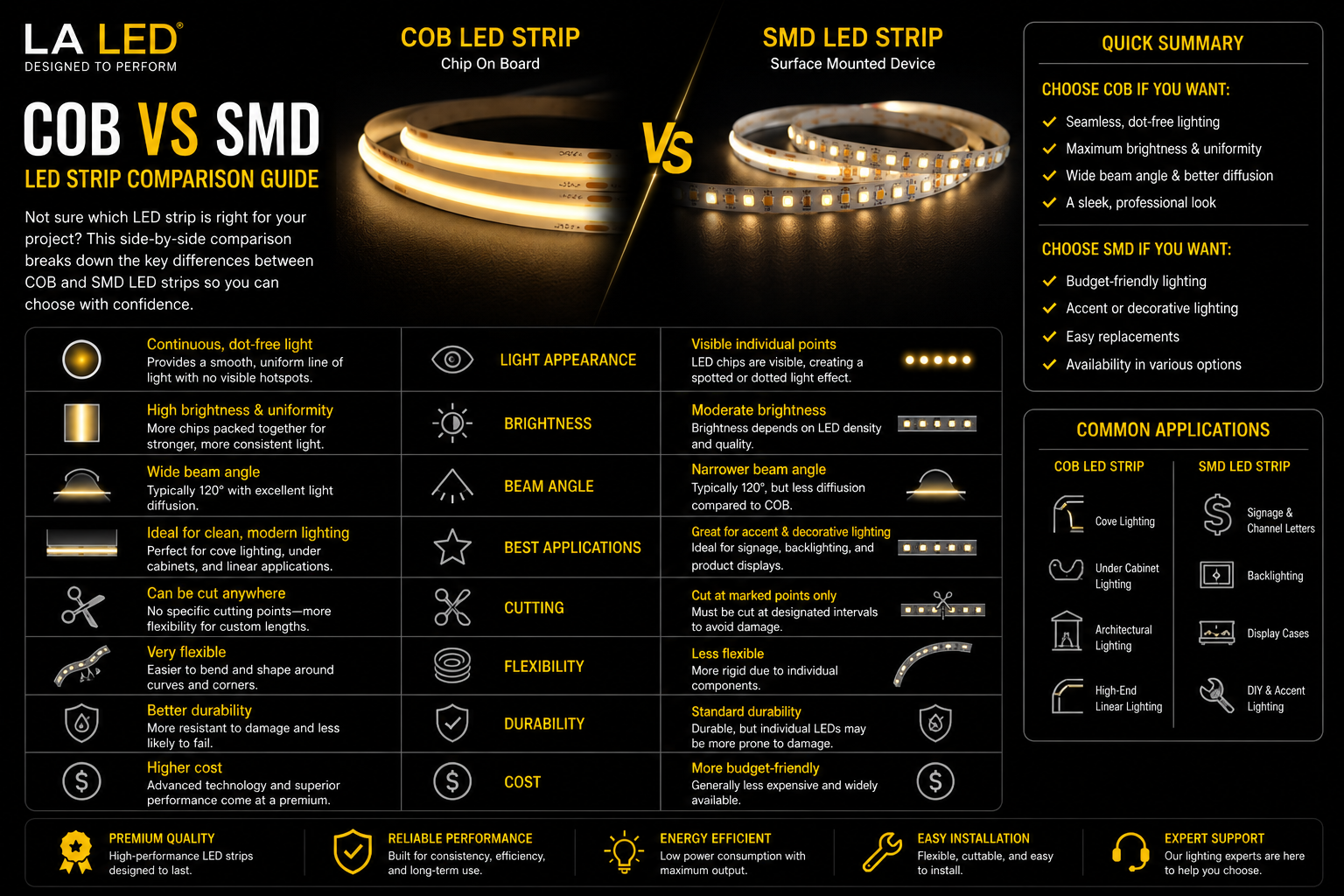
If you are comparing cob vs smd strip options for a job, the real question is not which one is newer or more popular. It is which one will look right, install cleanly, dim properly, and hold up in the space you are lighting. That answer depends on the finish level, viewing distance, channel depth, power requirements, and whether the project calls for a smooth architectural glow or a more budget-focused light source.
For contractors, electricians, and homeowners working on kitchens, coves, millwork, retail shelving, offices, or landscape details, this choice affects both appearance and performance. A strip light that looks acceptable under a cabinet may fall short in a high-end ceiling reveal. On the other hand, a premium strip can be unnecessary if the LEDs are hidden and the budget is tight.
COB vs SMD strip: the core difference
COB stands for chip on board. In a COB strip, many tiny LED chips are mounted closely together across the strip surface and covered in a phosphor layer. The result is a continuous, dotless line of light that looks smooth even in shallow aluminum channels.
SMD stands for surface-mounted device. In an SMD strip, individual LED packages are spaced along the tape. This format has been widely used for years and remains a strong choice for many applications because it is versatile, widely available, and often more cost-effective.
The visual difference is usually the first thing people notice. COB strip lighting delivers a cleaner, more uniform glow. SMD strip lighting can show visible light dots, especially when installed under a diffuser with limited depth or when the strip is directly visible.
Where COB strip has the advantage
The biggest reason buyers move to COB is appearance. If the strip will be seen directly, reflected in polished stone, glass, or glossy cabinets, or installed in a premium architectural channel, COB usually gives the better result. It creates a refined light line that feels finished rather than purely functional.
This matters in high-end residential work and commercial spaces where design details are part of the value. Cove lighting, floating vanities, stair nosing, open shelving, and toe-kick accents all benefit from a dotless output. In these settings, visible diode spacing can make even an otherwise good install look dated.
COB strips also help when channel depth is limited. With many SMD strips, avoiding hotspots often means using a deeper profile or a heavier diffuser. COB reduces that issue because the light source is already much more continuous. That can simplify product selection in tight millwork and compact extrusions.
Another practical advantage is visual comfort. A smoother line of light tends to feel less harsh at close range. If people will be near the strip or looking toward it often, COB can produce a more premium experience.
Where SMD strip still makes sense
SMD is not obsolete, and it is not automatically a lower-grade option. In many installations, it remains the practical choice. If the strip is hidden from direct view, mounted in a deep channel, or used for general accent lighting where the diodes are not noticeable, SMD can perform very well.
SMD strips are also available in a wide range of output levels, colors, RGB, RGBW, and specialty configurations. For some projects, especially larger runs where budget matters, SMD gives you strong performance without paying for a finish level the space does not require.
Under-cabinet lighting is a good example. If the strip is mounted far enough back and hidden by the cabinet lip, visible dots may not matter. The same goes for utility shelving, closet lighting, signage, or indirect lighting where the source itself is not a focal point.
Cost can also favor SMD, depending on the exact product class. If you are lighting a large commercial area and the strip will not be seen directly, SMD can be the more efficient spend.
Brightness, efficiency, and heat
Many buyers assume COB is always brighter, but brightness depends on the strip's actual wattage, LED density, chip quality, and driver pairing. A high-output SMD strip can outperform a lower-power COB strip. Product spec sheets matter more than format alone.
Efficiency is similar. Some COB strips are highly efficient, but some SMD strips are as well. If the project is sensitive to energy use or driver sizing, compare watts per foot, delivered lumens, and voltage drop across the run rather than relying on the name of the strip type.
Heat management is another area where install quality matters. Both COB and SMD strips benefit from proper mounting, especially in aluminum channels that help dissipate heat. Better thermal management supports longer life, more stable color, and reliable output. On premium jobs, that is not a small detail. It is part of whether the system continues to perform as expected months and years later.
Dimming and controls
When evaluating cob vs smd strip products, dimming compatibility should be checked before purchase, not after install. The strip itself is only part of the system. Driver selection, dimmer type, control protocol, run length, and voltage all affect performance.
Both COB and SMD strips can dim well when paired with the right components. Problems usually come from mismatched drivers, overloaded circuits, or using a dimming method that is not suited to the application. If the project requires TRIAC, ELV, MLV, or 0-10V compatibility, build the full system around that requirement from the start.
For tunable white, RGB, RGBW, or pixel-style effects, the format choice may also overlap with controller needs. Some applications prioritize smooth white light, while others prioritize dynamic color control. That is why the right strip is the one that fits the whole system, not just the tape reel.
Installation realities that affect your choice
Strip width, cut points, corner details, connectors, and wet or damp location requirements all matter. A beautiful strip that does not fit the channel, bends poorly in the layout, or complicates field termination can slow down the job.
COB strips are often chosen for premium interior detailing, but you still need to confirm width and cuttability for the exact application. If the project uses slim channels, narrow cabinet framing, or compact reveals, dimensions become critical. This is especially true when choosing between 8mm, 10mm, 12mm, or other strip widths.
SMD products can be easier to source across many output and color combinations, but they are not always the cleaner install visually. If the final reveal is shallow or the diffuser is light, the diode pattern can become a callback issue. Saving money on the strip but losing the finished look is rarely a good trade on custom work.
For outdoor or challenging environments, the strip rating and power components matter just as much as the LED format. Wet location transformers, enclosed drivers, and correct sealing methods should be selected with the environment in mind.
Which should you choose?
Choose COB when the strip will be visible, reflected, or judged as part of the design. It is typically the right fit for luxury residential interiors, display shelving, decorative coves, vanity lighting, stair details, and anywhere a smooth, dotless line matters.
Choose SMD when the light source is concealed, the budget is tighter, or the application is more functional than architectural. It can be the right call for backlighting, hidden under-cabinet runs, utility spaces, some commercial installs, and projects where channel depth already solves the hotspot issue.
If you are unsure, ask a simple question: will anyone notice the strip itself, or only the light it throws? If they will see the source, COB often justifies its place. If they will only experience the illumination, SMD may be all you need.
At LA LED Lighting, this is why product selection should start with the application, not the buzzword. A dotless COB strip, an SMD option with the right density, or a full dimmable system with a compatible driver each has its place when the specs match the job.
The best strip light is the one that makes the install look intentional on day one and keeps performing long after the drywall dust is gone.